Iberdrola begins assembly of wind turbines at Portugal's largest wind farm
With an investment of €350 million, Iberdrola has begun assembling the wind turbines for Portugal's largest wind farm, which will produce enough energy for 128,000 homes, equivalent to the Spanish city of Valladolid, and will avoid more than 230,000 tonnes of CO₂ per year. This pioneering project reinforces the company's leadership in electrification, contributes to Portugal's national energy independence and is a significant contribution to achieving the objectives of its National Energy and Climate Plan.
Comprising the Tâmega Norte and Tâmega Sur wind farms, the project is part of the agreement signed with the Norwegian sovereign wealth fund, managed by Norges Bank Investment Management. In addition, it will have a long-term supply agreement (PPA - Power Purchase Agreement).
The hybridisation of both technologies allows wind and hydroelectric energy to share the same grid connection infrastructure, reducing connection infrastructure costs, accelerating the integration of renewables and minimising environmental impact. It also reinforces the role of the Tâmega Eletroprodutor System as an anchor for Portugal's electrification.
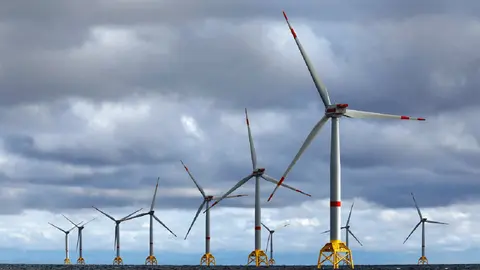
Located between Braga and Vila Real, the farm will have 38 Vestas EnVentus V172 wind turbines – developed by Vestas, they are the largest and most powerful on the onshore wind market – with 7.2 MW each, 85-metre blades and a tower height of 114 metres. In total, it will produce 601 GWh per year.
In addition to avoiding the emission of 230,000 tonnes of CO₂ per year, the project will have a significant economic impact, creating 700 direct jobs at its peak of construction and involving Portuguese companies such as CJR, Conduril, Socorpena, Painhas and Proef. The components are manufactured in different European countries, reinforcing the commitment to European industry and collaborative innovation.
Construction will continue until the third quarter of 2026, and all wind turbine material will be transported before the end of the first quarter.
Environmental measures
Protecting the ecosystem is a priority in the construction of the Tâmega Wind Farm. To this end, Iberdrola guarantees permanent environmental monitoring, with teams of biologists and archaeologists, to apply good practices and reduce the impact of the work.
Continuous monitoring of local biodiversity — including birds, bats and other mammals, flora and habitats — will be carried out to identify additional measures and deepen scientific knowledge of the region.
In addition, compensatory actions will be implemented to improve habitats and, upon completion of the work, the Landscape Recovery Plan will ensure the integration of the project into the territory. This commitment also includes measures to minimise social disruption, ensuring transparency and dialogue with local communities.

How to transport 85 head waiter blades? A major challenge
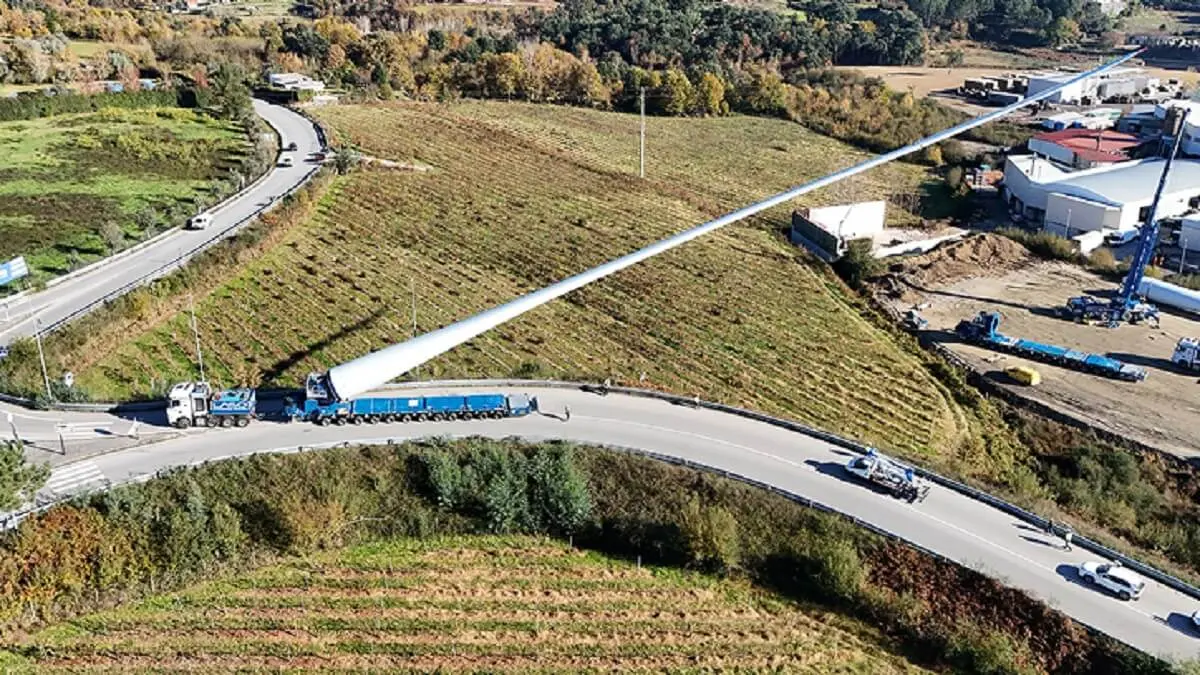
More than 110 blades will leave the port of Aveiro. In the final phase of transport to the construction/assembly area, transport will be carried out using an innovative system: a blade lift, a pioneering technology in Europe that allows the operation to be carried out safely.
This equipment allows the blades to be rotated vertically or horizontally using a hydraulic mechanism to which the blade is attached for transport, reaching inclinations of up to 60º. This allows it to negotiate sharp bends, slopes and other obstacles, adapting to existing roads.
This solution reduces the environmental impact, avoiding changes to the road layout and ensuring safety throughout the transport process.
This project reinforces Iberdrola's leadership as the largest investor in renewable energy in Portugal over the last 10 years, with more than €2.2 billion invested and more than 1,400 MW already installed. The company is now the largest electricity company in Europe and the second largest in the world by market capitalisation, playing a central role in electrification and the promotion of sustainable solutions.