Indra showcases drones, radars and anti-drone systems at the 2E+I Army 35 Forum
- Indra at the 2E+I Army 35 Forum
- Robotisation of the battlefield
- VALERO interference and attack system
- Solutions for anti-drone combat
- Fire superiority and MTR 5 radar
Indra at the 2E+I Army 35 Forum
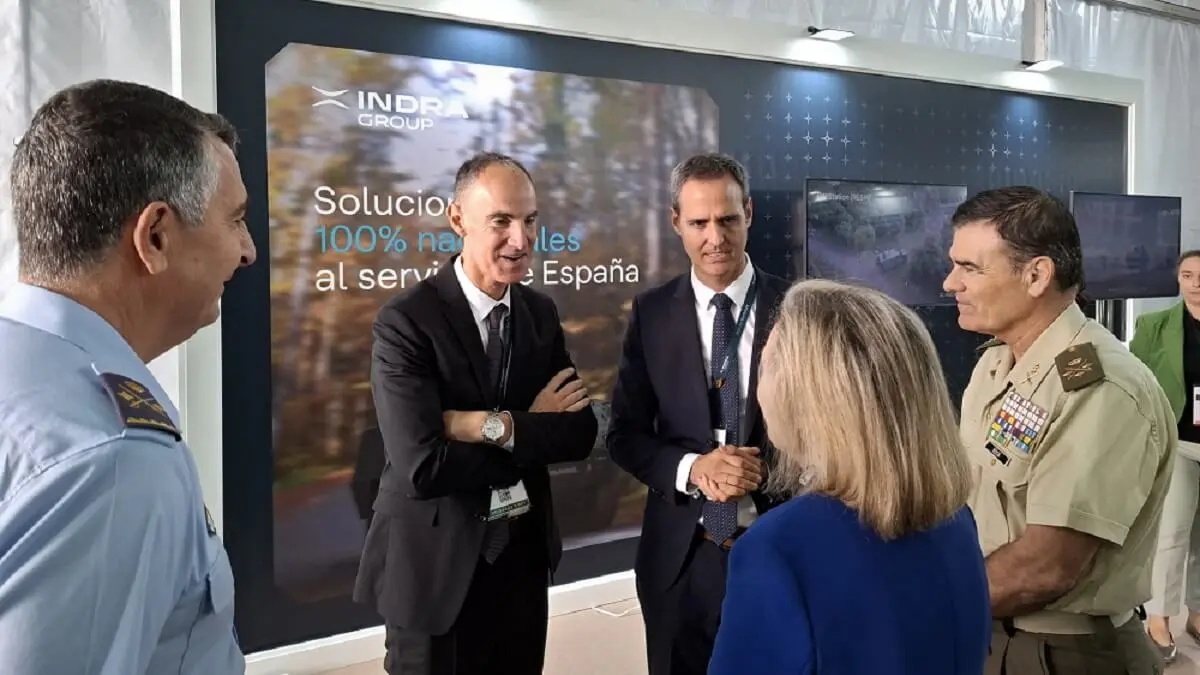
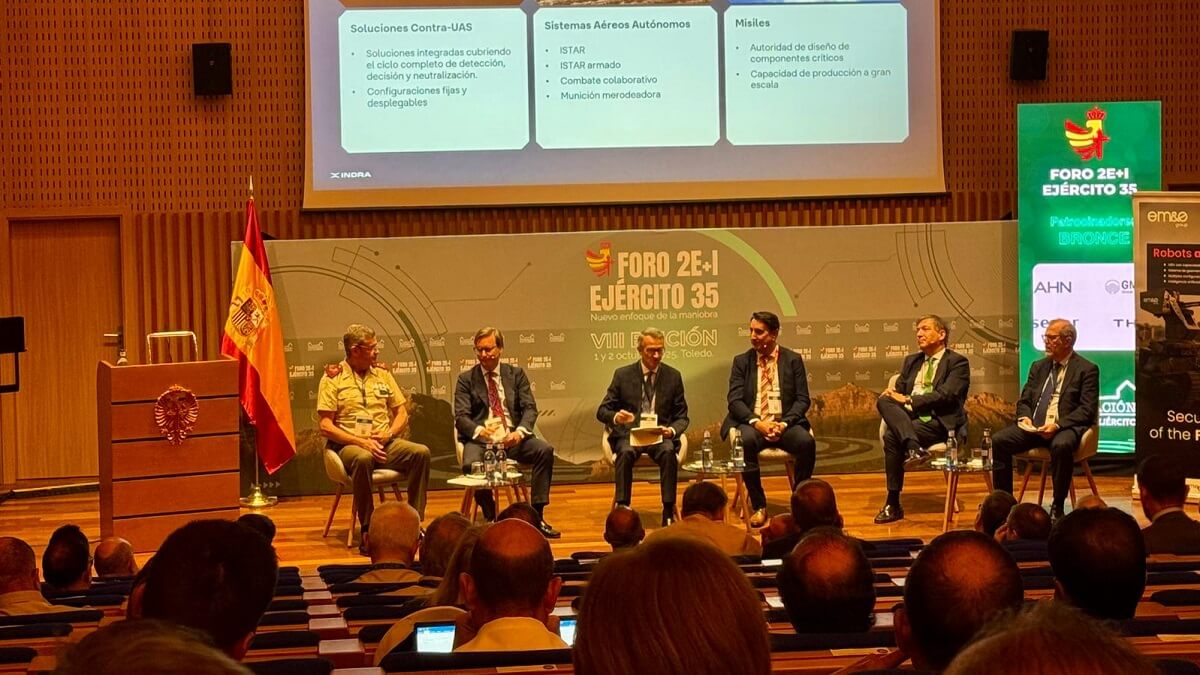
Indra has participated in the eighth edition of the ‘2E+I Army 35 Forum’, which brought together military commanders and industry leaders and this year was dedicated to the new approach to manoeuvring, to discuss three critical aspects of it: the robotisation of the battlefield, protection against drone attacks and the necessary firepower superiority to counter enemy artillery.
In a context where the use of drones has become widespread, it is essential to have, on the one hand, our own resources and, on the other, protective bubbles that allow units to move safely across the terrain.
Robotisation of the battlefield
The director of Indra's Weapons and Ammunitions area, Manuel Rodríguez Cerezo, highlighted in the panel ‘Robotisation of the battlefield’, moderated by the Chief of Staff of the High Availability Land Headquarters, Major General Enrique Silvela Díaz-Criado, that "Ukraine has shown us that conflicts are moving towards an increasingly robotised confrontation, led by drones‘ and highlighted ’the capabilities provided by the Tarsis family of unmanned systems in its two versions, one designed for intelligence gathering, surveillance and target designation (ISTAR) and the other which also adds the ability to carry light weapons for the suppression of unarmoured targets".
VALERO interference and attack system
Rodríguez Cerezo also referred to VALERO, Indra's multi-purpose aerial vehicle-based weapon system designed to interfere with enemy defences, act as a decoy or even as a missile, providing a cost-effective solution that can be applied in all domains.
Anti-drone combat solutions
Mobile anti-drone system
For his part, José Carlos Hidalgo, Head of Anti-Drone Systems Engineering at Indra's Weapons and Ammunitions unit, presented the mobile anti-drone solution the company is working on at the round table dedicated to ‘Anti-drone combat’, moderated by the Chief of Staff of the Canary Islands Command, Major General Ramón Armada Vázquez. This is a detection, electronic warfare and command and control system distributed across several interconnected vehicles that provides a protective bubble ‘on the move’.
Hidalgo stressed that ‘the success of offering such a flexible solution that is adapted to the operating environment requires in-depth knowledge of sensors and effectors and the ability to integrate not only our own systems, but also those of third parties’.
Nemus radar for vehicle protection
As part of the mobile C-UAS solution, Hidalgo highlighted the role of Nemus, a small, lightweight, flat-faced AESA electronic scanning radar designed by Indra specifically to protect military vehicles. The company expert stressed that Indra is currently one of the leading manufacturers of anti-drone systems in Europe.
Fire superiority and MTR 5 radar
The company's participation in the forum was rounded off with a presentation by Indra's operational advisor on Land Systems, Miguel Ángel de Díez, at the ‘Fire Superiority’ round table, moderated by the Chief of Staff of the Land Forces, Major General Alberto Javier García Romera, in which Miguel Ángel de Díez highlighted the capabilities of Indra's new fifth-generation MTR 5 multifunction radar, a state-of-the-art system that has been specially designed to operate in high-intensity scenarios, offering unique detection and tracking capabilities.
"The MTR 5 radar calculates the origin of the fires, alerts friendly units that may be threatened, provides information to interception systems to destroy projectiles in flight, and assists in decision-making to generate orders to strike the origins of the fires. It has a high capacity for detecting targets both on the surface (land and sea) and in the air, including those with a low radar signature such as UAVs, all with a level of accuracy far superior to any other current counter-battery radar," explained Miguel Ángel de Díez.
With a range of over 90 kilometres, this radar is mounted on a vehicle for total mobility and rapid deployment and withdrawal. Its radar signature has also been reduced to make it more difficult to detect and it can be used either independently or integrated into a surveillance network. It can also act as a remote sensor for Indra's Semi-Automatic Anti-Aircraft Artillery Operations Centre (COAAAS), which facilitates the control of medium, short and very short-range weapon systems, protecting a specific point or area.