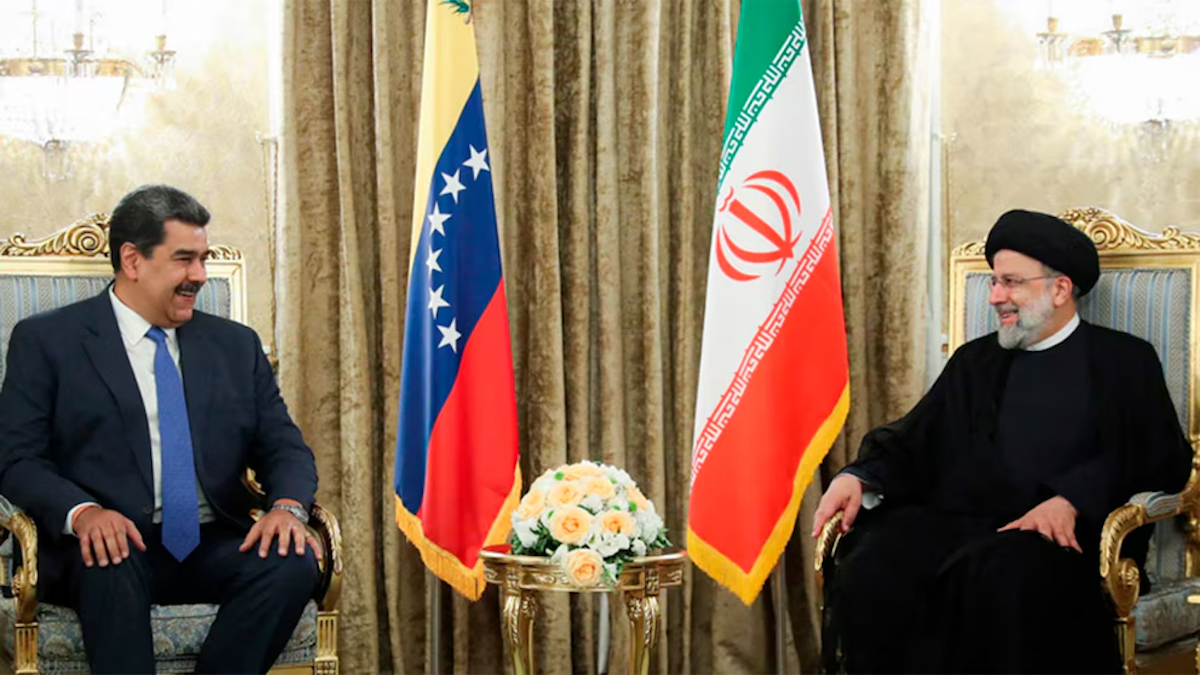
Gustavo de Arístegui: Iran's presence, influence, and projection in Latin America
Iran is deploying a strategy of strategic depth in Latin America against the United States. It is seeking state alliances that will allow it to break its international isolation, facilitate the evasion of sanctions, and build indirect coercive capacity.

Executive summary
In the OSINT analysis, the most consistent pillars of this strategy are Venezuela as a central hub for energy and logistics cooperation, Nicaragua as a political and security platform, the Triple Frontier as a historical ecosystem of illicit financing associated with Hezbollah networks, and episodic naval diplomacy in the Atlantic and Caribbean with mainly symbolic and strategic signalling value.
Methodological caveat: claims regarding alleged training camps or torture practices require a high threshold of evidence. This report explicitly distinguishes between documented facts, risk assessments, and unverified allegations.
- Executive summary
- Methodology and levels of certainty
- Map of presence and influence
- Designations and legal framework
- Illicit finance and money laundering
- Illegal mining and the gold economy
- Oil, oil tankers and sanctions evasion
- Political penetration and informational influence
- Intelligence, advisers and internal security
- Iranian naval presence in the Americas
- Appendices by country
- Risk matrix and bibliography
Methodology and levels of certainty
This report applies a strategic analysis approach based on open sources (OSINT), including international news agencies such as Reuters, AP and AFP, US Treasury regulatory documents (FinCEN and OFAC), publications from analysis centres such as RAND, and legislative texts. The inclusion of operational details that could facilitate illicit activities is deliberately avoided.
Three levels of certainty are used. The ‘confirmed’ level corresponds to information supported by official documentation or multiple verification from primary sources. The ‘highly probable’ level is assigned when there is convergence from several reliable sources or a strong inference based on observed patterns. The ‘indications’ level includes partial signals that are useful for prioritising research but insufficient for conclusive attribution.
Map of presence and influence
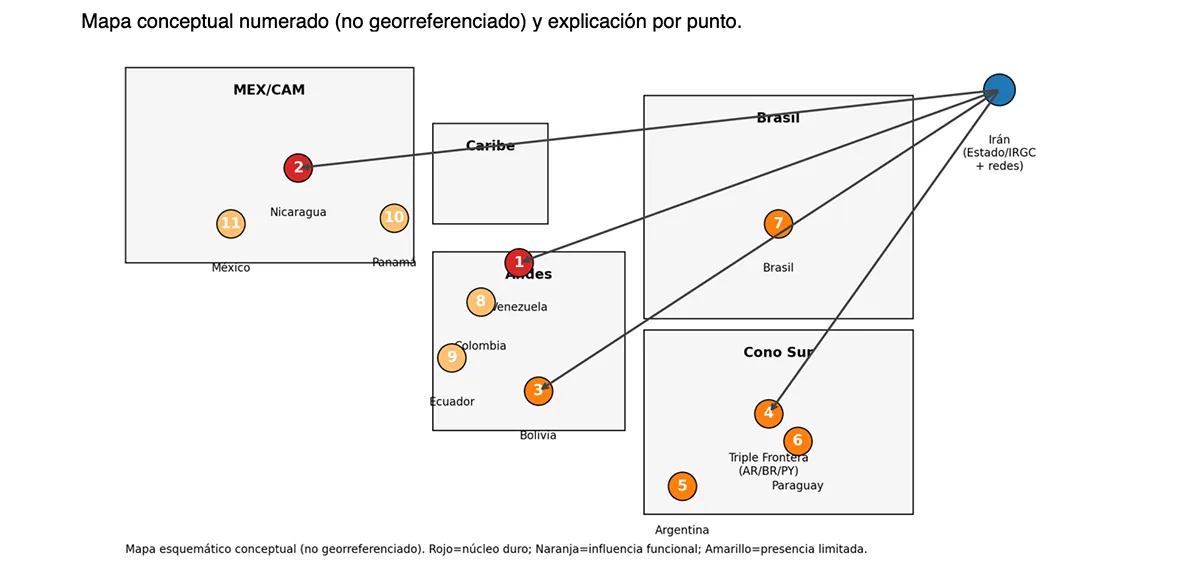
The map of Iranian presence in Latin America is structured around functional nodes and corridors. Venezuela appears as the core node of energy and logistics cooperation under sanctions, and as a recurring focus of analysis on the facilitation of Iranian networks.
Nicaragua acts as a low-cost, high-symbolic-value political and security platform. Bolivia is considered a sensitive vector, with growing attention from the United States and pressure for expulsions and terrorist designations.
The Triple Frontier continues to be a historical ecosystem for smuggling, money laundering and financing associated with Hezbollah networks. There are also other nodes of limited or functional presence related to finance, intermediation and surveillance.
Designations and legal framework
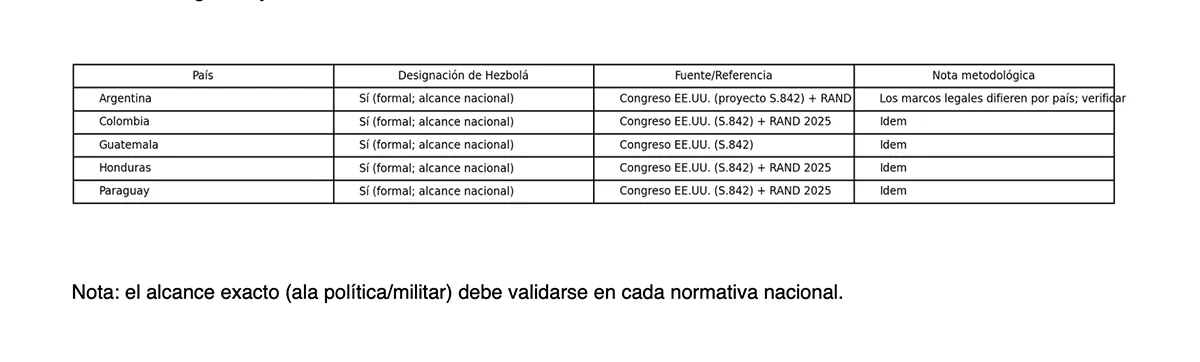
The designation of Hezbollah as a terrorist organisation has direct implications for asset freezing, judicial cooperation, intelligence sharing and enhanced due diligence obligations. According to a US Congressional legislative text (S.842), countries in Latin America with formal designations include Argentina, Colombia, Guatemala, Honduras and Paraguay.
RAND reports cover regional developments and the adaptation of associated networks. The exact scope of the designations, especially with regard to political or military wings, must be validated on a case-by-case basis in each national regulation.
Illicit finance and money laundering
FinCEN has issued several alerts describing types of illicit financing associated with Hezbollah and Iranian-backed organisations. These include the use of front companies, fictitious trade, intermediaries in permissive jurisdictions, and financial red flags for banking institutions.
The Triple Frontier remains an analytical benchmark due to its high cash economy, informality and density of intermediaries. Risk indicators include systematic discrepancies in invoicing, companies with no real activity, rapid turnover of executives, trade with high-risk counterparties, split transactions, conversion of funds into commodities and use of non-banking channels.
Illegal mining and the gold economy
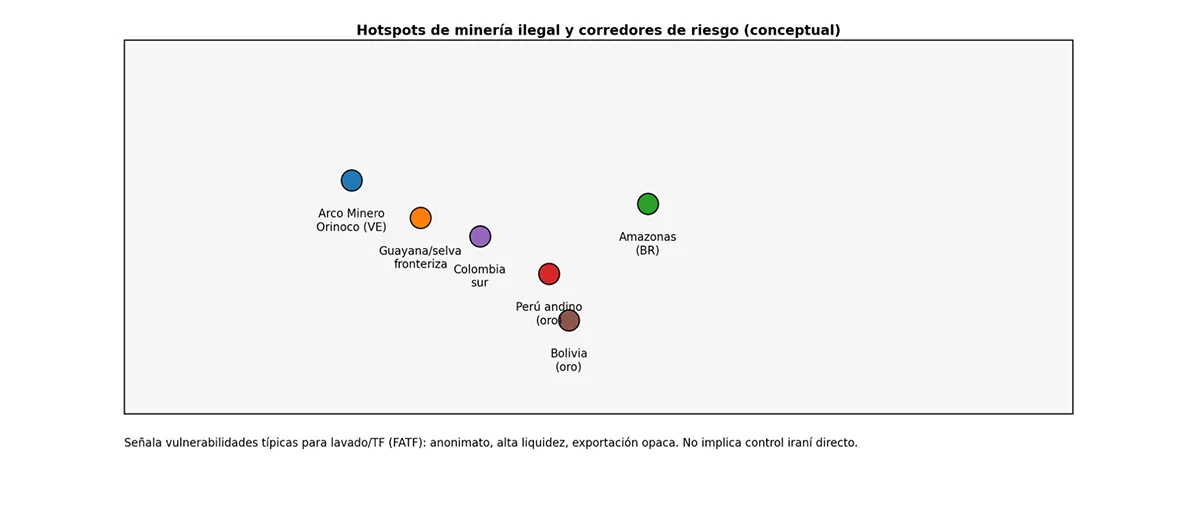
The gold sector has structural vulnerabilities to money laundering and illicit financing due to its anonymity, liquidity, and ease of transport. The Financial Action Task Force has highlighted risks throughout the chain, from mining to retail.
In Latin America, the main hotspots coincide with contexts of weak governance, organised crime, and corruption. OSINT evidence does not allow us to assert direct Iranian control over illegal mining, although it does show that the same financial highways used by criminal networks can be exploited by actors linked to Iran.
Oil, oil tankers and sanctions evasion
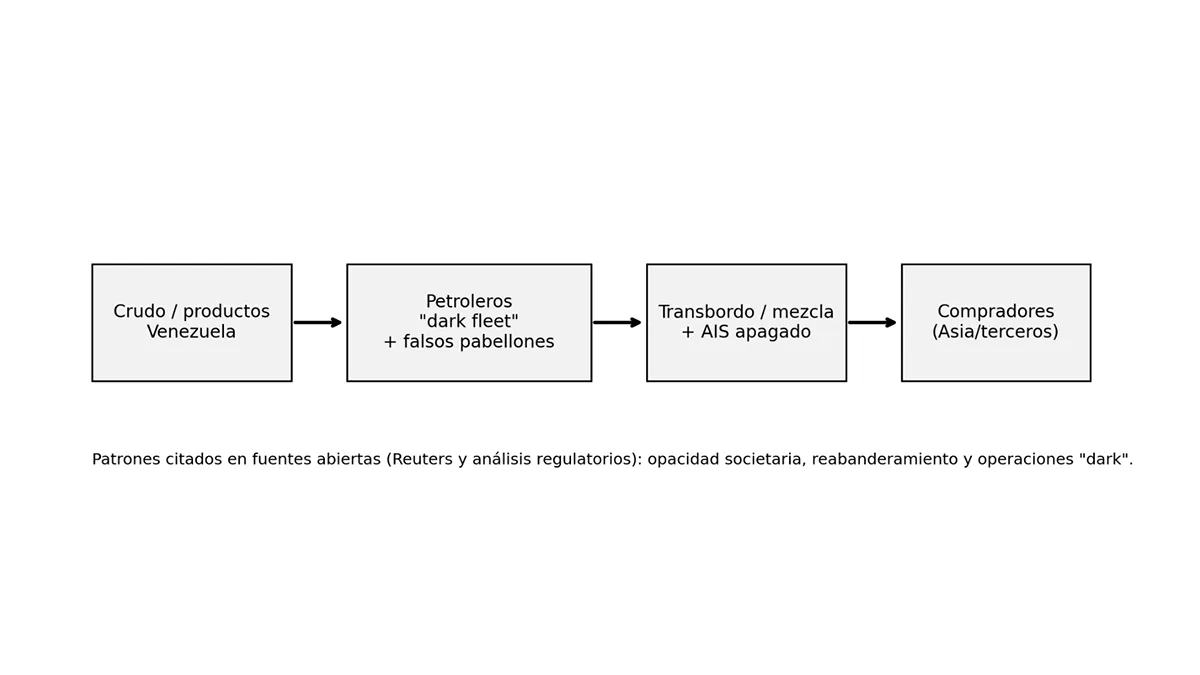
Energy cooperation between Iran and Venezuela includes technical assistance in refining, the supply of spare parts and additives, and maritime logistics.
FinCEN has described the financial architecture and shadow banking mechanisms that facilitate the Iranian regime's trade in oil and acquisition of sensitive materials. Reuters has documented shipments, stopovers in Venezuelan ports, and the use of ships to sustain the Caracas-Tehran axis.
Political penetration and informational influence
Iranian influence in the region is based on ideological affinities, the offer of cooperation without explicit political conditions, and institutional support networks.
The main risk lies not in visible propaganda, but in the capture of decisions through opaque contracts, favours, indirect financing, and privileged access to security apparatuses.
The main defences against this risk are institutional, including transparency, auditing, parliamentary control, and judicial and financial cooperation.
Intelligence, advisers and internal security
Recent reports from Reuters indicate US pressure on Bolivia to expel alleged Iranian operatives and designate the Islamic Revolutionary Guard Corps, Hezbollah and Hamas as terrorist organisations. These initiatives are often based on shared intelligence, although details are rarely made public to protect sources and methods.
Regarding allegations of torture, the report does not attribute direct Iranian involvement without verifiable evidence, proposing instead a framework of indicators for investigation, such as the presence of advisers, technology purchases, training, chains of command, and detention practices.
Iranian naval presence in the Americas
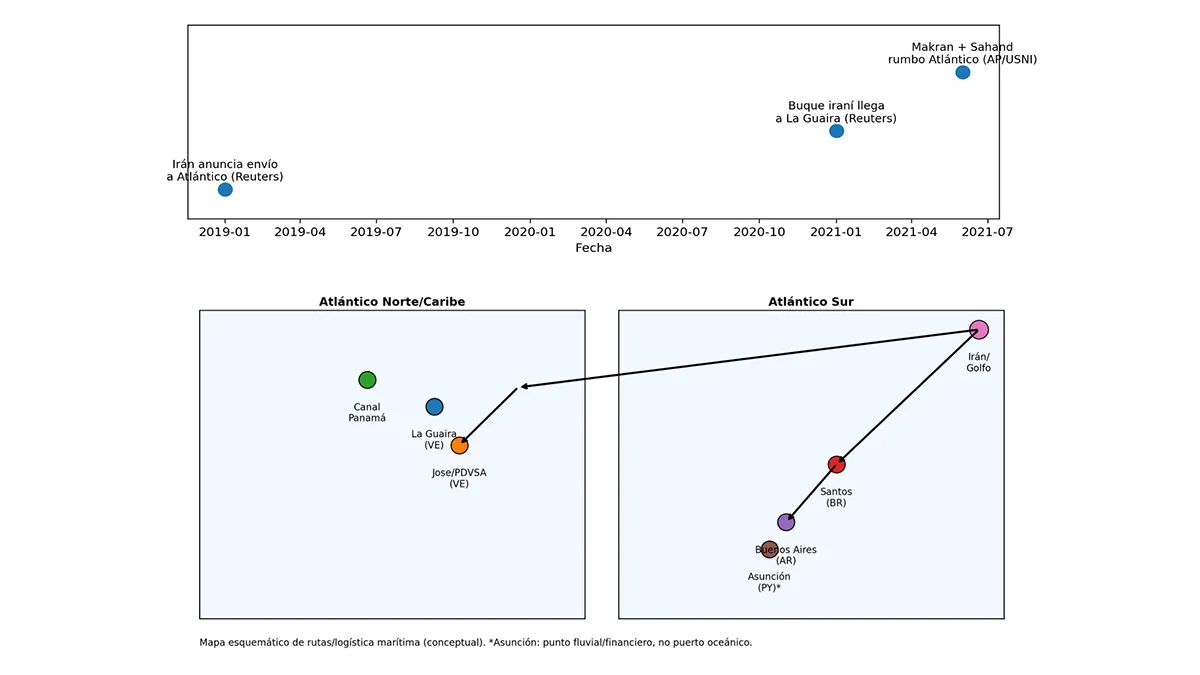
Iranian naval diplomacy in the Atlantic and Caribbean has been sporadic but significant. There have been reports of Atlantic deployments, the arrival of Iranian ships in Venezuelan ports, and the deployment of the support vessel Makran with speedboats on board.
The overall assessment is that these are coercive signals and demonstrations of strategic reach. There is no robust OSINT evidence of a permanent Iranian naval base in Latin America, although there is evidence of voyages, stopovers, and logistical support under sanctions.
Appendices by country
Venezuela
Predominant vectors
- Energy cooperation (refining, supplies, logistics).
- Use of ports and maritime transport under sanctions.
- Technological and security cooperation (heterogeneous OSINT).
- Regional facilitation hub.
Venezuela is the pivot of the Latin American axis. Reuters has documented stopovers by Iranian ships in the port of La Guaira and transfers of refining equipment in recent years.
Iran's interest is threefold: to ensure the economic survival of a strategic ally, to enable routes for evading sanctions, and to project a symbolic presence in the face of the United States.
The risk is hybrid in nature, combining energy, finance and internal security. Priority countermeasures include port traceability, contractual transparency, cooperation between financial intelligence units and control of sensitive technologies.
Nicaragua
Predominant vectors
- Political-security platform.
- Cooperation agreements and official visits.
- Low cost and high symbolic utility.
Nicaragua offers a low-friction institutional environment for signing cooperation agreements with Iran. OSINT evidence is mainly concentrated in the political and security spheres, with less financial density than in the Southern Cone. The main risk is the facilitation of Iranian presence and the use of the country as a platform for regional influence.
Recommended countermeasures include visa control, regional cooperation, and monitoring of financial flows.
Bolivia
Predominant vectors
- Sensitive vector due to political realignment.
- Explicit attention from the United States (Reuters 2026).
- Risk of intelligence operations according to US sources.
Bolivia has come into strategic focus due to US pressure to expel suspected Iranian operatives and designate terrorist organisations. If a political realignment takes hold, the country could go from being a permissive platform to becoming a regional test case. Risks include infiltration under diplomatic cover and exploitation of its central location.
Proposed countermeasures include strengthening counterintelligence, auditing diplomatic missions, reinforcing anti-money laundering frameworks, and judicial cooperation.
Argentina
Predominant vectors
- Formal designation of Hezbollah (according to S.842).
- Historical sensitivity due to attacks and support networks.
- Counterterrorism and anti-money laundering cooperation varies according to the political cycle.
Argentina combines high historical sensitivity with institutional weight. The Triple Frontier amplifies the risks of illicit financing and support networks.
Key countermeasures include cooperation between financial intelligence units, selective sanctions, robust prosecution, and foreign trade controls.
Brazil
Predominant vectors
- Large economy with vulnerabilities associated with scale.
- Financial and foreign trade risks.
- International pressure to strengthen counterterrorism and anti-money laundering frameworks.
Brazil is relevant due to the size of its economy: where there is scale, there is greater opportunity for opacity. The main risk lies in financial intermediation and international trade.
Countermeasures focus on regulatory compliance, traceability of transactions, and coordination between federal and state levels.
Paraguay
Predominant vectors
- Triple Frontier ecosystem.
- Formal designation of Hezbollah (according to S.842).
- Cash economy and smuggling.
Paraguay is key because of its role in the Triple Frontier. The main risk is fundraising and money laundering.
Countermeasures include cross-border cooperation, strengthening customs controls, and intensive use of financial intelligence.
Colombia
Predominant vectors
- Formal designation of Hezbollah (according to S.842).
- Risk of facilitators and illicit flows.
- Counterterrorism capabilities above the regional average.
Colombia has more developed counterterrorism capabilities compared to the rest of the region. The risk is more concentrated on facilitators and illicit flows than on an Iranian structural presence.
Recommended countermeasures are international cooperation and control of illicit corridors.
Panama
Predominant vectors
- Regional logistics and financial hub.
- Risk due to use of companies and maritime trade.
- Strategic importance of the Canal as a surveillance vector.
Panama is critical because of its logistical and financial infrastructure. The main risk is the use of corporate structures, international trade, and maritime transit for illicit activities.
Countermeasures include enhanced due diligence, information sharing between financial intelligence units, and control of flags and maritime registries.
Mexico
Predominant vectors
- Limited presence in OSINT sources.
- Risk derived from financial scale and proximity to the United States.
- Need for surveillance of intermediation networks.
Mexico does not appear as a hard node in the OSINT analysis, but its financial scale and integration with the US system require constant surveillance of financial intermediation and trade.
Priority countermeasures include coordination with the financial intelligence unit, supervision of correspondent banking, and control of foreign trade.
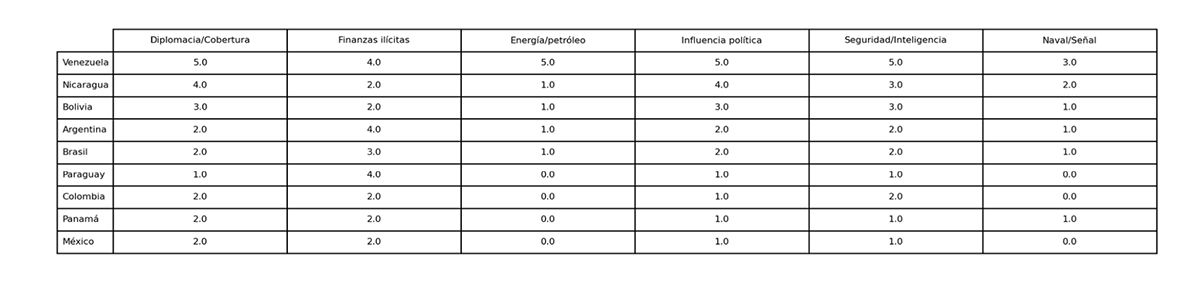
Risk matrix and bibliography
The report includes a qualitative risk matrix to prioritise attention by country and vector, as well as an essential bibliography based on Reuters, USNI News, RAND, FinCEN, the US Congress, and the Financial Action Task Force.