Gustavo de Arístegui: Geopolitical Analysis 8 January
Below is an analysis of current global events, structured around key topics for clear and direct understanding, followed by a summary of coverage in the mainstream media
- Introduction
- Arrest of Nicolás Maduro and strategic blow to the Cartel of the Suns
- Cartel of the Suns: from ‘diffuse structure’ to formal terrorist organisation
- Charges against Maduro: narco-terrorism, terrorism and state capture
- Possible phases of transition in Venezuela
- Reactions: Venezuelan exile, Iran, Russia, China and Western leftists
- Reactions of jubilation from the Venezuelan exile community
- New statements from Trump on Gustavo Petro and his possible links to drug trafficking
- New statements from Trump on Greenland
- Paris summit on Ukraine: security guarantees and military hubs
- The United States joins in providing security guarantees for Ukraine
- Media rack
- Editorial commentary
Introduction
The arrest of Nicolás Maduro, after years of narco-dictatorial impunity, and the new Paris summit on Ukraine are currently the focus of the international system: the fall of a mafia regime, the redefinition of security guarantees in Europe and Washington's hardening stance on political drug trafficking in Latin America are all coming together.
At the same time, Donald Trump, strengthened after the operation against the Cartel of the Suns, is now targeting Gustavo Petro and putting the issue of Greenland back on the table, while Europe is trying to finalise a security architecture that will curb Russian aggression without giving in to strategic fatigue.
Arrest of Nicolás Maduro and strategic blow to the Cartel of the Suns
Facts
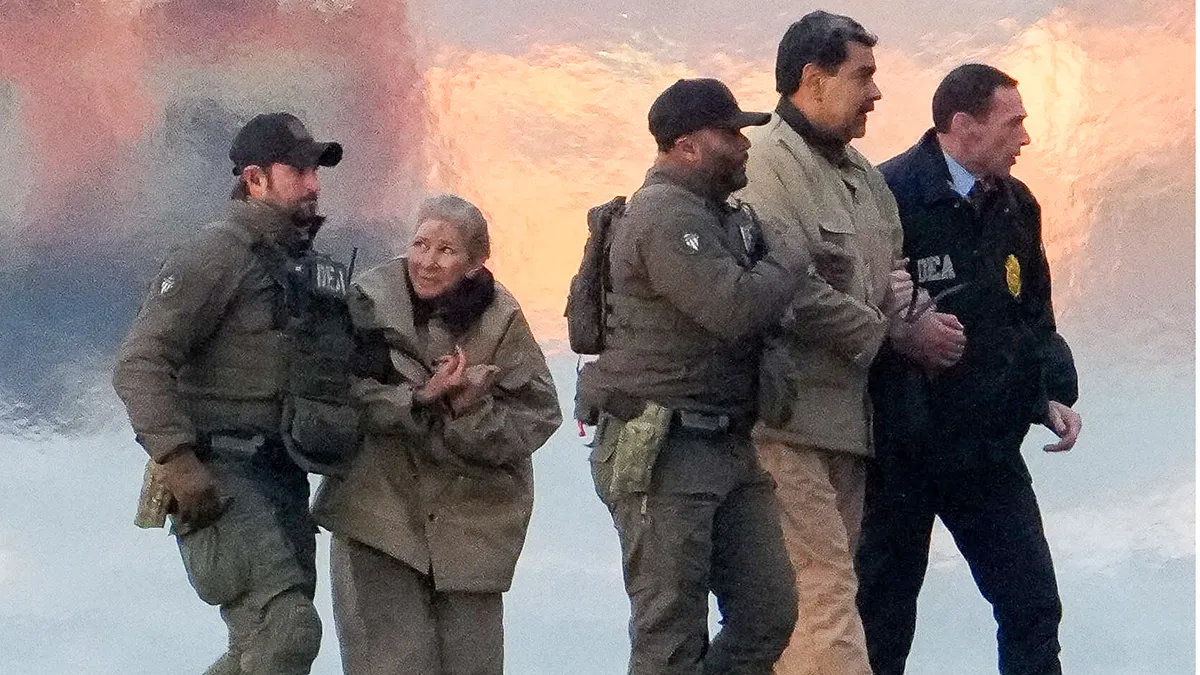
Following the designation of the Cartel de los Soles as a Foreign Terrorist Organisation (FTO) in November 2025, as a criminal network headed by Maduro and senior regime officials, the joint US and allied military-police operation has culminated in its capture and transfer out of Venezuelan territory.
The US Treasury had already sanctioned the Cartel of the Suns as a global terrorist entity for its role in trafficking cocaine to the United States and supporting other criminal and terrorist organisations, legally consolidating the identification between the Chavista state and the mafia structure.
Implications
Maduro's arrest confirms what the facts have been showing for years: the Venezuelan state had merged with the Cartel de los Soles to become one and the same, a narco-mafia structure hiding behind a pseudo-revolutionary façade. The myth of the ‘legitimate president’ collapses, exposing the reality of a drug lord who used institutions to shield his impunity and finance allies and proxies hostile to the West.
From an Atlanticist and centre-right liberal perspective, the message is forceful and necessary: those who turn the state into a cartel pay the consequences; it is unacceptable that, in the name of a caricatured left, tonnes of cocaine are trafficked, institutions are devastated and terrorism is financed without response. If the operation is consolidated legally and politically, it could set a precedent that deters other regimes that flirt with the total criminalisation of their state apparatus.
Cartel of the Suns: from a ‘diffuse structure’ to a formal terrorist organisation
Facts
On 24 November 2025, the State Department formalised the inclusion of the Cartel of the Suns as an FTO, emphasising that it is a criminal network directly linked to Maduro and senior military commanders, integrated into the structure of the Venezuelan state.
Criminal analysis reports indicate that, beyond the label, the cartel functions as a system of corruption and institutional capture in which military personnel and Chavista leaders monetise their power by facilitating drug trafficking routes and illicit businesses, which in Washington's eyes justifies the leap to terrorist treatment.
Implications
The designation as a foreign terrorist organisation breaks with the complacent narrative of much of the Western left, which continued to speak of a ‘Bolivarian experiment’ while a narco-terrorist network with regional reach was consolidating. At the same time, it gives the US and its allies a much wider range of instruments: extraterritorial criminal prosecution, asset embargoes, criminalisation of material support and the eventual use of force under the umbrella of the fight against terrorism.
For the Latin American chessboard, the Venezuelan case becomes an uncomfortable mirror: it shows that ‘21st-century socialism’ has degenerated into armed and cynical crony capitalism, where the word revolution serves to cover up cocaine, illegal gold and alliances with terrorist groups. The challenge for the region's democracies is not to look the other way, because every complicit silence strengthens the normalisation of the narco-state as an option for power.
Charges against Maduro: narco-terrorism, terrorism and state capture
Facts
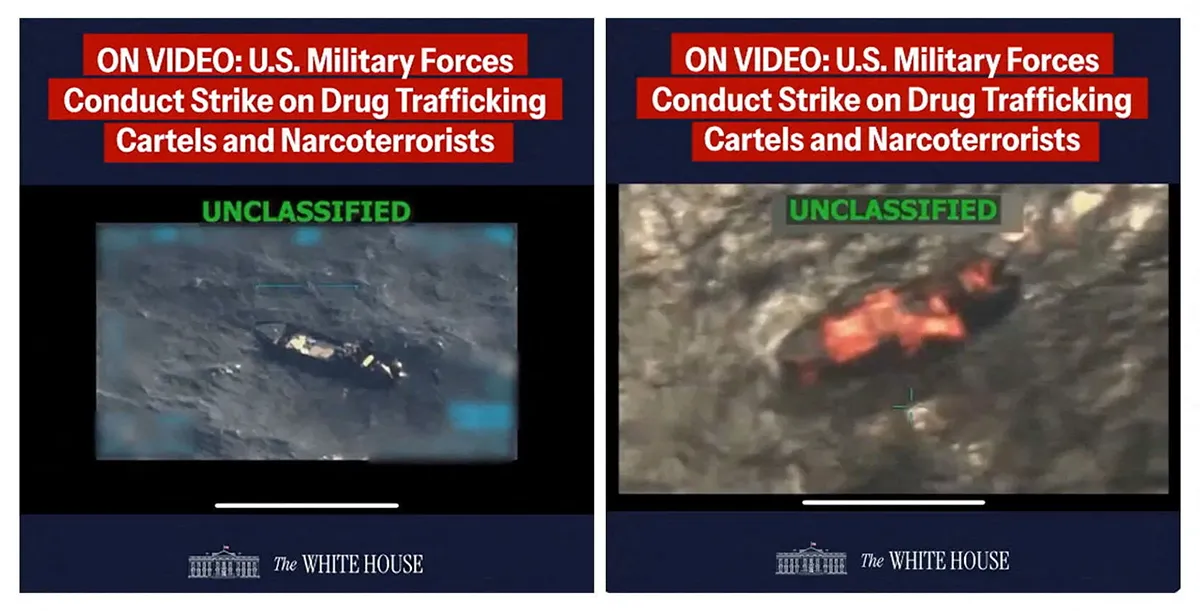
Public accusations by the United States describe Maduro as the head of an organisation that has used the armed forces, intelligence services and judiciary to facilitate massive drug trafficking to the United States, as well as providing support to regional criminal and terrorist organisations.
The official US narrative emphasises that the Cartel of the Suns, and therefore the core of the Chavista state, has cooperated with other groups designated as terrorists and has used illicit profits to sustain a repressive regime that has generated millions of refugees and a humanitarian catastrophe unprecedented in the region's recent history.
Implications
The charges against Maduro are not an ideological settling of scores, but the culmination of a long-running criminal case that places Chavismo in the same moral and legal league as the major cartels and terrorist organisations. The old alibi of ‘sovereignty’ no longer works when the state apparatus itself is engaged in poisoning American society and destabilising the neighbourhood.
For Europe, which for too long has oscillated between equidistance and complacency with Caracas, the Maduro case forces it to abandon its rhetorical comfort zone: it cannot defend the rule of law in Ukraine while maintaining a shameful ambiguity with a narco-dictatorship allied with Moscow and Tehran. Strategic consistency requires treating all mafia regimes with the same rigour, regardless of the ideological colour of their propaganda.

Possible phases of transition in Venezuela
Facts
Maduro's personal downfall opens up a scenario of enormous uncertainty in Caracas: Chavista structures persist in the security apparatus, in the party and in the economic networks that have survived thanks to their control of resources, while the opposition and the diaspora are calling for a genuine democratic transition. Recent reports describe the Cartel de los Soles as a widespread system of corruption, not as a small gang that can be easily dismantled.
International pressure—sanctions, diplomatic isolation, terrorist designation—is now coordinated with the narrative of justice for victims and the need to rebuild collapsed institutions, while actors such as Russia, China, and Iran seek to preserve influence in the transition so as not to lose their economic and strategic assets in the country.
Implications
A successful transition will require three phases: truly dismantling the narco-military networks, regaining civilian control of institutions, and opening a constitutional or profound reform process that shields the separation of powers and the market economy from future populist temptations. Any amnesty that is not accompanied by truth, justice and effective dismantling of the cartel would be nothing more than window dressing that would allow the same actors to recycle themselves.
The Atlanticist world has a responsibility: to help Venezuela become a representative liberal democracy with a social market economy, not a protectorate under the tutelage of corporations or authoritarian powers. The risk that Russia, China or Iran will fill the vacuum by buying strategic positions is real; that is why international aid must be generous, but conditional on serious and verifiable reforms.

Reactions: Venezuelan exile, Iran, Russia, China and the Western left
Facts
Millions of Venezuelans have left the country in the last decade, forming a diaspora of close to eight million people according to various estimates by international organisations; a large part of this exile has publicly celebrated the actions against the Cartel de los Soles and the fall of Maduro.
Meanwhile, Tehran has repeatedly denounced Washington's actions against allies such as Venezuela, framing them as part of an alleged ‘imperialist war,’ and Moscow and Beijing have criticised US pressure, while taking care to protect their own commercial and energy interests.
Implications
The jubilation of the exiles contrasts with the furious reaction of Iran and the indignant rhetoric of a section of the Western left, which continues to present Maduro as the ‘constitutional president’ and speaks of ‘kidnapping’ when in fact he faces charges of narco-terrorism and terrorism. This wilful blindness reveals the extent to which wokism and ideological radicalism are capable of justifying the unjustifiable when the executioner bears the label of ‘anti-imperialist’.
China and Russia, for their part, are playing a game of ambiguity: they criticise the operation for domestic consumption and that of their allies, but carefully measure their movements so as not to appear as open defenders of a narco-dictatorship, while negotiating to retain oil and mining concessions and strategic positions. This cynical balancing act reveals the true face of global authoritarianism: ideology is a disguise; what counts are resources and power bases.

Reactions of jubilation from the Venezuelan exile community
Facts
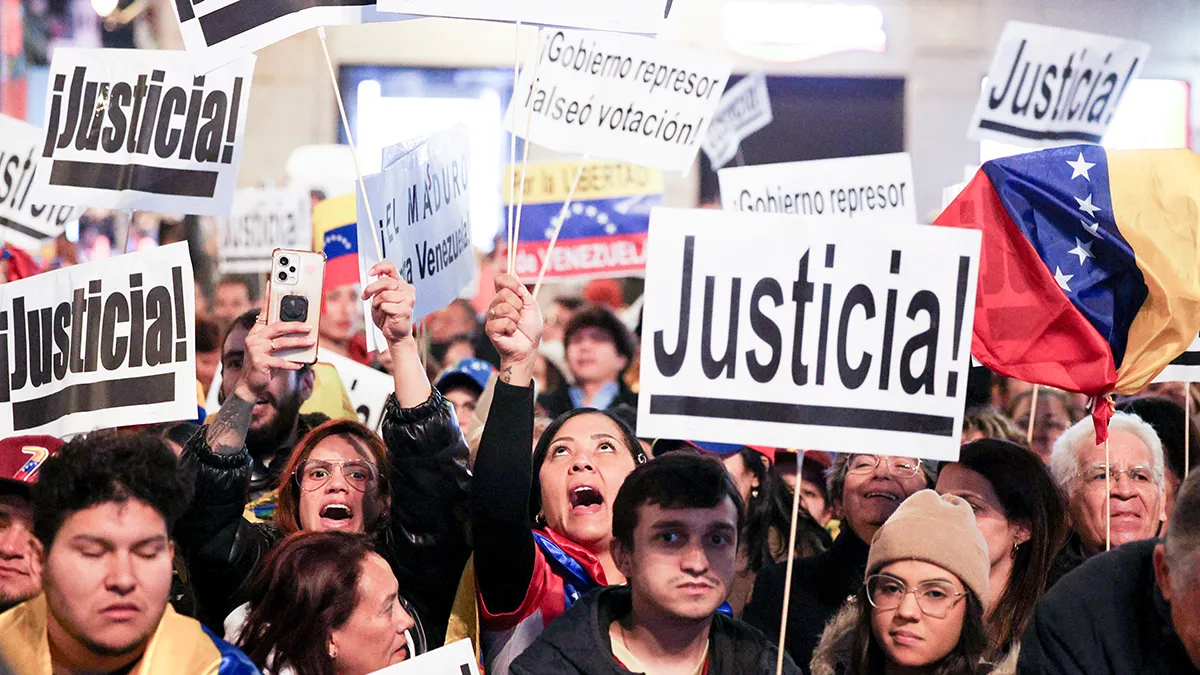
The Venezuelan diaspora, scattered throughout Latin America, the United States and Europe, has in recent months staged demonstrations and public events denouncing the regime and the Cartel de los Soles, insisting on the mafia-like and terrorist nature of the Chavista network, as reported by both regional media and international press analysis.
NGOs working with Venezuelan refugees have highlighted the link between the economic devastation caused by the regime and the mass exodus, which has strained the reception capacities of neighbouring countries such as Colombia, Peru and Brazil.
Implications
The enthusiasm of the exiles is not only emotional, it is political: those who have suffered under Chavism know that it was not a poorly managed social experiment, but a project to completely capture the state and put it at the service of a corrupt elite and, later, a cartel. Their voice must be at the centre of any transition, not on the periphery.
For the receiving democracies, the challenge is to turn this human capital expelled by the dictatorship into a factor of economic dynamism and political testimony. Giving public space to the memory of Chavista barbarism is also a vaccine against the contagion of populisms that promise impossible paradises in exchange for handing over institutions to a caudillo.
New statements by Trump on Gustavo Petro and his possible links to drug trafficking
Facts
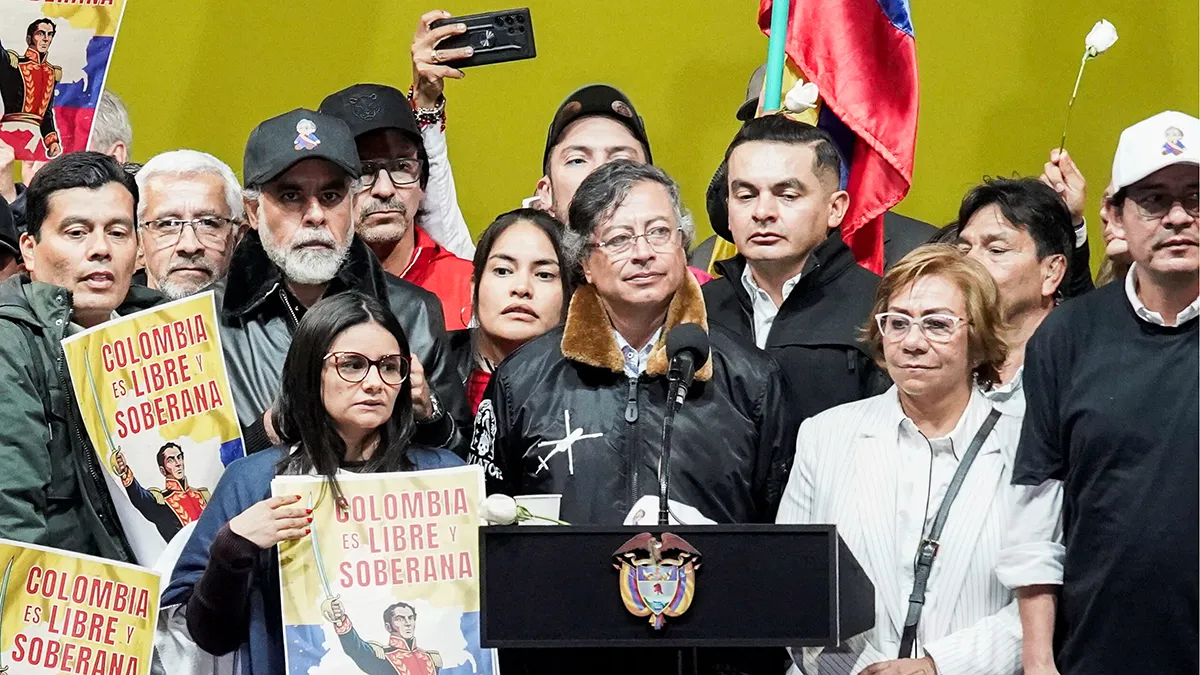
Donald Trump and his administration have toughened their rhetoric against Colombian President Gustavo Petro, whom they accuse of allowing record expansion of cocaine production under the umbrella of his ‘total peace’ policy. Trump has publicly singled out Petro as responsible for the increase in cocaine reaching the United States and has backed Treasury sanctions against him and his entourage.
In his latest statements, Trump has gone so far as to insinuate that Petro ‘enjoys producing cocaine’ and has suggested that an operation against Colombia ‘sounds good,’ prompting an angry response from Petro, who has even said he would be willing to ‘take up arms again’ for his country.
Implications
The Trump-Petro confrontation consolidates an axis of ideological and geopolitical tension in the heart of the Andes: on the one hand, a Colombia governed by a left that has favoured concessions to irregular groups and relaxed pressure on illicit crops; on the other, a White House obsessed—and rightly so—with the human cost of drug trafficking on its territory. The question is not whether there will be a clash, but in what arena it will take place: sanctions, diplomatic pressure or something else.
From a liberal-conservative perspective, one can and should be cautious in the face of excessive rhetoric, but at the same time it is impossible to ignore the facts: if drug traffickers feel more comfortable with Petro than with his predecessors, it is no coincidence. Firmness in the face of illicit economies is not a whim of the right, it is a moral and security obligation.
New statements from Trump on Greenland
Facts
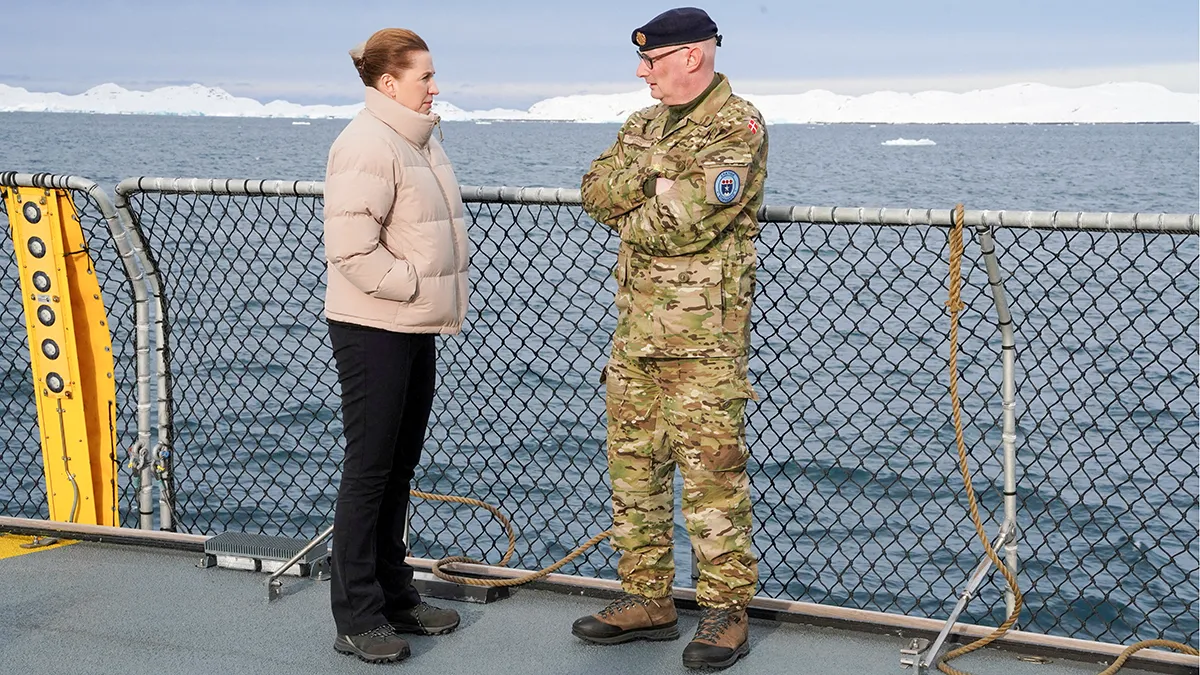
In parallel with the verbal offensive against Petro, Trump has once again raised the issue of Greenland, insisting on the need to strengthen the US presence on the island because of its strategic value in the Arctic, its resources and its key position vis-à-vis Russia and China.
This debate has resurfaced at a time when several European leaders, meeting in Paris to discuss security guarantees for Ukraine, have had to back Denmark in the face of speculation about a possible annexation or change of status for Greenland, insisting on respect for the Euro-Atlantic framework and Danish sovereignty.
Implications
Washington's interest in Greenland is not an eccentricity, but rather another chapter in global strategic competition: whoever controls the Arctic and its routes will dominate much of the trade and military projection of the 21st century. The question is how to reconcile this legitimate ambition with respect for allies and existing legal frameworks.
If Europe wants to be more than just a silent observer, it must make it clear that Western defence of the Arctic is carried out through NATO and cooperation, not at the expense of the Alliance's internal cohesion. The message to Moscow and Beijing must be clear: the Euro-Atlantic space is not for sale to dictatorships or tactical improvisations.
Paris summit on Ukraine: security guarantees and military hubs
Facts
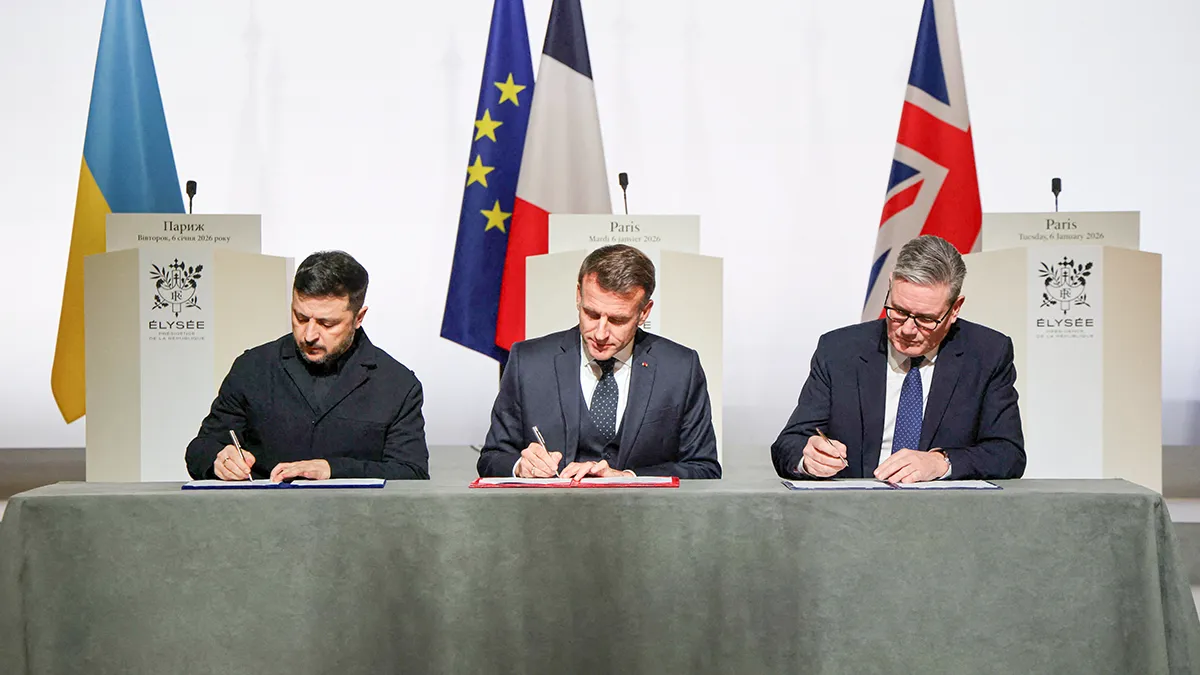
In Paris, more than thirty allies of Ukraine have met to define ‘robust’ security guarantees for Kiev after a possible ceasefire, as French President Emmanuel Macron has emphasised. France, the United Kingdom and Ukraine have signed a declaration of intent that envisages the installation of ‘military hubs’ (military logistics centres) on Ukrainian territory if a truce is consolidated.
Key European states—France, the United Kingdom, Poland, Italy—and, finally, the United States have backed a security architecture that, without becoming a NATO Article 5, does represent a long-term commitment to arm, train and support Ukraine in the face of Russian aggression.
Implications
The Paris summit marks a turning point: for the first time, a security framework for Ukraine is being drawn up that is not limited to ad hoc military aid, but aims at de facto integration into the Western defence system. This is the minimum that justice demands after years of Russian aggression and flagrant crimes against sovereignty and the civilian population.
For the Kremlin, the signal is clear: the strategy of attrition to break the will of the allies is not working. For Europe, the challenge is to sustain this commitment over time, avoiding the temptation to seek ‘peace’ at any price, even at the cost of legitimising territorial annexations achieved by force. To give in on this would be to undermine the international order it claims to defend.
The United States joins in security guarantees for Ukraine
Facts
The latest reports confirm that Washington has decided to explicitly back the coalition of security guarantees for Ukraine that emerged from the Paris summit, committing to a combination of military support, training, intelligence and financial assistance linked to reforms.
European leaders have presented this step as a ‘milestone’ in the peace talks, stressing that it is not a question of forcing Kiev to make territorial concessions, but of ensuring that any ceasefire is not simply a respite for Moscow to rearm and attack again.
Implications
US involvement consolidates the Atlanticist dimension of Ukraine's defence: this is not exclusively a European issue, but a test of credibility for the entire West. If the message to Russia is ambiguous, other revisionist actors – China in the South China Sea, Iran in the Middle East – will interpret it as meaning that borders can be changed by force without lasting consequences.
The summit also confirms that isolationism is not a viable option for the democratic superpower: when the United States withdraws, the vacuum is filled by Moscow, Beijing or Tehran; when it exercises leadership, firmly but also with rules, there is a real possibility of curbing barbarism without renouncing principles. The balance between hard power and legitimacy is, once again, the key.
Media rack
NYT, Washington Post, CNN, CBS, USA Today, Politico, The Hill, Fox News: focus on Maduro's fall, the narco-terrorist dimension of the Cartel de los Soles and Trump's verbal offensive against Petro and Greenland; on the domestic front, debate on how far US foreign policy can go without repeating past mistakes.
WSJ, Financial Times, The Economist, Foreign Affairs, The National Interest: emphasis on the financial risks of the Venezuelan transition, the impact on energy markets and the security guarantee architecture for Ukraine decided in Paris, with special attention to the fiscal and political sustainability of the Western commitment.
Le Monde, Le Figaro, Libération, La Tribune de Genève, France Info, LCI, BFM: extensive coverage of the Paris summit, with Macron presenting the guarantees to Ukraine as a ‘historic’ moment for Europe, and more nuanced analysis of the legality and timeliness of the operation against Maduro, at times with unacceptable attempts at impartiality.
FAZ, Die Welt, Die Zeit, DPA, Helsingin Sanomat: Central European and Nordic perspective very focused on the message to Moscow; concern about energy security and the need not to reward Russian aggression in Ukraine; to a lesser extent, reflection on the precedent set by the fall of a narco-dictatorship in Latin America.
BBC, Reuters, AP, AFP: factual agency coverage of Maduro's capture, the terrorist designation of the Cartel of the Suns, reactions from Tehran, Moscow and Beijing, and the Paris summit; emphasis on the humanitarian consequences and the refugee dimension.
SCMP, China Daily, Yomiuri Shimbun, The Times of India, Hindustan Times, Indian Express, The Straits Times, Tokyo/Tokio Times: coverage combining a global geopolitical reading with an emphasis on market and route stability; from the Chinese press, criticism of Washington's ‘unilateralism’, but eloquent silence on the mafia nature of Maduro's regime.
Al Jazeera, Al Arabiya, Asharq Al-Awsat, Arab News, Peninsula Qatar, Gulf News, Khaleej Times, Jordan Times, Hürriyet: intense debate on the precedent set by the fall of a regime allied with Iran and on how Tehran will interpret it; parallel attention to guarantees for Ukraine and how the balance with Russia is being reconfigured.
Ukrainska Pravda, Ukrinform, Kyiv Post, The Kyiv Independent, Fakty i Kommentarii, Vesti: almost exclusive focus on Paris; cautious satisfaction with the guarantees, concern about any suggestion of a ‘territorial solution’ that legitimises Russian occupations; the official narrative emphasises that without the restoration of borders, peace would be capitulation.
Editorial Comment
The capture of Nicolás Maduro is not only the end — hopefully definitive — of a cycle of ignominy in Venezuela; it is also a brutal mirror in which the West must look at itself. For years, a significant portion of the political, academic and media elites have whitewashed Chavism, presenting it as a social experiment while millions of Venezuelans fled hunger, repression and the structural violence of a narco-state. Today, when the Cartel of the Suns appears in black and white on the lists of terrorist organisations and its leader is in handcuffs, many of those defenders remain deafeningly silent.
It is no coincidence that the same people who are excited about wokism and the most delusional social engineering have relativised the Chavista horror, or have preferred to demonise those who denounced the mafia drift in Caracas. For them, ideology outweighs reality. For liberal democracy, it should be exactly the opposite: facts matter, freedom matters, the rule of law matters. It is intolerable that, in the name of supposed social justice, an entire country should be turned into a platform for exporting cocaine and misery.
In Latin America, the message is twofold. First, for the peoples who have suffered dictatorships of the left and the right: no regime that tramples on freedoms, destroys the economy and hands over the territory to armed gangs can hide forever behind the word “sovereignty”. Sovereignty resides with the citizens, not with a caudillo surrounded by enriched generals. Second, for governments such as Gustavo Petro's: flirting with drug traffickers, disarming the state in the face of illicit economies and using progressive rhetoric as an alibi not only has a domestic cost, but also an international one.
The Paris summit on Ukraine, for its part, reminds us that the battle for international order is being fought on several fronts at once. Kiev cannot be expected to resist Russian aggression alone while those in Caracas, Tehran or Moscow who use organised crime and terrorism as instruments of power are viewed with indulgence. Defending Ukraine, supporting a genuine transition in Venezuela, containing Chinese expansionism and curbing the export of Iranian terrorism are all part of the same task: preserving a world in which borders are not drawn with bombs, governments are not cartels and human dignity does not depend on the whims of an enlightened leader.
Anyone who believes that it is possible to choose between freedom and security, between the rule of law and a firm stance against crime, has understood nothing. The experience of Venezuela and the tragedy of Ukraine teach us exactly the opposite: when the state renounces its legitimate monopoly on force or places it at the service of mafias and tyrants, society is left defenceless and democracy becomes a mere facade. What is needed is a new synthesis of courage and responsibility, of unapologetic Atlanticism and unnaive Europeanism. Because, in the end, the real choice is not between right and left, but between civilisation and barbarism.