Gustavo de Arístegui: Geopolitical Analysis 9 December


- Introduction
- Ukraine: an agreement ‘very close’ that may be an unacceptable peace
- New US security strategy: Moscow applauds, Europe holds its breath
- Venezuela: closure of airspace and consolidation of Operation Southern Spear
- China-Japan: aircraft carriers, fire control radar and the normalisation of intimidation
- Thailand launches air strikes against Cambodia: collapse of a fragile ceasefire
- Benin: foiled coup and serious warning for the Gulf of Guinea
- Germany toughens its stance on China and travels to Beijing
- Gaza: Netanyahu and Trump prepare for the ‘second phase’
- Minnesota: the immigration offensive against the Somali community
- Publication of the US National Security Strategy
- Special report on the sale of Nvidia chips to China
- Media rack
- Editorial commentary
Introduction
The international scene over the last 24 hours has seen several moves in the same strategic game. In Ukraine, Washington proclaims that an agreement is ‘very close’, Moscow demands ‘radical changes’ and Zelensky resists any formula that would enshrine Russia's territorial gains. This is the most dangerous moment in any war negotiation: when peace is in sight, the parties tense up to the maximum to see how far the other is willing to concede, with Europe fearing an ‘ugly peace’ that sacrifices principles for speed.
At the same time, Trump's new National Security Strategy softens the language towards Russia and speaks of ‘strategic stability’, while presenting the war in Ukraine as a file to be closed in order to focus on the real systemic challenge: China. Moscow applauds, Europe watches with a mixture of concern and resignation.
In Asia-Pacific, Beijing responds with action: an aircraft carrier launching a hundred sorties around Japan and fighter jets targeting Japanese aircraft with their radar, normalising intimidation in the Okinawa area and, by extension, Taiwan.
At the same time, the border war between Thailand and Cambodia reopens, a failed coup rocks Benin, Germany finally attempts to behave like a strategic power vis-à-vis China, the ‘second phase’ of the plan for Gaza enters the decision-making zone, the White House toughens its immigration policy on the Somali community in Minnesota, and the Venezuelan crisis becomes a testing ground for a doctrine of maximum pressure in the Caribbean.
All of this paints a clear picture: strategic ambiguity is ending and hard deterrence is returning. The question is no longer whether the West will use its power, but whether it will do so intelligently, without selling its soul in a bad deal and without leaving gaps that others will be happy to fill.
Ukraine: an agreement ‘very close’ that may be an unacceptable peace
Facts:
Trump's envoy to Ukraine, Keith Kellogg, says the peace agreement is ‘really close’ and that only two major points remain to be finalised: the future of Donbas and control of the Zaporizhzhia nuclear power plant.
Leaked drafts of the so-called ‘Kellogg Plan’ point to a freeze on the current lines, with Russia retaining around a fifth of Ukrainian territory and a severely limited relationship with NATO for years to come.
Zelensky describes the talks with the United States as ‘constructive, but not easy’, stresses that he will not accept territorial concessions without domestic support and announces intensive consultations with European partners.
Meanwhile, the Kremlin insists that ‘radical changes’ to the draft are needed, but without closing the door, an unmistakable sign that it is already moving on ground it considers negotiable.
Implications:
Any agreement that validates annexation by force and freezes the occupation of around 20% of Ukraine would set a devastating precedent for European security and the international order. It would confirm that, with patience and brutality, borders in Europe can be changed. Washington's pressure to ‘close the file’ clashes with Kiev's vital interests and with the responsibility of a Europe that cannot simply acquiesce.
The only solution compatible with a serious and responsible vision of Atlanticism involves robust security guarantees, a long-term allied military presence, clear commitments to European rearmament and a formal mechanism for non-recognition of the occupation. Peace must reduce risks, not reward armed revisionism or convey to Beijing the idea that faits accomplis come free of charge.
New US security strategy: Moscow applauds, Europe holds its breath
Facts:
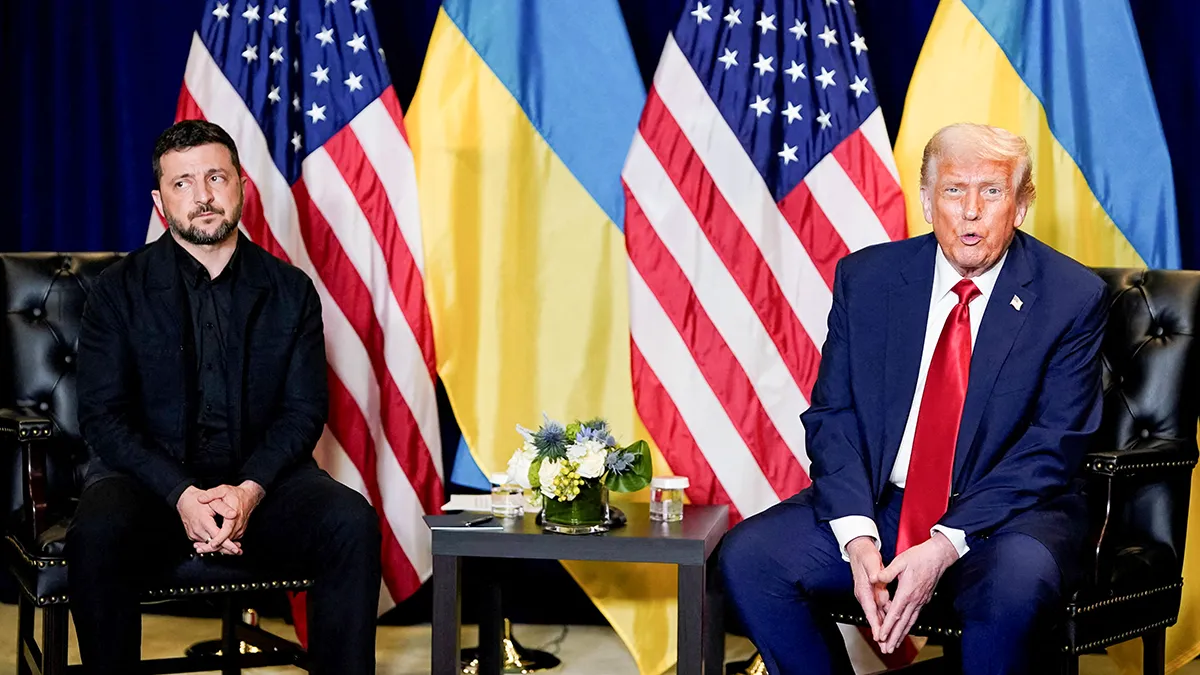
The Kremlin welcomes the fact that Trump's new National Security Strategy ‘largely agrees’ with its world view and, above all, with the idea of ‘strategic stability’ between Washington and Moscow.
The document softens the tone towards Russia, displaces it as a priority threat and focuses attention on China, while insisting that the war in Ukraine must be ended soon in order to reallocate resources.
Several European allies privately express fears that this shift could lead to a covert ‘reset’ with Moscow, right in the middle of negotiations on Ukraine.
Implications:
Talking to Moscow about arms control and nuclear stability is essential; whitewashing its aggression in Ukraine is not. Russian enthusiasm for the new text is no coincidence: the Kremlin sees it as an opportunity to consolidate its gains and continue to present Europe as the weak link in the Western chain.
If Washington leans towards unchecked transactional realism, Europe's responsibility multiplies. The old reflex of looking to the White House for guidance is no longer enough: Berlin, Paris, Warsaw and the Baltic capitals will have to maintain, politically as well, a firm stance against Putinism, even if the wind in Washington blows towards accommodation.
Venezuela: closure of airspace and consolidation of Operation Southern Spear
Facts:
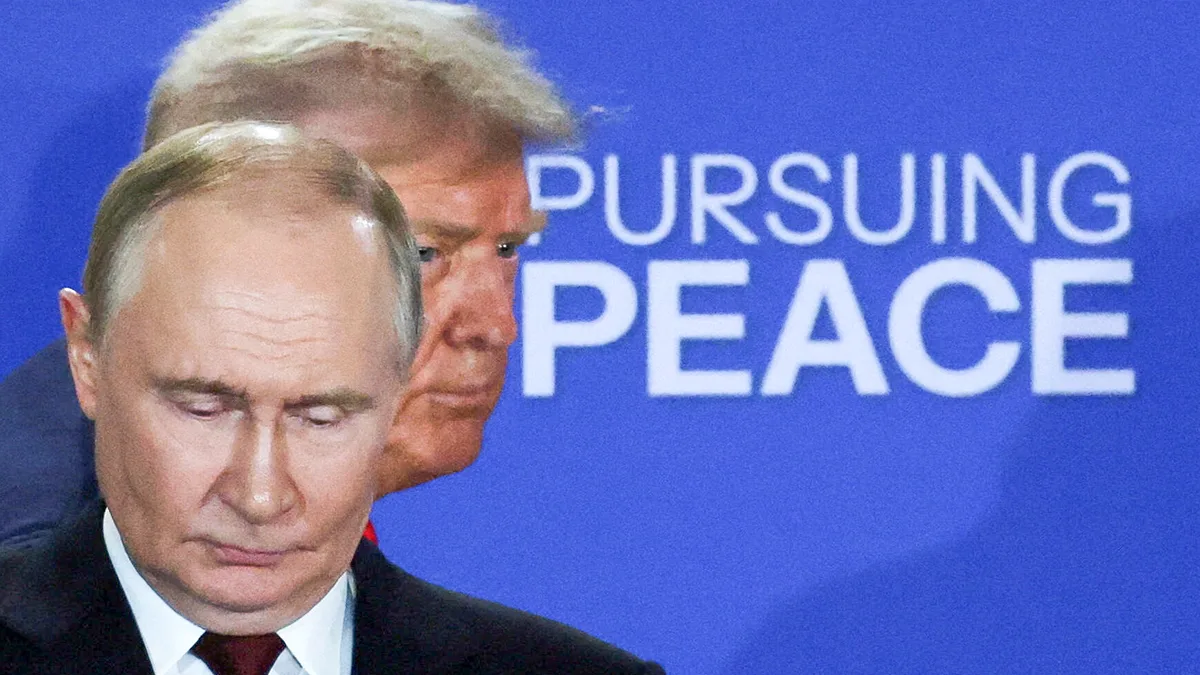
Trump has declared on social media that the airspace ‘above and around’ Venezuela should be considered ‘completely closed’, without detailing through official channels how this order is to be enforced, which has caused a mixture of confusion and panic in Caracas.
Operation Southern Spear, a massive naval and air deployment against drug trafficking in the Caribbean and eastern Pacific, now includes nearly a dozen ships and up to 12,000 troops, with attacks on vessels that Washington links to narco-terrorism networks.
Venezuela has denounced a ‘colonial threat’ and revoked licences for several airlines, while the last remaining foreign companies are suspending flights for safety reasons and due to increasing interference with navigation signals.
Implications:
The de facto closure of Venezuelan airspace and the intensification of Southern Spear are the first large-scale application of a doctrine of maximum pressure in the Western Hemisphere. From a perspective that is under no illusions about the mafia-like, narco-terrorist and pro-Iranian nature of the Chavista regime, it was only a matter of time before patience ran out. But forcefulness does not exempt one from prudence.
The manoeuvre has clear advantages: it isolates the Chavista leadership, strikes at its logistical routes and forces Moscow and Beijing to gauge how far they are willing to risk to maintain an exhausted pawn. The risk lies in an armed incident—a shootdown, a naval clash—that would force Washington to respond militarily and precipitate a monumental humanitarian crisis. Firmness is necessary; adventurism is suicidal.
China-Japan: aircraft carriers, fire control radar and the normalisation of intimidation
Facts:
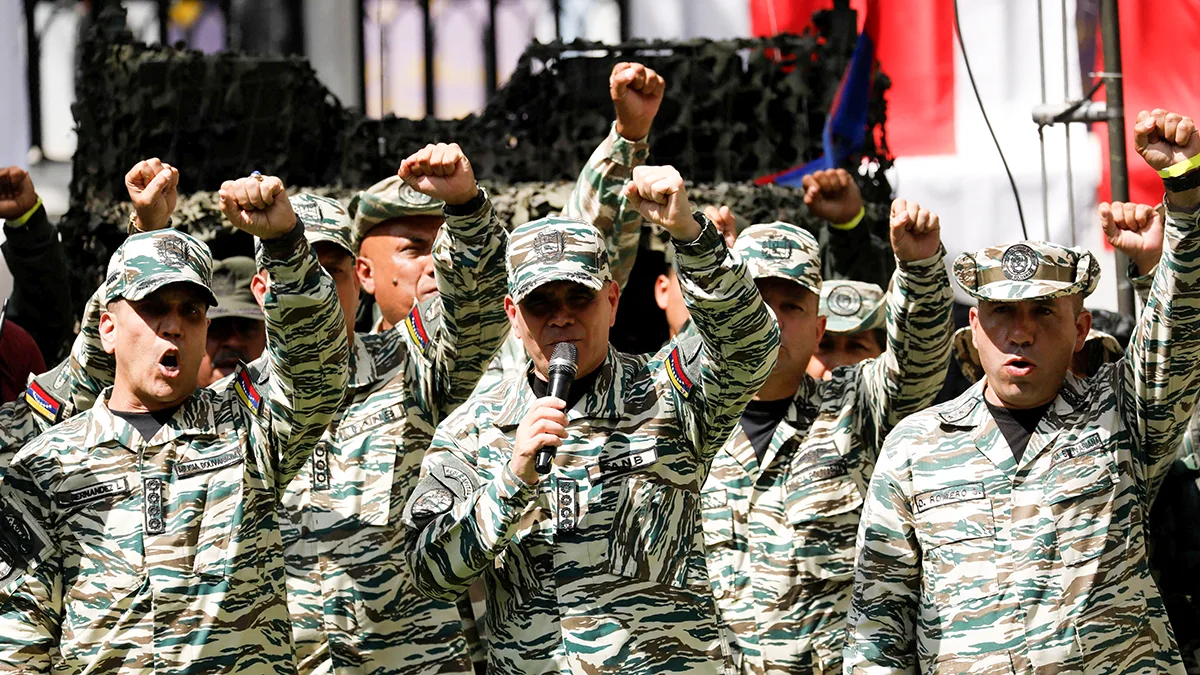
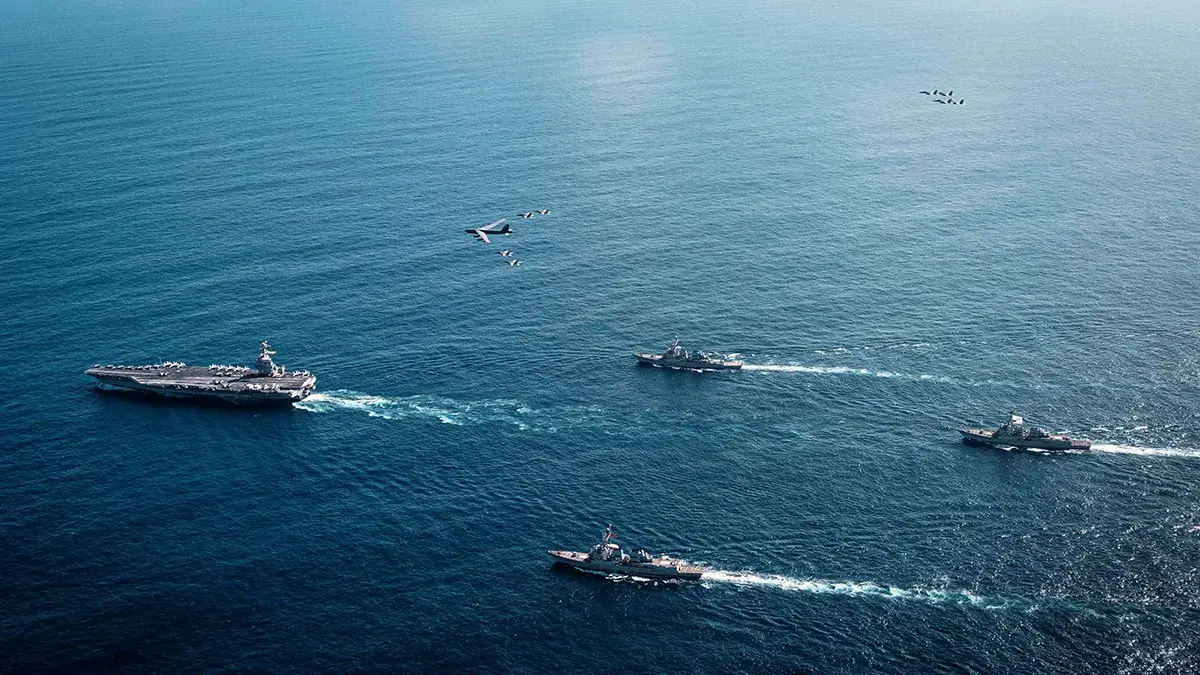
The Chinese aircraft carrier (full combat group) has carried out around 100 take-offs and landings of its fighter jets in the last 48 hours near the chain of islands in south-western Japan, advancing towards the Pacific east of Okinawa.
Japan reports two incidents in which Chinese fighter jets directed their fire control radar—the step prior to the use of missiles—at Self-Defence Force aircraft, describing them as ‘dangerous’ and ‘extremely regrettable’.
Beijing denies the accusations, claiming it was ‘routine training’ and accusing the Japanese aircraft of endangering flight safety by flying too close to the naval group.
Implications:
Illuminating a neighbouring aircraft with fire control radar is not a symbolic game: it forces that aircraft to behave as if it were seconds away from being attacked. It is another step in Beijing's calculated escalation, which aims to accustom Japan, Taiwan and the United States to a level of permanent military tension on their periphery.
For Tokyo, the response must be firm but calm: transparency, unambiguous diplomatic protests and strengthened coordination with the United States. For Europe, the message is simple: the dispute over the balance of power in the 21st century is also being fought over the skies of Okinawa. To ignore it is to give up on understanding the world we live in.
Thailand launches air strikes against Cambodia: collapse of a fragile ceasefire
Facts:
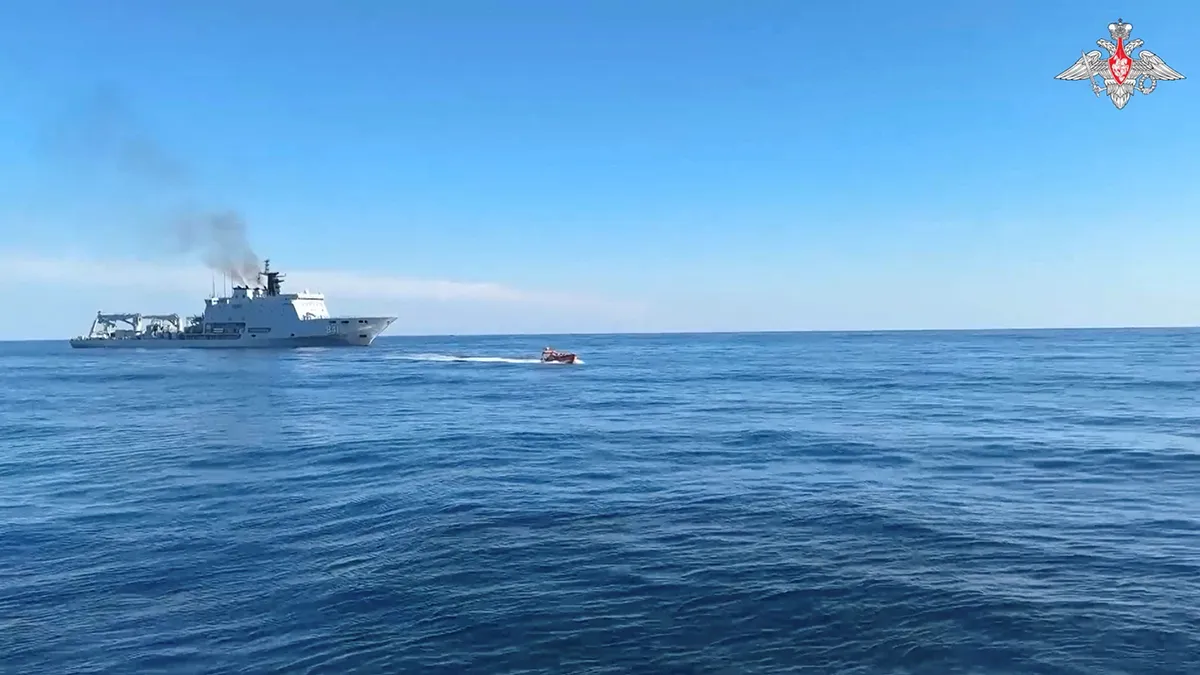
The Thai army has launched air strikes along the disputed border with Cambodia in Ubon Ratchathani province after reporting that Cambodian fire killed one soldier and wounded four others.
The fighting reignites a conflict that already caused at least 48 deaths and some 300,000 displaced persons in July, before a truce brokered by Trump and Malaysian Prime Minister Anwar Ibrahim.
Thailand announces mass evacuations (hundreds of thousands of civilians) and accuses Cambodia of firing BM-21 rockets at civilian areas; Phnom Penh denies this and presents itself as the victim of aggression.
Implications:
The resurgence confirms that agreements without political architecture, serious verification or effective demining are mere parentheses. For the United States, which had scored a point with the ceasefire, it is an uncomfortable wake-up call; for China, it is an opportunity to present itself as an alternative mediator and to deepen its influence over Phnom Penh.
Allowing two Western partners to bleed each other dry over a colonial-rooted border dispute in the heart of ASEAN is a strategic gift to Beijing. Three-way mediation (ASEAN-US-EU) is needed to contain Bangkok's nationalist reflexes and Cambodia's growing dependence on China.

Benin: foiled coup and serious warning for the Gulf of Guinea
Facts:
Benin's President Patrice Talon announces that the government and armed forces have foiled a coup attempt by a group of soldiers who appeared on state television proclaiming his dismissal.
Talon promises exemplary punishments, praises the loyalty of the rest of the army and places the episode in a regional context marked by successful coups in Niger, Burkina Faso, Mali and Guinea.
Implications:
The fact that the coup failed does not diminish the seriousness of the symptom: the coup virus in the Sahel is attempting to spread to coastal democracies. Benin is a key player in regional logistics, the fight against jihadism and security in the Gulf of Guinea, which is increasingly important for European energy and trade.
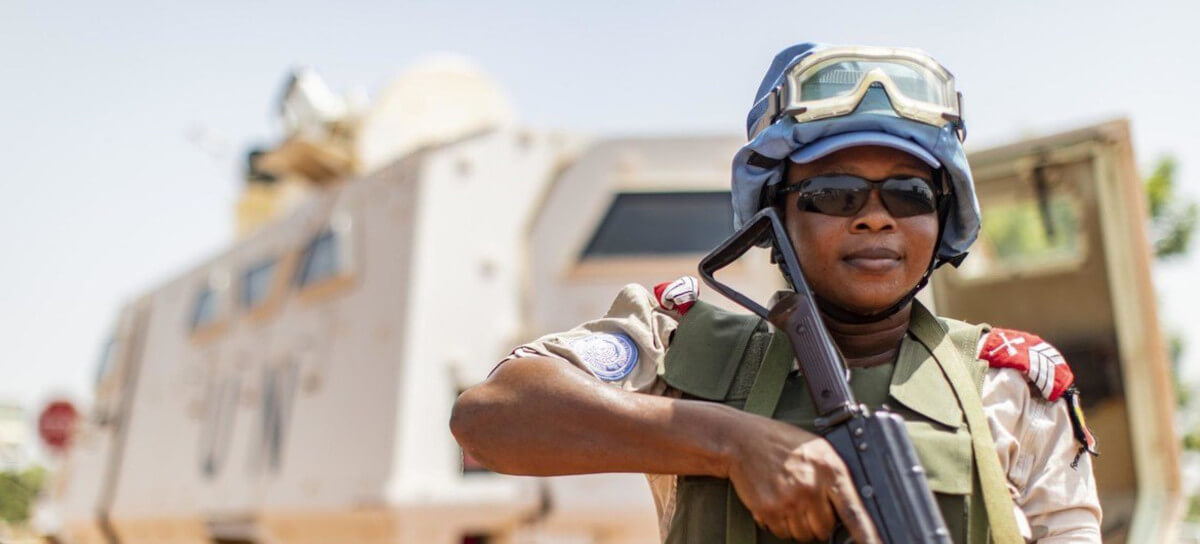
Leaving Cotonou alone would be a grave mistake. A combination of security, intelligence and development support is needed, conditional on real reforms and respect for the rule of law. Every democracy saved in West Africa is a bulwark against pro-Russian military regimes and networks of jihadism and organised crime.
Germany toughens its stance on China and travels to Beijing
Facts:
German Foreign Minister Johann Wadephul is travelling to China on his first official visit at a time when Berlin is toughening its stance on Chinese trade practices and its dependence on rare earths, steel and semiconductors.
Germany has set up a commission of experts to review critical dependencies and is aligning itself with the EU in strengthening trade defence instruments against Chinese overcapacity.
Implications:
For years, Berlin was the most naive link in the transatlantic triangle with regard to China. The fact that it is now talking about ‘risk reduction’ is good news, albeit belated and with industry already deeply exposed.
If Germany perseveres, the EU will be able to move from preaching to acting: conditioning access to its market, protecting its technological capabilities and reducing its vulnerability to a regime that combines aggressive mercantilism with very clear strategic ambitions. It is the practical end of the old Wandel durch Handel; security reality finally prevails over illusion.

Gaza: Netanyahu and Trump prepare for the ‘second phase’
Facts:
Netanyahu announces that he will meet with Trump at the end of the month to finalise the ‘second phase’ of the US-backed plan for Gaza, focused on the demilitarisation of the Strip and the disarmament of Hamas.
The first phase, now almost complete, has involved the exchange of 20 living hostages and 27 bodies for some 2,000 Palestinian prisoners and detainees, with Israel retaining control over more than half of Gaza.
Implications:
Hamas is a terrorist organisation responsible for mass atrocities; its disarmament and political defeat are a sine qua non for any real peace. But stability cannot be built solely on ceasefire lines and security technicalities. It requires an architecture of responsible Palestinian governance, a moderate Arab presence, and a regional framework that incentivises sensible actors and reduces the room for manoeuvre of Iran and its proxies.
Trump's pragmatic approach has shown that, when pressure and realism are combined, progress can be made. The risk now is to remain in an interim arrangement that turns Gaza into a de facto protectorate with no clear political horizon, fertile ground for extremists to rebuild their narrative.

Minnesota: the immigration offensive against the Somali community
Facts:
‘Border czar’ Tom Homan defends the intensification of immigration operations against Somalis in Minnesota, citing a large presence of irregular immigrants, without providing verifiable data.
He denies that the operations are a direct response to Trump's statements, in which he called some Somali immigrants ‘garbage,’ but acknowledges the general hardening of the approach.
Congresswoman Ilhan Omar and the mayor of Minneapolis point out that most of the Somali community are US citizens and denounce a campaign of stigmatisation.
Implications:
Border security and the fight against jihadist terrorism — including the very serious allegations of funds being diverted to Al Shabab — are legitimate priorities. But defending the rule of law requires a precise distinction between criminals, radicals and entire communities.
The responsible response is neither identity-based do-goodism that turns a blind eye to extremism, nor punitive populism that criminalises an entire group, but a demanding balance: zero tolerance for terrorism and its supporters, and zero tolerance for racism, Islamophobia and discrimination. This is the terrain of the democratic centre where the cultural battle must be fought.

Publication of the US National Security Strategy
Facts:
The new US National Security Strategy (NSS), signed in November 2025 and made public in early December, represents a clear doctrinal shift from previous documents, both Republican and Democratic. The text abandons the language that presented Russia as a ‘direct threat’ and repositioned it as a power with which ‘strategic stability must be restored’, while defining the People's Republic of China as the main systemic rival and placing the Western Hemisphere at the centre of Washington's priorities.
The NSS is articulated around a concept of ‘flexible realism’ and proclaims the intention to ‘reconstitute and apply’ an updated version of the Monroe Doctrine, with a ‘Trump corollary’: to deny non-hemispheric powers the possibility of deploying forces or controlling strategic assets on the American continent. In practice, this translates into a desire to expel or reduce the Russian, Chinese and Iranian presence in Latin America and the Caribbean, and to concentrate military resources on controlling the hemisphere and fighting drug trafficking and organised crime.
According to analyses by centres such as the Council on Foreign Relations, the document significantly downplays the importance of the discourse on “defending democracy” and “promoting freedom” as the cornerstone of US foreign policy, replacing it with a logic of hard interests, balance of power and burden-sharing with allies. European partners are expressly criticised for ‘over-regulating’ and not investing enough in defence, and are urged to assume greater military responsibility on their continent as the United States pivots towards Asia-Pacific and strengthens control over its own hemisphere.
In this context, the chapter on Russia no longer describes it as an existential enemy, but as an actor with whom Washington must rebuild a framework of ‘strategic stability’ that includes arms control, nuclear risk management and, above all, a negotiated end to the war in Ukraine. The Strategy explicitly links this objective to the need to free up political, military and budgetary resources for the great competition with China.
The Kremlin's reaction has been unusually effusive. Official spokespeople – including Dmitry Peskov – have stated that the Strategy is ‘largely consistent’ with the Russian vision of the international order, welcoming the reference to strategic stability and, in particular, the emphasis on addressing ‘Russia's legitimate concerns about NATO expansion’. Peskov goes so far as to say that the document aligns with the idea of a world of ‘spheres of influence’ shared among great powers, provided that the United States ‘contains its deep state’.
European media and Atlanticist analysts have pointed out that this is probably the first time in decades that Moscow has publicly welcomed a US National Security Strategy, in contrast to the reactions in 2017 and 2022, when Russia was bluntly described as a revisionist actor and a major threat to Europe. At the same time, reports from agencies such as Reuters and the BBC reflect the concern in several European capitals that Washington is no longer classifying Russia as a direct threat in the midst of negotiations on a peace plan for Ukraine that many fear could become an ‘ugly deal’ at the expense of Kiev.
Implications:
For a serious Atlanticist and Europeanist perspective, the essential factor is not only what the Strategy says, but who applauds it. The fact that the Kremlin enthusiastically welcomes a US NSS is, in itself, a strategic warning sign. Moscow reads the text as confirmation of three things: that Washington wants to close the Ukrainian front as soon as possible, that it is willing to modulate its discourse on Russia to avoid a simultaneous confrontation with Beijing, and that Europe will continue to depend, for some time, on a security umbrella that is increasingly less of a priority on the US agenda.
The central risk is that Russia will interpret this shift not as a reorganisation of global priorities, but as a prelude to an agreement on Ukraine that will freeze its territorial gains and, in practice, enshrine its revisionism. If the NSS translates into a negotiation that leaves Moscow with nearly a fifth of Ukraine in its possession, recognised de facto, if not de jure, the message sent to the world will be devastating: it is possible to invade, destroy and annex parts of a European country and, with enough patience and brutality, end up being treated once again as a respectable partner.
The red line, therefore, must be clear: talking to Moscow about strategic stability is not only legitimate but necessary; what cannot be accepted is that Western fatigue becomes a bargaining chip at the expense of Ukrainian territorial integrity and the security of Central and Eastern Europe. Credible deterrence against Russia is not based on rhetoric, but on three pillars: maintaining sanctions and diplomatic isolation while the occupation persists; strengthening the allied military presence on the eastern flank; and making it very clear, in practice and not just in speeches, that no ‘sphere of influence’ can be built on Ukrainian ruins and cemeteries.
At the same time, it would be naive to ignore the structural logic underlying the Strategy. The United States rightly perceives the Chinese challenge – technological, military, economic and ideological – as more profound and systemic than the Russian one. The NSS essentially seeks to prevent Russia from becoming a mere vassal of Beijing and to push it towards a relationship of managed rivalry with Washington. From a strictly geopolitical point of view, the idea of preventing a full Moscow-Beijing alliance makes sense. But the devil is in the detail: what exact price is one willing to pay to achieve this partial decoupling? If the price is the permanent mutilation of Ukraine, the cure will be worse than the disease.
In this scenario, Europe ceases to be a mere spectator and, whether it likes it or not, moves to the forefront. The NSS harshly criticises the Union's lack of defence spending and regulatory complacency, while demanding that European allies take on more responsibility. There is an uncomfortable truth to this criticism: for decades, too many European governments have preferred to invest in welfare with cheap debt while outsourcing security to the United States. Now, as Washington increasingly looks to Asia and the Western Hemisphere, the time for shortcuts is over. Either Europe quickly builds a military and technological pillar worthy of the name, or it will be treated – even by its friends – as a secondary player in a world of giants.
There is also an element of cultural battle. The text speaks of ‘civilisational erosion’ in Europe and paints a picture of a weary continent, entangled in internal debates, captured by postmodern discourses and unwilling to defend its own values. That this caricature has some basis in reality does not mean it should be accepted without nuance. The best European response is not rhetorical indignation, but the practical demonstration that the model of representative liberal democracy, social market economy and the rule of law can combine strategic firmness with internal cohesion and prosperity. In other words, exactly the opposite of the caricature of decadence painted, for different reasons, by both anti-Western populists and some American hawks.
Finally, the revival of the Monroe Doctrine in the 21st century has implications that go beyond the American continent. If Washington explicitly reserves the right to prevent the strategic presence of China and Russia in the Western Hemisphere, it will be difficult to argue that those powers will not, in turn, attempt to consolidate their own ‘exclusion zones’ in Eastern Europe or the Asia-Pacific.
That is why it is so important that the Western response does not consist of legitimising a tacit division of spheres of influence, but rather of defending a basic principle: countries, large or small, have the right to choose their alliances without being reduced to pawns on an imperial map. That is the true test of consistency for a foreign policy that claims to defend a rules-based order, rather than the mere law of the strongest.
Special report on the sale of Nvidia chips to China
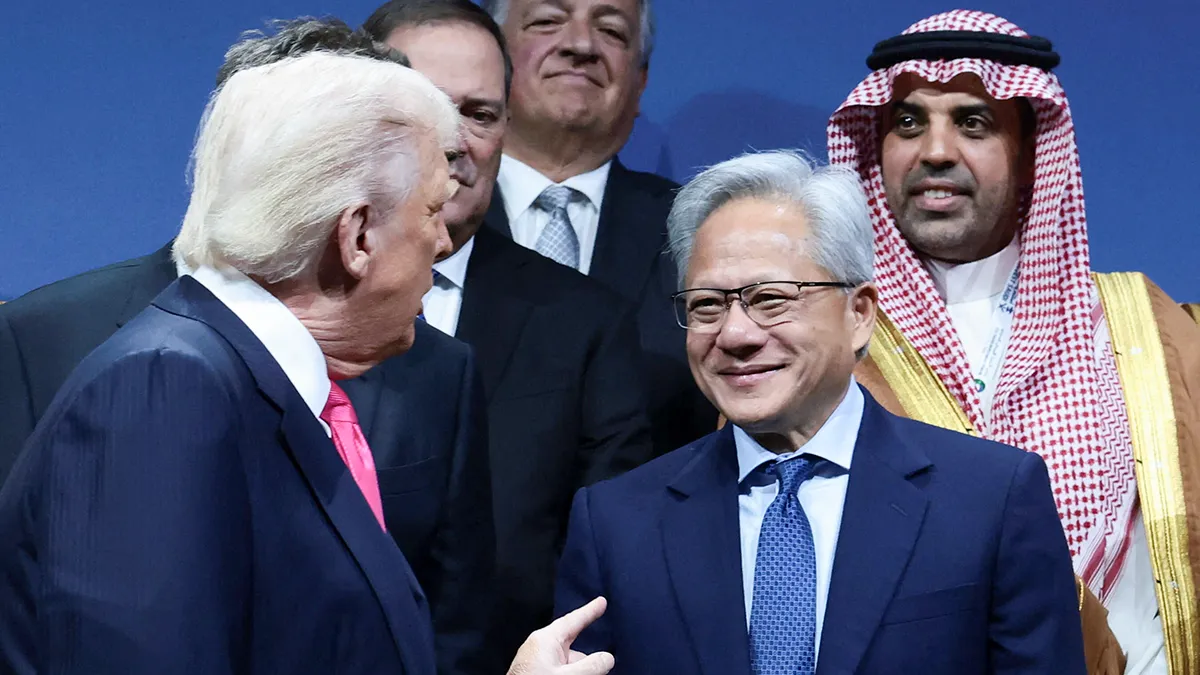
Selling advanced Nvidia chips to China has clear short-term economic benefits, but significant strategic and geopolitical risks in the medium and long term, especially in terms of military power, technological dependence and the balance of the AI race.
Economic impact:
For Nvidia and the US sector, access to the Chinese market represents tens of billions of dollars in potential revenue; recent restrictions have resulted in estimated annual losses of around £10-15 billion for Nvidia alone.
For China, purchasing Nvidia chips accelerates the deployment of data centres and AI infrastructure, avoiding years of investment and trial and error in less efficient domestic solutions.
Technological and AI consequences:
Stable access to cutting-edge GPUs would allow Chinese companies and laboratories to train larger, faster and cheaper foundational models, reducing the gap with the United States and its allies.
Limiting sales has partially slowed Chinese access to the ‘state of the art,’ but it has also incentivised a sharp acceleration of local alternatives, reducing dependence on Western technology in the medium term.
Military and security dimension:
Nvidia chips are clearly dual-use technology: the same capability that powers language models is used for military simulations, logistics optimisation, autonomous systems and electronic warfare applications.
Although the restrictions attempt to cut off direct military access, some of the hardware ends up reaching the Chinese defence ecosystem via third countries or covert purchases, which limits the effectiveness of the control but makes it more expensive and slows down its escalation.
Geopolitical repercussions:
Allowing broad sales strengthens economic interdependence but weakens the United States' strategic leverage in the ‘chip war,’ making it easier for China to reach near parity in advanced AI capabilities sooner.
Restricting or cutting sales erodes US technology revenues and pushes China towards accelerated autonomy in semiconductors, reconfiguring global chains and aligning Beijing more closely with other alternative suppliers and partners.
Effects on Western technological leadership:
Selling chips preserves Nvidia's position as the global de facto standard in AI hardware, maintaining its software ecosystem as a global backbone.
Overly harsh controls could ‘shoot Western industry in the foot’: they reduce scale, margin for reinvestment in R&D, and open space for the Chinese technology stack to gain weight in emerging markets outside the Western bloc.
Media rack
Leading Anglo-Saxon press
They highlight the Ukraine-Security Strategy-China triangle. Explicit fear of an ‘ugly deal’ for Europe, of a peace that consolidates Russian occupation and of an excessively transactional drift with Moscow in the name of the great anti-China pivot.
European media
They insist on the discomfort of EU capitals in the face of a tougher and colder Washington, and read Wadephul's trip to Beijing as a symptom of a belated awakening to critical dependencies on China.
Asian press
Focus on the naval and air escalation between China and Japan, the firing radar and intensive flights of the aircraft carrier, and the resurgence of war on the Cambodia-Thailand border, with special attention to how the United States and ASEAN react.
Russian and allied media
They present the new US Security Strategy as a victory for their narrative, emphasising that ‘we are no longer called a threat’ and fuelling the idea of a weary West seeking a way out of Ukraine at almost any cost.
Middle East
They divide their attention between the ‘second phase’ of the plan for Gaza, the ongoing struggle between Israel and Iran (with their proxies in Gaza, Lebanon and Yemen) and the regional impact of a possible major agreement in Ukraine that would rearrange relations between Washington and Moscow.
Americas and Africa
They report on Milei's economic and political offensive in Argentina, Brazil's fragility, the failed coup in Benin and the human and strategic consequences of the forgotten conflicts in the Sahel and Sudan.
United States – internal cultural battle
They cover Homan's offensive in Minnesota from opposing perspectives: ‘law and order’ as a priority for some, racism and selective persecution for others, with Ilhan Omar as a symbol of this divide.
Editorial commentary
The era of naive idealism, of solemn statements with no muscle behind them, is fading. What lies ahead is a phase of ‘warm peace’ in which liberal democracy will have to prove that it is not just a nice story, but a political project capable of defending itself.
Washington's commitment to ending the war in Ukraine and refocusing its strategy on China is understandable from the logic of power.
But form matters as much as substance. A peace that leaves Russia with the territorial spoils in hand, turns Ukraine into a mutilated state and leaves Europe feeling like an uninvited guest would be a triumph of geopolitical cynicism and a defeat for the values that the West claims to embody. It is possible to be realistic without abandoning basic principles: not legitimising annexations, not rewarding aggression, not treating allies as expendable pieces in a transaction.
At the same time, China's deployment around Japan reminds us why any concession to territorial revisionism is so dangerous. Beijing is testing Japanese and American patience inch by inch, just as Russia tested European tolerance for years before launching its large-scale invasion. If it is accepted that borders in Europe can be changed by force, with what moral and political authority will China be told that it cannot do so in the South China Sea or the Taiwan Strait?
In the Western Hemisphere, the closure of Venezuelan airspace and the expansion of Southern Spear embody another obvious lesson that too many preferred to forget: the narco-regimes allied with Iran and supported by Russia and China are not a local problem, they are a direct threat to the security of the United States, Europe and all of Latin America. Democracy cannot survive if it resigns itself to coexisting forever with mafia states that turn their territory into a platform for transnational crime and destabilisation. Firmness in the face of Chavism is not an ideological choice: it is a security necessity.
And while the great powers move their pawns, the map is filling with cracks: failed coups in Benin, forgotten genocides in Darfur, ‘peripheral’ wars in border temples in Cambodia and Thailand. Each of these cracks is an open invitation to revisionists to continue advancing. The space that the West denies—whether out of fatigue, complexes, or simple distraction—will undoubtedly be filled by Russia, China, Iran, and their networks.
The conclusion is as simple as it is uncomfortable: freedom, the rule of law, and the market economy cannot sustain themselves. They require political will, moral clarity, and, when necessary, hard power. The challenge in the coming months will be to avoid two equally suicidal extremes: appeasement that disguises capitulation as “realism”, and adventurism that confuses firmness with recklessness. Between the two lies the space where serious democracies must stand: a position of sober strength, capable of deterring predators without renouncing what makes us different from them.