Connected Sovereignties: Towards a New Geopolitical Architecture
- Introduction
- Empirical foundations of the doctrine
- The Five Pillars of the Doctrine of Connected Sovereignties
- I. Empirical foundations: from diplomatic practices to theorization
- II. Conceptual architecture: the five pillars
- III. Positioning in the contemporary doctrinal ecosystem
- IV. Applications and prospective scenarios
- V. Implications for research
- VI. Outlook
Based on an in-depth analysis of the geostrategies implemented by His Majesty King Mohammed VI since the beginning of his reign—notably the Abidjan Doctrine and the Mogador Doctrine of Balance—this approach articulates five fundamental pillars: adaptive sovereignty, sovereign connectivity, multi-level resilience, selective cooperation, and preservation of strategic identity.
The doctrine proposes a conceptual framework for thinking about the exercise of state sovereignty in a context of growing structural interdependence. The article examines the theoretical foundations of this doctrine, situates it within the contemporary doctrinal ecosystem, and explores its implications for research and political action.
Article previously published on the website of the Institut Géopolitique Horizons
Introduction
Since the turn of the 21st century, the exercise of state sovereignty has undergone profound changes linked to the acceleration of global interdependence, the spread of digital technologies, and the multipolar restructuring of the international system. The classic doctrines of Westphalian sovereignty, based on absolute territorial control and exclusive decision-making autonomy, now clash with geopolitical realities characterized by intense transnational flows, interconnected critical infrastructures, and diffuse hybrid threats.
In this context, several states and regional groupings are developing strategies aimed at preserving their strategic autonomy while recognizing the impossibility of complete isolation. The European Union refers to “open strategic autonomy,” France theorizes “digital sovereignty,” the United States is structuring a multi-domain “integrated deterrence,” while China asserts strict "cyber sovereignty ."
This contribution to the debate proposes an integrated conceptual framework: the doctrine of Connected Sovereignties. Developed at the IGH based on an analysis of contemporary geopolitical changes and informed by exchanges with field consultants and primary sources, this approach finds its empirical foundations in the observation and conceptualization of concrete diplomatic and strategic practices.
Empirical foundations of the doctrine
More specifically, the doctrine of Connected Sovereignties was developed from an in-depth analysis of the geostrategies implemented by His Majesty King Mohammed VI since the beginning of his reign in 1999. Two doctrines in particular served as a conceptual matrix: the Abidjan Doctrine, which articulates royal diplomacy, South-South economic partnerships, and African continental integration, and the Mogador Doctrine of Balance, which theorizes a posture of strategic balance between the major powers while preserving national decision-making autonomy.
These two doctrines, formalized by the IGH based on observations of Moroccan diplomatic practices, have revealed strategic principles that can be transposed to a larger scale. The Doctrine of Connected Sovereignties thus represents a rise in conceptual generality, aiming to offer a theoretical framework applicable to other geopolitical contexts while retaining the analytical depth derived from the Moroccan case study.
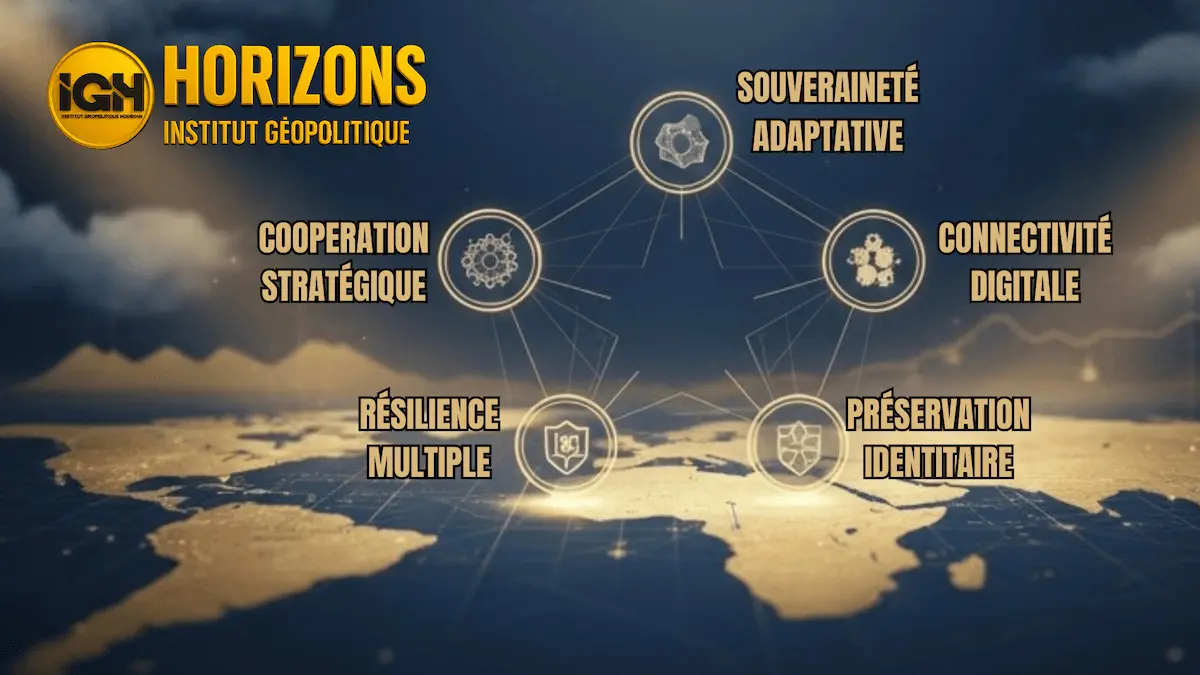
The Five Pillars of the Doctrine of Connected Sovereignties
Adaptive Sovereignty
The ability to modulate the exercise of sovereignty according to domains, threats, and technological cycles, without relinquishing decision-making autonomy.
Sovereign Connectivity
Voluntary and secure control of interconnection networks, transforming interdependence into an instrument of power.
Multi-level Resilience
Integrated architecture of absorption, adaptation, and reconstruction capabilities in the face of systemic shocks, from the local to the transnational level.
Selective Cooperation
Strategy of differentiated and modular partnerships, favoring ad hoc coalitions and thematic minilateralism, with contractual reversibility.
Preservation of Strategic Identity
Protection and promotion of values, the institutional model, and the national narrative, articulating cultural identity and techno-industrial governance.
Empirical foundations: This doctrine was developed based on an in-depth analysis of the geostrategies implemented by His Majesty King Mohammed VI, notably the Abidjan Doctrine (African connectivity) and the Mogador Doctrine of Balance (autonomy in multipolarity).
I. Empirical foundations: from diplomatic practices to theorization
1.1 The Abidjan Doctrine: African connectivity and shared sovereignty
The Abidjan Doctrine, conceptualized by the IGH based on an analysis of Moroccan diplomacy in sub-Saharan Africa, is based on several structuring principles:
· Active African multilateralism: Intensive participation in continental bodies (African Union, ECOWAS, CEMAC) while preserving national room for maneuver.
· Win-win economic partnerships: Structural investments in infrastructure (banking, telecommunications, energy) creating chosen mutual interdependencies.
· Royal diplomacy of proximity: Regular royal missions establishing solid bilateral relations in parallel with multilateral frameworks.
· Genuine South-South cooperation: Transfer of know-how, training, academic and religious partnerships creating lasting links.
Founding principle: sovereign connectivity
These principles reveal an approach in which sovereignty is not conceived as opposed to interconnection, but is strengthened by strategic control of interdependence networks. This empirical observation forms the basis of the pillar of sovereign connectivity in the doctrine of Connected Sovereignties.
1.2 The Mogador Doctrine of Balance: autonomy in multipolarity
The Mogador Doctrine of Balance, also formalized by the IGH, analyzes Morocco's strategic posture vis-à-vis the major powers:
· Strategic non-alignment: Refusal to align exclusively with any one power center despite geopolitical pressures.
· Differentiated partnerships: Privileged relations with the United States (major non-NATO ally status), the European Union (advanced status), China (strategic partnership), Russia (selective cooperation), and the Gulf (historic alliances).
· Modular diplomacy: Ability to activate or temper certain partnerships depending on the context and issues at stake.
· Preservation of national identity: Maintenance of a foreign policy consistent with national constants (territorial integrity, African positioning, moderate Islamic identity).
Founding principles: selective cooperation and adaptive sovereignty
This doctrine reveals the principles of selective cooperation and adaptive sovereignty, two central pillars of the Connected Sovereignties doctrine.
1.3 From case study to conceptual generalization
Methodical observation of Moroccan diplomatic practices over more than twenty-five years of reign has made it possible to identify transposable strategic constants. The doctrine of Connected Sovereignties is therefore not an abstract theoretical construct, but a conceptualization of proven practices, elevated to the status of a general analytical framework.
This methodological approach—starting from a specific case to develop a universal framework—is part of a tradition of research in international relations where in-depth analysis of unique national strategies allows for the development of generalizable conceptual categories.
II. Conceptual architecture: the five pillars
2.1 Adaptive sovereignty
Adaptive sovereignty refers to a state's ability to modulate the exercise of its sovereignty according to domains, threats, and technological cycles, without renouncing the fundamental principle of decision-making autonomy.
This concept differs from traditional Westphalian sovereignty in that it is dynamic and functional rather than static and territorial. It is partly inspired by work on “graduated sovereignty” (Ong, 2006), while reorienting it towards issues of national security and strategic resilience.
Empirical basis
Observation of Moroccan diplomacy reveals a capacity for continuous adjustment: economic openness in certain sectors, strategic protectionism in others, activation or moderation of partnerships depending on the context. This institutional flexibility is at the heart of adaptive sovereignty.
Operational implications:
· Regulatory flexibility in the face of technological innovations (AI, quantum, biotechnologies)
· Differentiated calibration of economic openness according to strategic sectors
· Institutional mechanisms for rapid adjustment in the face of exogenous shocks
2.2 Sovereign connectivity
Sovereign connectivity is the central conceptual innovation of this doctrine. It refers to the voluntary and secure control of interconnection networks (digital, energy, logistics, financial) that transform interdependence into an instrument of power rather than pure vulnerability.
This approach differs from traditional conceptions of digital sovereignty (focused on territorial control of data) by making governed interoperability a vector of power rather than a risk to be minimized.
Empirical basis
The Abidjan Doctrine reveals how strategic investments in critical African infrastructure (banking, telecommunications, ports, energy) create selective interdependencies that strengthen influence without creating asymmetric dependence. This observation forms the basis of the concept of sovereign connectivity.
Operational implications:
· Control of critical infrastructure (submarine cables, data hubs, energy corridors)
· Definition of national or regional interoperability standards
· Reversibility and auditability clauses in strategic partnerships
· Geographic and technological diversification of dependencies
2.3 Multi-level resilience
Multi-level resilience combines the capacities for absorption, adaptation, and reconstruction in the face of systemic shocks, deployed simultaneously at the local, national, regional, and transnational levels.
This concept is inspired by recent work on “systemic resilience” (World Bank, 2021; OECD, 2024) while proposing a more integrated architecture linking cyber, physical, financial, and informational dimensions.
Empirical basis
Morocco's ability to maintain its institutional and economic stability despite regional shocks (Arab Spring, Sahelian crises, COVID-19 pandemic) reveals the existence of coordinated resilience mechanisms at several levels. This observation supports the pillar of multi-level resilience.
Operational implications:
· Coordinated strategic redundancies (storage, industrial capacity, alternative networks)
· Continuity plans involving public and private actors
· Complex crisis simulation exercises integrating multiple threat vectors
2.4 Selective cooperation
Selective cooperation refers to a strategy of differentiated and flexible partnerships, calibrated by domain and values, favoring ad hoc coalitions over bloc alignments, with mechanisms for contractual reversibility.
This approach is in line with the “variable geometry” practiced by certain regional organizations, while systematizing it as a doctrinal principle rather than simple diplomatic pragmatism.
Empirical basis
The Mogador Doctrine of Balance demonstrates an ability to simultaneously maintain strategic partnerships with powers whose interests are sometimes contradictory (the United States, China, Russia, the EU), while preserving decision-making autonomy. This practice forms the basis of the concept of selective cooperation.
Operational implications:
· Thematic minilateralism (one coalition for climate, another for semiconductors)
· Exit clauses negotiated in strategic agreements
· Continuous assessment of the risk/benefit ratio of cooperation
2.5 Preservation of strategic identity
The preservation of strategic identity aims to protect and promote fundamental values, the institutional model, the national narrative, and strategic knowledge in the face of normative integration pressures and influence operations.
This dimension links cultural identity and techno-industrial governance, going beyond traditional approaches to “soft power” (Nye, 2004) to articulate narrative dimension and technical sovereignty.
Empirical basis
Moroccan diplomacy under Mohammed VI reveals remarkable strategic consistency around national constants (constitutional monarchy, moderate Islam, African and Mediterranean roots, defense of territorial integrity) that structure all international partnerships. This observation forms the basis of the strategic identity pillar.
Operational implications:
· Cognitive counter-interference and narrative sovereignty
· Protection of strategic industrial and military secrets
· Articulation between technical standards and institutional values
III. Positioning in the contemporary doctrinal ecosystem
3.1 Doctrines of economic and digital sovereignty
Several recent doctrines address the issue of sovereignty in specific areas:
The open strategic autonomy promoted by the European Union aims to reduce critical dependencies while maintaining trade openness. The doctrine of Connected Sovereignties shares this objective but proposes a more systematic articulation between autonomy and connectivity, making the latter an active instrument rather than a constraint to be managed.
Digital sovereignty, theorized in particular in France (CESE, 2019; CERNA, 2018) and India, emphasizes control over data and technological infrastructures. The IGH approach extends this thinking by integrating the dimensions of multi-level resilience, selective cooperation, and strategic identity, thus going beyond a purely sectoral approach.
Chinese cyber sovereignty asserts strict control over digital flows within the national territory. The Connected Sovereignties doctrine differs from this by rejecting autarky and favoring secure connectivity over disconnection.
3.2 Military and security doctrines
The US integrated deterrence and NATO's multi-domain approaches integrate cyber, space, and information dimensions into defense strategies. The IGH doctrine converges on the importance of cross-functionality but adds the dimensions of reversible selective cooperation and strategic identity, which are less developed in traditional military frameworks.
The doctrines of total national resilience practiced in the Nordic countries and Singapore share the ambition of systemic resilience. The IGH approach differs in its explicit articulation of resilience and sovereign connectivity, as well as its methodology of selective cooperation.
3.3 Originality of the proposed synthesis
The distinctive feature of the Connected Sovereignties doctrine lies in the systemic integration of dimensions that are usually treated separately. Three elements deserve attention:
The reversal of the interdependence paradigm
Instead of viewing interdependence as a threat that needs to be reduced or disconnected, the doctrine proposes turning it into an instrument of power through the governance of interconnections. This conceptual reversal is a significant contribution to the strategic debate.
The methodology of selective reversible cooperation
The introduction of reversibility, auditability, and portability clauses in strategic partnerships transforms cooperation into a flexible lever. This procedural dimension goes beyond the “friend-shoring” or “de-risking” approaches currently under discussion.
The identity-technology link
The link established between the preservation of strategic identity and the governance of technical standards (and not just culture or public diplomacy) is an original contribution to the debate on sovereignty in the digital age.
IV. Applications and prospective scenarios
4.1 Relevance for middle powers
The doctrine appears particularly relevant for middle powers (France, India, Brazil, Indonesia, Turkey, etc.) faced with the need to navigate between poles of power without exclusive alignment. It offers a conceptual framework for building ad hoc coalitions according to sectoral interests while preserving strategic identity.
4.2 Application to the African context
In the African context, characterized by multiple dependencies and increased competition for influence, the doctrine suggests the construction of interconnected networks of regional sovereignty. These networks would combine secure energy corridors, regional data hubs, and thematic minilateral coalitions (maritime security, technological R&D).
Morocco's experience in sub-Saharan Africa, as conceptualized in the Abidjan Doctrine, offers valuable lessons for other African states seeking to strengthen their continental influence while preserving their strategic autonomy.
4.3 Regional groupings and integration
For regional organizations (EU, ASEAN, African Union, etc.), the doctrine provides a framework for articulating national sovereignty and regional integration, defining the boundaries between deeper cooperation and the preservation of autonomy, while structuring collective resilience without diluting identity.
V. Implications for research
5.1 Empirical research agenda
The formalization of this doctrine opens up several areas of research:
Operationalization and measurement: Construction of measurable indicators of adaptive sovereignty, sovereign connectivity, and multi-level resilience. Development of comparative metrics between states.
Comparative case studies: Application of the doctrine to different geopolitical contexts to test its explanatory and prescriptive relevance. Comparative analysis of Turkish, Indian, and Brazilian strategies in light of this conceptual framework.
Prospective modeling: Simulation of crisis scenarios under the assumption of application of the doctrine to assess its robustness.
Deepening of empirical foundations: Detailed historical studies of the Abidjan Doctrine and the Mogador Doctrine of Balance to refine the conceptual framework.
5.2 Dialogue with theoretical traditions
This doctrine engages in dialogue with several traditions of research in international relations:
· Structural realism (Waltz, Mearsheimer) on the importance of strategic autonomy
· Neo-institutionalism (Keohane, Nye) on forms of cooperation in interdependence
· Critical theories (Cox, Sassen) on the transformation of sovereignty
· Contemporary strategic studies on hybrid and cognitive warfare
It does not claim to settle theoretical debates but proposes an analytical framework that can be mobilized for strategic action.
VI. Outlook
The doctrine of Connected sovereignties, developed within the Horizons Geopolitical Institute based on an in-depth analysis of the geostrategies implemented by His Majesty King Mohammed VI — notably the Abidjan Doctrine and the Mogador Doctrine of Balance — represents a contribution to strategic thinking on the exercise of sovereignty in a world characterized by growing interdependence and accelerated multipolarity.
By articulating adaptive sovereignty, sovereign connectivity, multi-level resilience, selective cooperation, and preservation of strategic identity, it offers an integrated conceptual framework for thinking about contemporary transformations of state power.
This initial academic formalization will be further developed in a forthcoming white paper, which will detail sectoral applications, evaluation methodologies, and prospective scenarios. Through this work, the IGH hopes to contribute to the international academic and strategic dialogue on the changes in sovereignty in the 21st century.