INTERPOL: Hammouchi reinforces Morocco's position as a key player in global security
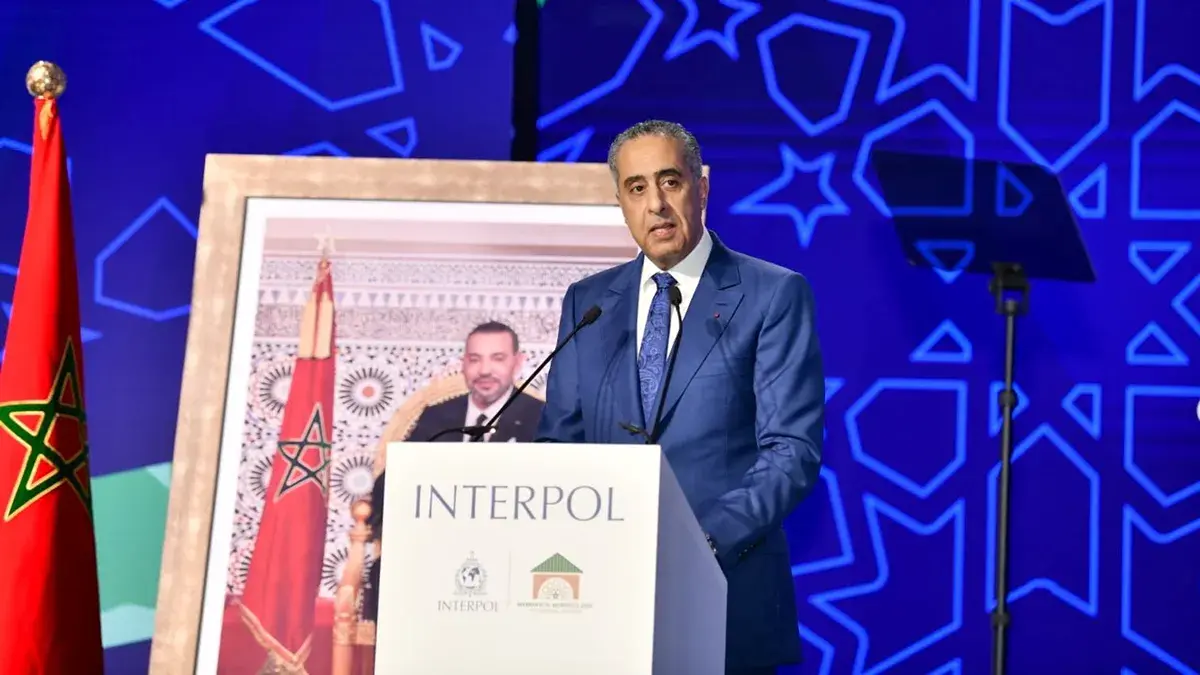
- Abdellatif Hammouchi's leadership in international security
- INTERPOL's institutional support and strategic vision
- Morocco's international relations and collaborations
- Cybercrime situation and legal framework in Morocco
- Memorandum of Understanding between Morocco and Ethiopia
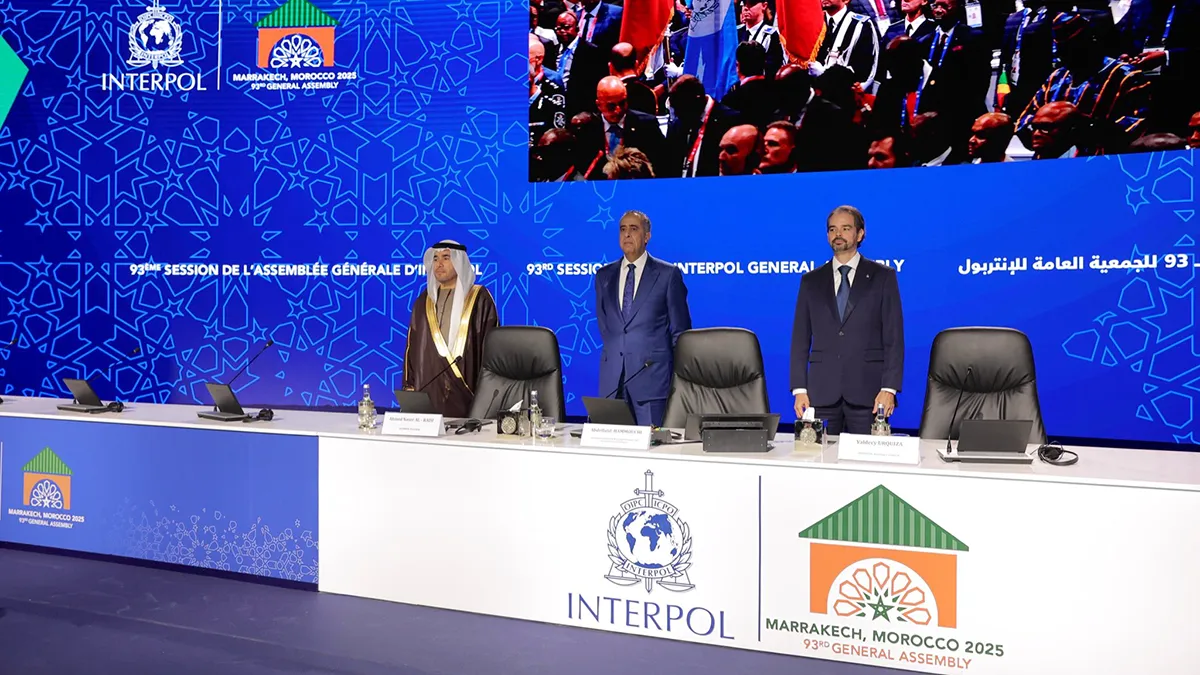
The 93rd INTERPOL General Assembly (GA), taking place in Marrakesh from 24 to 27 November, represents a significant shift in Morocco's global involvement in security matters.
At the global level, terrorism and cybercrime have been central issues where Morocco, under the leadership of Abdellatif Hammouchi, who heads National Security and Territorial Surveillance, has demonstrated its capacity, cooperation and strategic vision.
Today, the topics to be discussed at the General Assembly are: a debate on the consolidation of cybercrime and how the United Nations can help; the rise of transnational organised crime; and the importance of good data governance and information sharing between intelligence services.
In addition, the guidelines for the implementation of the Paletada Notification will be outlined: the highest-level mechanism for tracking criminal assets worldwide.
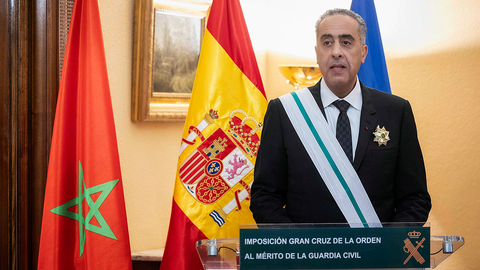
Abdellatif Hammouchi's leadership in international security
During his speeches, Hammouchi specified that the purposes of international security must be based on broad alliances and the establishment of an information exchange system that adapts to current technologies. He reiterated that crimes and threats ‘know no borders.’
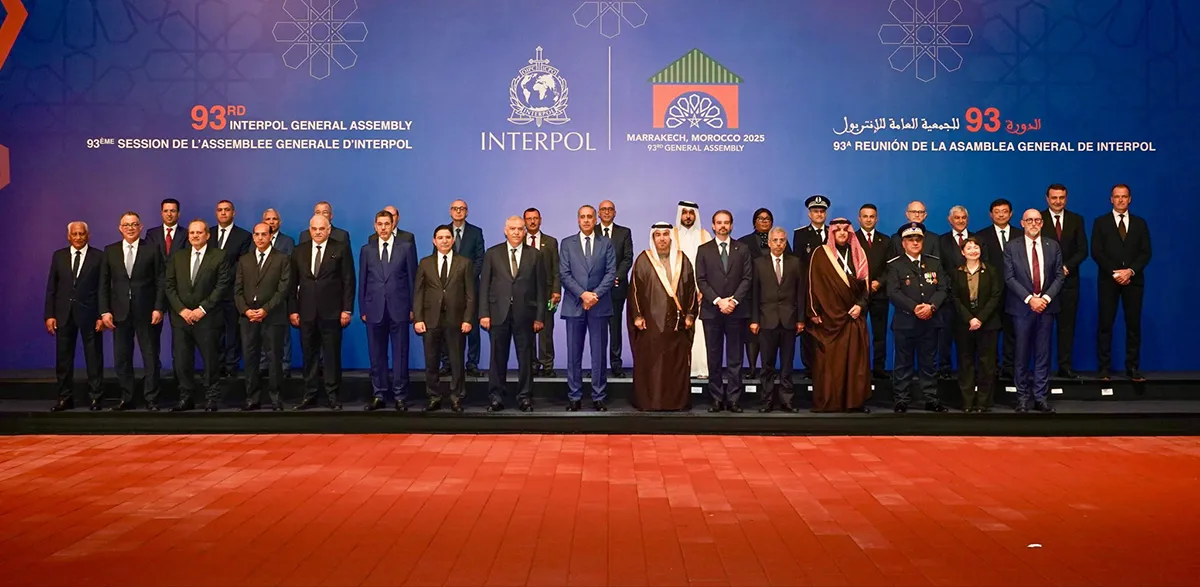
These statements resonated with the more than 800 leaders present at the Summit, from 179 member countries, including 82 police chiefs and 25 ministers and deputy ministers, who later highlighted, in interviews with media outlets around the world, the impact of Rabat's perspective on global security.
In fact, hosting the GA in Morocco makes it the only Arab country to do so twice, since it first organised it in 2007. Interestingly, the vote for Marrakesh as the venue for the GA was the first time it was unanimous, with all 196 participating countries voting in favour of the Moroccan city as the venue.

INTERPOL's institutional support and strategic vision
INTERPOL leaders expressed their satisfaction. President Ahmed Naser Al-Raisi said that this event ‘marks the beginning of a new collective phase’. These words were echoed by Secretary General Valdecy Urquiza, who said that ‘Moroccan leadership defines the approach to the fight against terrorism within the international system of information exchange between police forces’. ‘On behalf of INTERPOL and the entire police community here today, we would like to thank the Moroccan authorities for their invaluable support,’ he concluded.
The DGSN-DGST's experience in major international events demonstrates this. Support provided at the Paris Olympics and Euro 2024 in Germany are examples of this.
INTERPOL has full confidence in Morocco. On its first day, the organisation presented two tools that will ‘transform international security’: Nexus, an artificial intelligence platform for organising information, and AVA, the first virtual assistant capable of translating, summarising and interpreting data to support police officers. According to INTERPOL, Morocco's modernisation initiatives have made the launch of these tools possible.
Morocco's international relations and collaborations
In the European context, Morocco is seen as a key partner for key economies such as France, the United Kingdom, Germany and Spain. However, Morocco's increased presence in this area will lead to greater international control over policing practices.
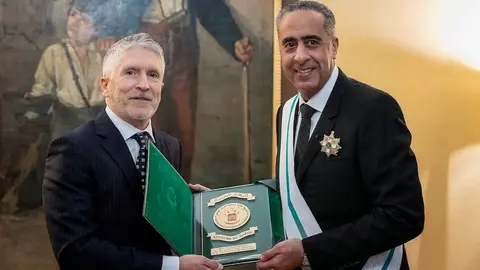
Internationally, Morocco is the United States' priority partner for Africa, with which it conducts the AAfrican Lion manoeuvres. Likewise, manoeuvres with agents from the Spanish National Police and Civil Guard have been a constant feature in recent years.
لقطات من عرض الطائرات المسيرة المضيئة الذي أقامته المديرية العامة للأمن الوطني احتفاءً بفعاليات الدورة 93 للجمعية العامة للأنتربول، التي يحتضنها فضاء "حدائق المنارة" بمدينة مراكش خلال الفترة 24-27 نونبر 2025. pic.twitter.com/8NBwBRdAu8
— DGSN MAROC (@DGSN_MAROC) November 25, 2025
Cybercrime situation and legal framework in Morocco
On numerous occasions, Morocco has emphasised that its police forces operate transparently, respecting data protection and ensuring compliance with interoperability standards (conditions that guarantee more adequate and rapid anticipation).
Since Hammouchi's arrival, cybercrime has increased by 40% globally. However, in Morocco, 95 out of every 100 criminal acts have been solved, placing Rabat among the countries with the best rates worldwide.
In addition, as revealed by Boubker Sabik, spokesperson for the Directorate General of National Security (DGSN), Morocco is updating its legal framework to give its intelligence services more capacity, which has led to the arrest of 70 cybercriminals wanted by INTERPOL. These achievements led Hammouchi and Morocco to the vice-presidency of INTERPOL for Africa.
Memorandum of Understanding between Morocco and Ethiopia
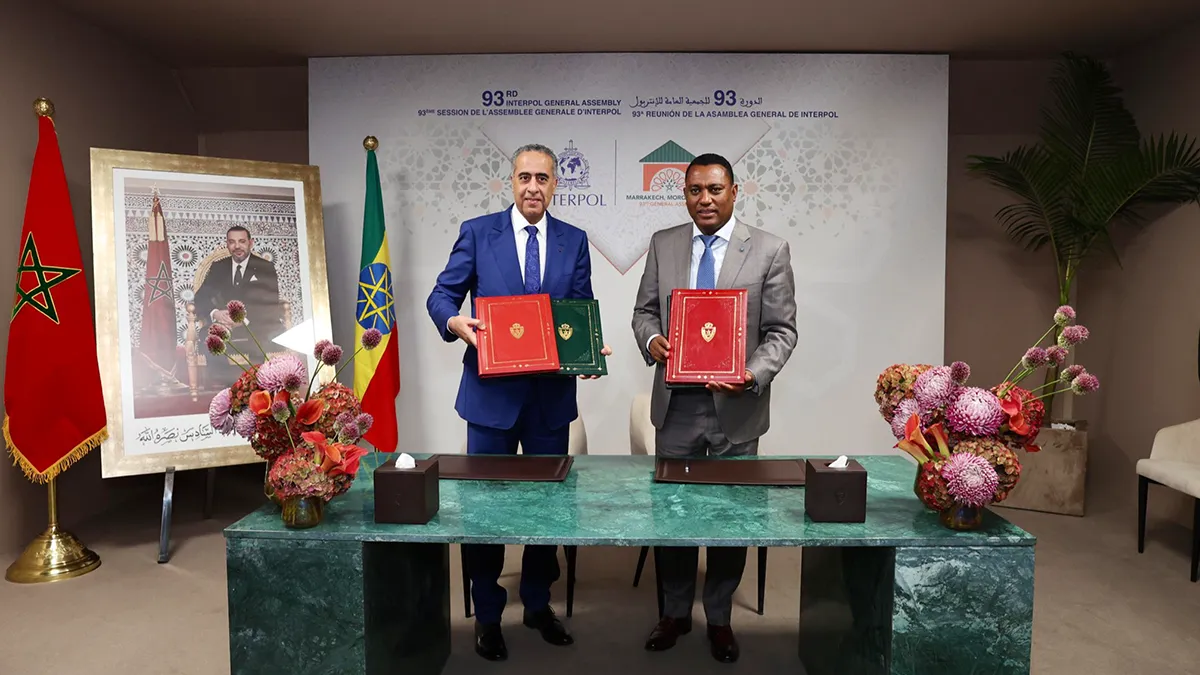
In the context of the GA, Morocco and Ethiopia signed a significant bilateral agreement in the form of a Memorandum of Understanding (MoU) between the Director General of National Security and Territorial Surveillance, Abdellatif Hammouchi, and the Commissioner General of the Ethiopian Federal Police, with the aim of increasing and improving the fight against violent crime, modern slavery, arms trafficking, criminality and money laundering.
Ethiopia is the most important country in the Horn of Africa in terms of border control and counter-terrorism. Its decision to draw on Morocco's experience highlights Rabat's growing influence on the continent.