Japan puts a woman at the head of the government for the first time

- Election of Sanae Takaichi as Prime Minister
- Profile of Sanae Takaichi and economic policy
- Political alliances to implement reforms
- International agenda and relations with the US and China
- Internal and demographic challenges
This is a huge change in a country that, despite ranking fourth in the world in terms of economic power, maintains a tight grip on its most ancient traditions. One of these traditions, and not the least important, is the preference for men in the vast majority of strata of Japan's insular society.
Election of Sanae Takaichi as Prime Minister
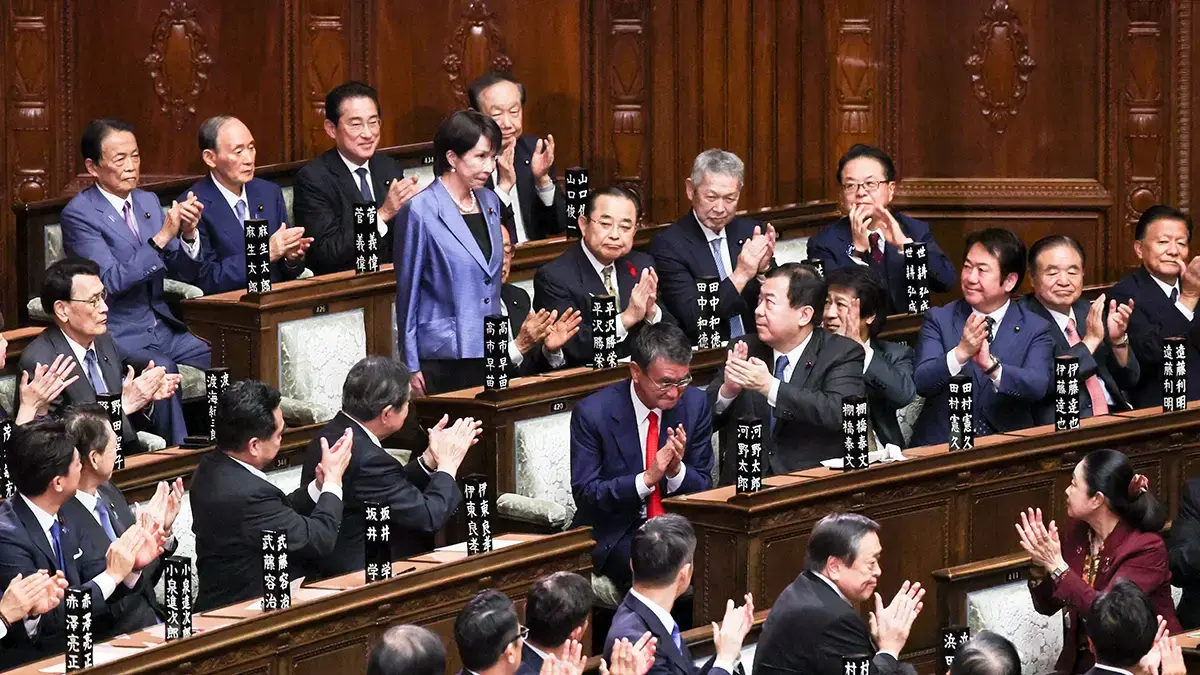
Thus, after being elevated to the presidency of the Liberal Democratic Party (LDP), Sanae Takaichi was elected Prime Minister of Japan by the Lower House of the Japanese Parliament on Tuesday, following intense negotiations that were resolved at the last minute. The reason for such laborious negotiations lies in the fact that the long-standing LDP, which has governed Japan almost uninterruptedly since 1955, had lost its absolute majority in both houses of Parliament due to a financial scandal that has meant that, including Takaichi, Emperor Naruhito has had to endorse five heads of government in the last five years.
The country's political turmoil worsened throughout this year, when the LDP's traditional ally since 1999, the centrist Komeito party, decided to break the coalition for fear that the financial scandal would tarnish it more than it should.
Profile of Sanae Takaichi and economic policy
An admirer of Margaret Thatcher, the British Iron Lady, Sanae Takaichi has also cultivated an image of firmness.
Launched into politics by the most popular head of government in modern Japanese history, Shinzo Abe, Takaichi has promised to follow his lead in planning massive public investment to revive a faltering economy, at a time when the global context, and especially Asia, is embroiled in a fierce economic and financial war for supremacy. Far from welcoming her with reservations, the financial media, and in particular the Tokyo Stock Exchange, have experienced spectacular optimism and a spectacular rise with her appointment.
Political alliances to implement reforms
The first glimpse of the determination of this 64-year-old woman has been to secure the political agreement that has enabled her election with a clearly reformist party, the Japan Innovation Party (Ishin), which advocates precisely massive new investment to enable Japan to regain the ground it has lost in technology compared to China and even South Korea.
The first and most visible of the innovations that Takaichi will introduce is the formation of a ‘Scandinavian-style’ government, i.e. with many more women than the two who have sat on the Council of Ministers until now, and where the one with the greatest responsibility will be Satsuko Kitayama, promoted from her current ministerial portfolio of Regional Revitalisation to that of Finance. The new prime minister also advocates increasing the proportion of women in the Japanese Parliament, which, with only 15% women, is one of the least gender-balanced in Western democracies.

International agenda and relations with the US and China
Her first major international test will come next week, with the visit of US President Donald Trump, who will spend three ‘long’ days in Japan after attending the decisive meeting of the Association of Southeast Asian Nations (ASEAN) in Malaysia, just as China continues to demonstrate its hegemonic aspirations on the continent, and especially in the maritime geopolitical environment that surrounds it.
Traditionally very combative in her rhetoric, the new head of the Japanese government has toned down her aggressive discourse on China and has made the highly significant gesture of not visiting the Yasukuni Shrine, considered by the Chinese and Koreans to be a symbol of bloody Japanese imperialism.
Internal and demographic challenges
On the domestic front, in addition to massive financial investments, the first woman to head the government will have to tackle the country's severe demographic decline and introduce reforms that will lead to greater gender equality in society and solve the problem of an ageing population and the filling of both vacant and newly created jobs by immigrants, whom Japan only allows in dribs and drabs.