Spain and Morocco consolidate agreements for a more stable and secure Atlantic
Spain and Morocco are at a decisive moment in how they manage two key areas for regional stability: the Atlantic sea off the Canary Islands and the airspace over the Sahara
- A new approach to the Atlantic maritime space
- Monte Tropic: minerals and opportunity for cooperation
- Saharan airspace
- The Atlantic as a symbol of stability and shared prosperity
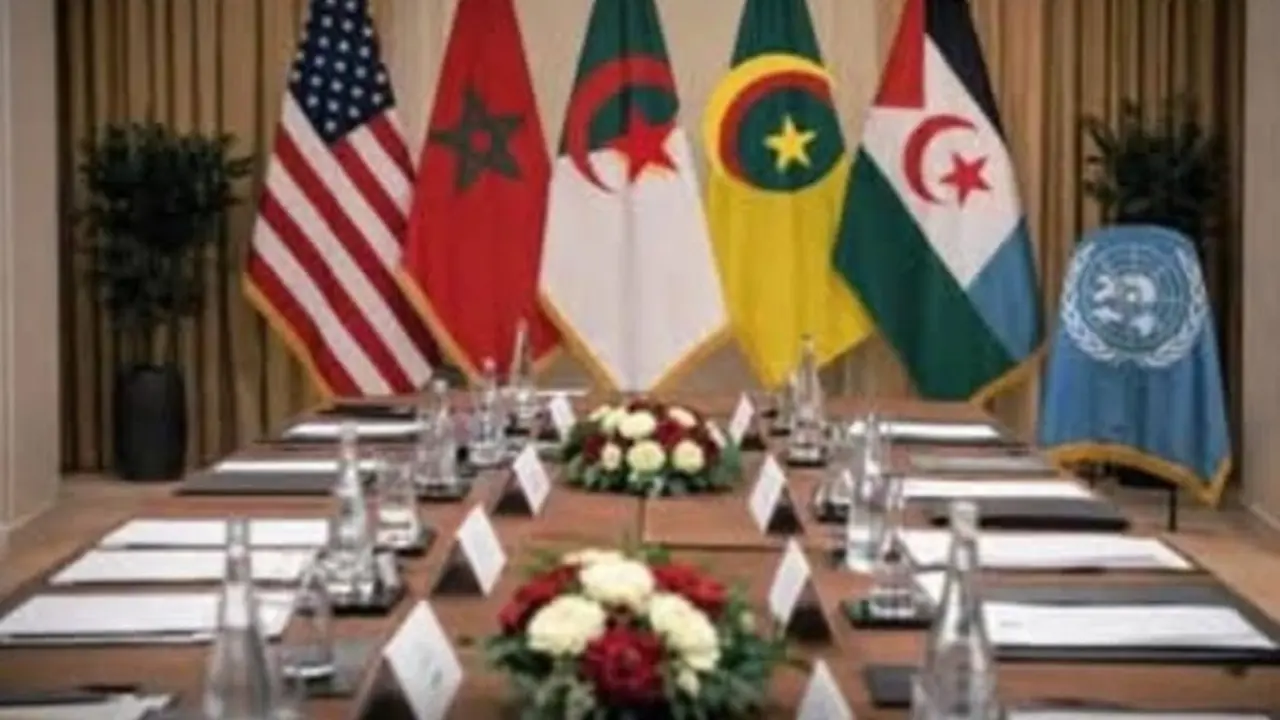
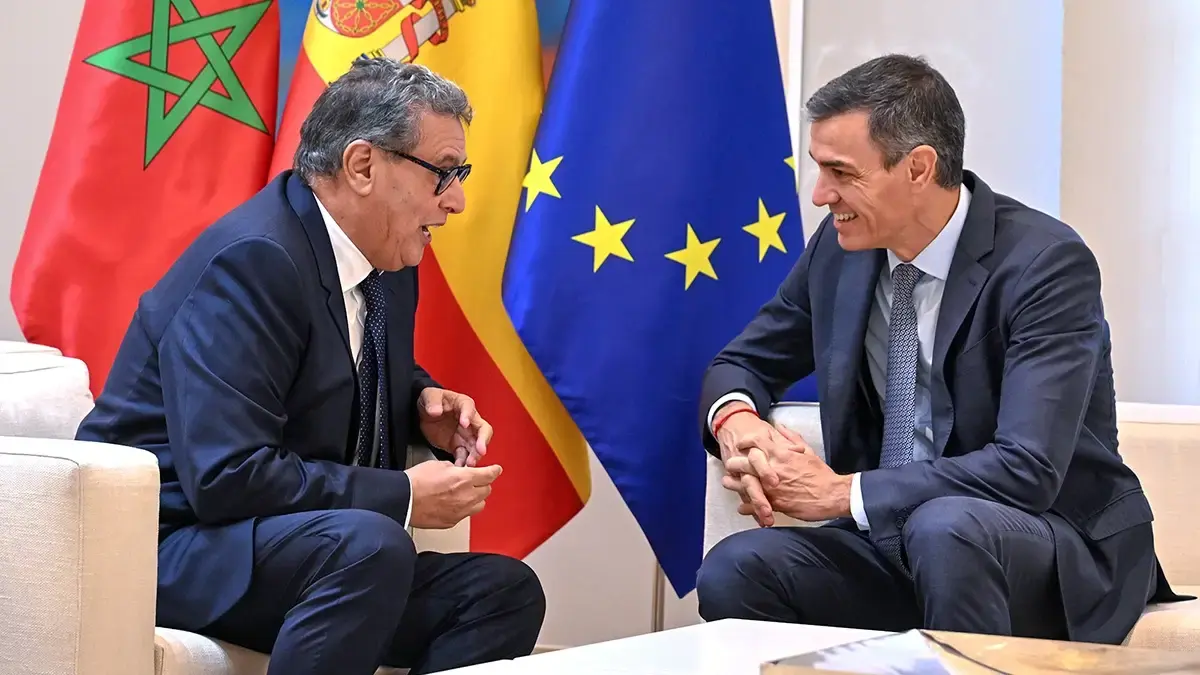
Historically, the Sahrawi question and the Canary Islands have been fraught with political and legal sensitivities and opinions. However, based on the current relations between the governments of Spain and Morocco – meeting today in Moncloa as part of the 13th High Level Meeting (RAN) – cooperation and equity are the terms that best encapsulate the current dynamics.
The legal frameworks behind maritime and airspace are fixed and clear. However, as Daniel Abascal pointed out in his article published on 23 November, consensus can only be achieved ‘when both parties accept that understanding does not come from imposition, but from equanimity navigated with patience’. This perspective fits in with current bilateral relations.
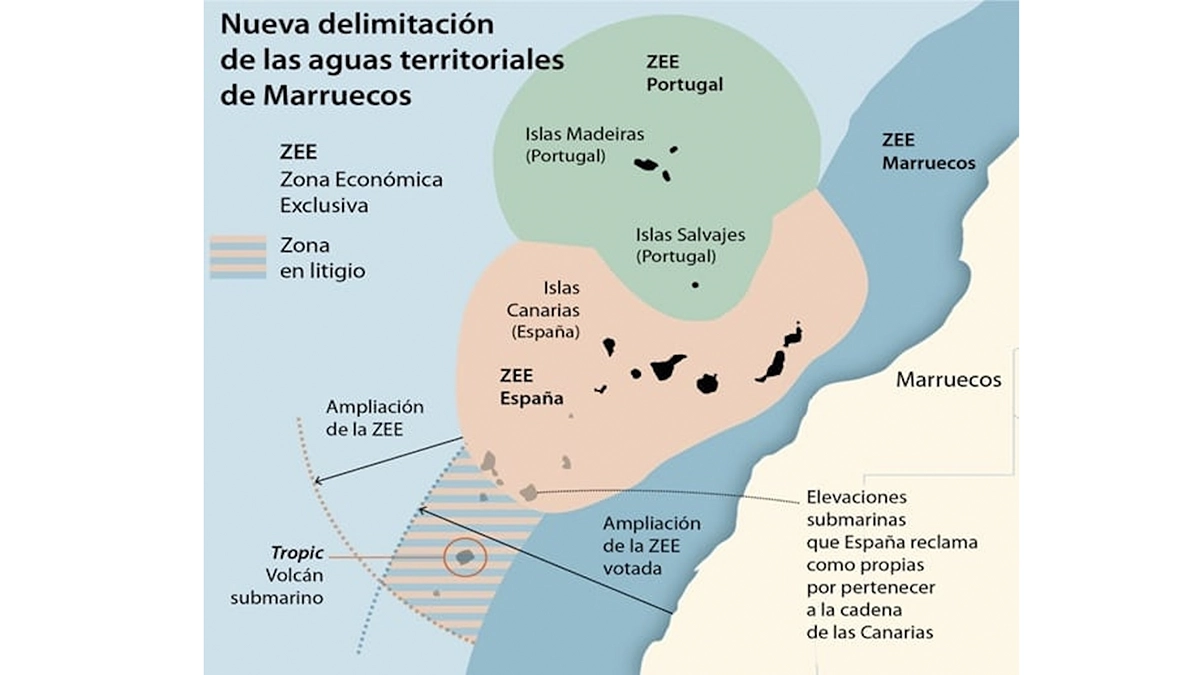
A new approach to the Atlantic maritime space
The lack of clarity between maritime and airspace boundaries has been a reality for decades, but changes in current geopolitics have reignited the debate, especially following the United Nations' decision to announce that Morocco's Autonomy Plan for Western Sahara would be used as a basis.
The great potential for investment in energy has fuelled the controversy over the need to reach agreements on these areas, which will be negotiated.
Morocco maintains that its space should be larger and that, therefore, the current boundaries do not reflect the enormous inequality between the Canary Islands archipelago and the more than 3,500 kilometres of coastline. Spain, for its part, bases its position on the legal security of the Canary Islands and the boundaries established in 2010, which were not requested by the Moroccan authorities.
And this is where both administrations seek to maintain a dialogue based on geopolitical balance and concessions from both sides in order to reach a mutually beneficial agreement.

Monte Tropic: minerals and opportunity for cooperation
Monte Tropic has become the topic of the week and has taken on broad symbolism across the political spectrum. The key: the strategic minerals found there, despite the fact that, in the short term, their extraction is not at all viable, an aspect that reduces or deactivates the urgency and relevance that this issue has gained in the last week.
UNCLOS (United Nations Convention on the Law of the Sea) in its Article 83.3, invites States to avoid unilateral actions in areas of possible continental shelf overlap. In other words, it states that the parties involved must collaborate in joint studies so that, when the time comes, shared exploitation mechanisms can be established.
Saharan airspace
For decades, the management of airspace over the Sahara has been the responsibility of the Gran Canaria control centre. However, in the current political context, Morocco's responsibility for this is increasing.

Despite the political noise, the challenge of delimitation – including that of Monte Tropic – is more technical than political. Setting aside interests, the prevailing premise must be the safety of the space. To this end, Morocco and Spain have shared protocols at the highest level and total coordination.
It is therefore important to emphasise that the new boundaries that may emerge from the talks between Spain and Morocco are not intended to displace anyone, but rather to adapt to the new reality with a strengthening and increase in security as a basis.
The Atlantic as a symbol of stability and shared prosperity
A shared vision of the Atlantic must be the focus of the negotiations. In addition to the technical details – which are very important in this matter and should not be overlooked – the Atlantic should be seen as an area of shared responsibility and stability between Madrid and Rabat.
In this context, both countries have made it clear that silence wears thin. That is why terms such as equity, prosperity and trust must be the basis for dialogue.
Relations between Spain and Morocco have led to the signing of major agreements, which did not come about out of nowhere, but rather from years of diplomatic work and efforts by both countries.
The challenge is clear, and Daniel Abascal summed it up perfectly: ‘true balance comes from shared responsibility’.