Gorka Espiau: ‘More than the jobs you create, you need to know if you are changing lives’
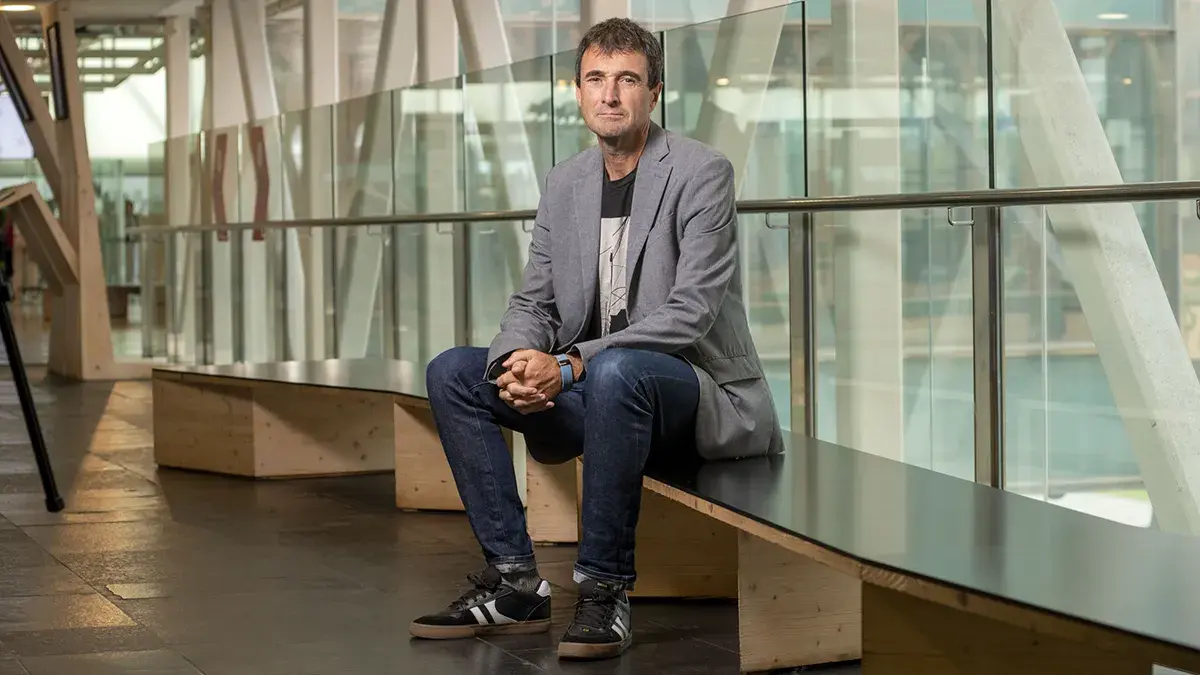
Gorka Espiau advocates a different approach to development challenges: with real innovation, local participation and joint learning. With a PhD in Social Sciences, he is the director of the Agirre Lehendakaria Centre (EHU), an advisor to the European Commission and scientific director of Work4Progress, a programme run by the International Area of the ”la Caixa” Foundation that contributes to the creation of quality jobs in rural areas of Colombia, India, Mozambique and Peru for women and young people. We spoke with him in Barcelona, where he attended the programme's annual meeting and moderated a round table on digital social innovation.
What distinguishes Work4Progress from a traditional cooperation programme?
The Western approach to cooperation—thinking that we bring solutions to places that don't have them—is still in place, even though we know it no longer works. And that logic creates inequality. Work4Progress is conceived as a platform for social innovation, a space for joint learning where all actors contribute and learn, where the common good is sought. It is not about implementing isolated pilot projects whose results are difficult to scale up, but rather about carrying out interconnected innovation experiences.
The term innovation is often used, but not always understood. How would you define social innovation?
Social innovation emerges as a response to a reductionist view of innovation focused solely on technology or business. It is about responding differently—and better—to current or emerging social needs through new products, services or processes. What interests us is how societies learn to respond collectively to complex problems, in our case the generation of employment in rural areas. The innovation that interests us goes to the root of the problem; it does not seek quick results or successful start-ups, but rather a real impact.
Can you give us some examples?
In India, we work with a cooperative that offers safe transport to women to avoid unsafe situations on their way to work. They buy their own vehicles—electric rickshaws—and provide a taxi service designed specifically for women, which solves a clearly identified problem. In Peru, we put agricultural producers in touch with Michelin-starred chefs. Their production processes improved to adapt to the needs of restaurants. Today, some of their products, such as cheese, can be purchased at the restaurants of Peruvian chef Gastón Acurio.
‘You have to understand the needs from within. No project that is not built from within the communities will work.’
You work in very different countries. How do you manage to bridge cultural differences?
What we have discovered is that the differences between countries are not so great because the challenges are similar. For example, one of the main problems in generating employment in rural areas is that young people do not want to stay in the countryside, which is the case in Mozambique as well as in Catalonia or the Basque Country. That doesn't mean you don't have to build interaction mechanisms adapted to each culture, but with the same goal: to understand needs from within. No project that is not built from within communities will work.
How do you ensure people's participation?
We collect local narratives — problems, aspirations, opportunities — and organise them into ethnographic profiles that reflect the ways in which different groups see reality.
This allows us to know whether an initiative is aligned with the perceptions of the community. Sometimes their ideas do not match the objective data, but these perceptions have a greater influence on the success or failure of a project than the circumstances themselves because reality is socially constructed. Work4Progress has generated a lot of interest because it has a very systematic way of incorporating this cultural dimension into development processes.
The challenge now is to know how to take advantage of digital tools so that this listening and joint creation are more agile and we can obtain more information. And here, the ”la Caixa” Foundation has made a strong commitment that could be a benchmark on a global scale.
‘Artificial intelligence will allow us to simulate intervention scenarios in specific areas, such as the Andean regions of Peru.’
What does this commitment consist of?
We have digitised the information on all our projects, which will allow us to apply artificial intelligence to better analyse what is happening and run simulations. For example, we will be able to interact with a bot that represents the specific aspirations of young women in the state of Uttar Pradesh, India, and ask them if an initiative makes sense for them. We will also be able to simulate intervention scenarios in specific areas, such as the Andean regions of Peru. It is not a question of replacing human work, but of complementing it and improving decision-making. We believe that it is necessary to integrate these types of technologies in a more ambitious way.
To what extent is it safe to use these technologies in the global south?
We have realised that in these countries, the needs are so urgent that technology is adopted quickly, without much thought for the side effects. In the North, there is more caution. The ideal is to find a balance: to use the tools with a critical awareness.
Technology does not fix everything, but we must recognise that it creates opportunities. Thanks to it, for example, we can learn from each other. From the North, we can see how these technologies are being applied in the South and how they can be scaled up. And in the countries of the South, practical solutions are being developed that handle large volumes of data and therefore need infrastructure that is currently located in the North, such as the Barcelona Supercomputing Centre. The important thing is to generate this collaboration from the outset in terms of horizontality.
Would you say that traditional cooperation is outdated?
The sector has structural problems: lack of resources, obsolete funding models and competition between entities that prevents collaboration. We replicate in cooperation the logic of traditional consulting that seeks efficiency in management, but that distances us from our main objective: impact.
Some entities are already making a transition towards platform logic, trying to connect with other actors, generate spaces for experimentation and incorporate open innovation. The same is true of donors. Some continue with the old logic of counting how many jobs a programme generates without analysing the context, while others are beginning to look at the impact it has on the entire system.
‘Today, the European Commission's top priorities are competitiveness and resilience. For us, there is no competitiveness without social innovation.’
The political context does not favour change: there is more interest in competitiveness than in social investment.
Today, the European Commission's top priorities are competitiveness and resilience. For us, there is no competitiveness without social innovation. There is a lot of scientific evidence to support the idea that a system is not competitive if it generates large social inequalities, if it is not sustainable from the point of view of human development. On the other hand, we must bear in mind that resilience also has to do with the generation of social capital: if we want to be resilient, societies must increase their collective response capacity in any crisis situation.
Therefore, issues such as cooperation, social innovation, competitiveness and resilience must be addressed at the same table. They are often discussed separately: the ‘serious table’ of governments and businesses, and the ‘social table’ of foundations and NGOs. This separation is outdated. For us, it is very important that programmes such as Work4Progress demonstrate that they can contribute to competitiveness and resilience with strategies that are more interesting than those proposed in traditional terms. It is a battle that is being fought in the realm of ideas, but it will be important in the coming years.
In this environment, how can innovative initiatives be financed?
The financing model based on the myth of Silicon Valley — brilliant people, lots of money, magical solutions — continues to dominate, even though there is no evidence to support it. It is an extractive model that concentrates resources and generates inequality. We must question this archetype. Philanthropy such as that of the ”la Caixa” Foundation is key, but insufficient on its own. I believe that in the coming years we will see connections between the public, private and community sectors in which entities and institutions will act as integrators, not as sole solvers.
‘To innovate, we need radicalism and balance: solutions that go to the root of the problem, but are well designed and do not generate negative effects.’
What challenges lie ahead for the Work4Progress programme?
Right now, managing success. We started as a small experimental pilot project, intended as a test, but the results have been very positive. This forces us to be more rigorous in the way we work and share knowledge. We need to be very clear about what has worked and why.
We need to focus more on impact: not just how many jobs have been created, but what kind of jobs, how they affect families and communities, whether they empower women and young people, whether they break down structures of inequality... Counting jobs is fine, but the important thing is to understand whether those jobs change lives.
Are there reasons for optimism?
It depends on the context. In the north, there is a lot of despair, fear of losing well-being. In the south, there is more openness to change because there is not as much to protect. To innovate, we need radicalism and balance: solutions that get to the root of the problem, but are well designed and do not generate negative effects. Day-to-day life can sometimes be difficult, but seeing communities with fewer resources who believe that change is possible makes you think that there are reasons to keep going. The global south reminds us that our fears are linked to our privilege. And that forces us to act.