
Between weapons and narratives: philosophy of a world on the brink of conflict

Today, the world is not experiencing temporary tensions or diplomatic hesitations, but rather a process of radical reconfiguration of global consciousness, marked by fire and blood.
Germany announces an increase in its defence budget and the number of soldiers, as if declaring the death of the traumas of the Second World War and repositioning itself as a central and armed player. France, for its part, is testing mobilisation plans as if recalling 1914 and 1939, as if Paris understood that the era of European complacency is over. Britain is raising its defence budget to its highest level since World War II, a decision that is not economic, but rather a recognition that the days of naval and financial supremacy are over and that ‘military protection’ is now the guarantee of international survival.
Turkey, obsessed with its historical place, is racing against time to develop its military industry and build shelters, aware that what is coming will leave no room for neutrality. China, with its cold restraint, reveals terrifying nuclear weapons, sending a silent but resounding message to the Western world: ‘We are not just the factory for your goods, we are the factory for the possible end.’ Russia bluntly announces that its missiles can reach all European capitals in minutes, challenging NATO: ‘Come closer and see what we will do.’
Meanwhile, the United States abandons the mask of diplomacy and changes the name of the Department of Defence to the Department of War, a return to its essence since 1945, recognising that what lies ahead will not be defence, but offensive warfare to reconfigure the world.
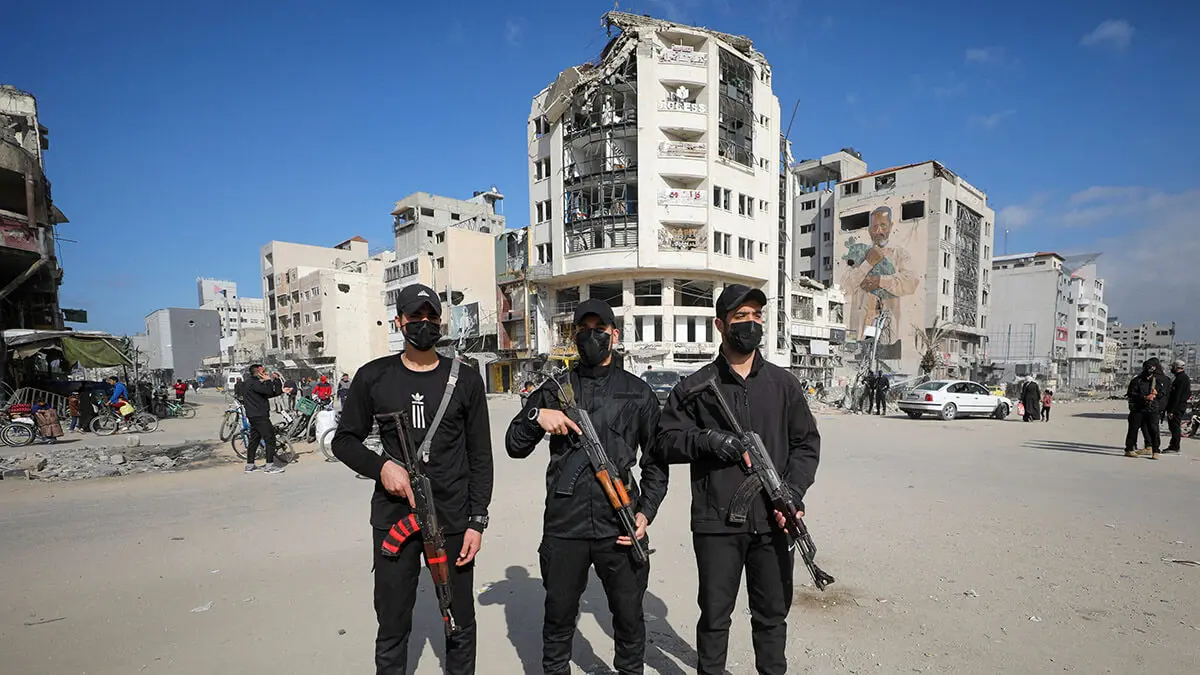
These events are not isolated, but episodes in the same sequence, whose threads converge in a small epicentre called Gaza. Gaza, still under a war of extermination, is not just a territory; it is a mirror reflecting the collapse of all narratives. The Israeli narrative has collapsed in the face of collective Western consciousness, and for the first time since 1948, the Western media can no longer spread lies without facing a mass awakening. Gaza ceases to be just a Palestinian cause and becomes the central node that reveals the fragility of the international system and exposes Western hypocrisy.
In terms of collective psychology, when the masks suddenly fall, a feeling of chaos arises and the impulse to rebuild a new order at any cost. This scenario shows that the West is rearming not only to confront Russia or China, but to confront the collapse of its internal legitimacy. Europe fears internal revolutions in the face of inflation and power struggles, and the United States fears the collapse of its financial empire, returning to its old strategy: militarising the world.
But the conflict is not only political; it is civilisational and psychological. Today, the world is divided between two levels of consciousness: an old one that sees security in more weapons and nuclear deterrence, and a new one, born in the streets that cry out for Palestine, in university students who challenge media and political lobbies, in millions who watch massacres from their phones without intermediaries. This new consciousness is the most profound threat to the system, because it lays bare the fragility of the global balance and demonstrates that no weapon can dominate an idea.
It is the same time that Hobbes described as ‘the war of all against all,’ but today it translates not only into state conflicts, but also into clashes of narratives. The West is rearming its armies, Russia is flexing its muscles, China is threatening with its nuclear power, and the Middle East is oscillating between the wounds of Gaza and their repercussions. But beneath the surface there is a deeper conflict: who has the right to define justice? Who has the right to narrate the truth?
Systems declare their readiness for war, but people are discovering that the great war is already underway: it is the war of consciousness. Gaza is not just a victim; it is revealing. It has exposed Europe's contradictions between values and convenience, showing that the democracy taught in Western universities collapses in the face of lobbies that decide who lives and who dies. For this reason, it can be said that Gaza is the university that teaches the world the meaning of resistance, demonstrating that a devastated city can expose the fragility of an entire civilisation.
History reminds us that arms races do not prevent war; they accelerate it. Before the First World War, Europe was engaged in a similar arms race; before the Second, countries invested in arms factories with the same logic: deterrence guarantees peace. But deterrence did not prevent the explosion; it precipitated it. Today, the scenario is repeating itself: armament, hate speech, global divisions and a small epicentre: Gaza.
La historia nos recuerda que las carreras armamentísticas no previenen la guerra; la aceleran. Antes de la Primera Guerra Mundial, Europa vivía una carrera armamentística similar; antes de la Segunda, los países invertían en fábricas de armas con la misma lógica: la disuasión garantiza la paz. Pero la disuasión no impidió la explosión; la precipitó. Hoy se repite el escenario: armamento, discursos de odio, divisiones globales y un epicentro pequeño: Gaza.
What makes this stage more dangerous is that technology has brought war into the global consciousness. Drones, artificial intelligence, intercontinental missiles and digital media have blurred borders. The war in Ukraine is no longer just European; it is global by proxy. The war in Gaza is no longer just against a small people; it is against truth itself.
Perhaps that is why we see everyone sharpening their knives: they know that the post-1945 global system is collapsing, and that what is coming will not only be a redistribution of power, but a redefinition of the human being: who deserves to live? Only white Westerners, or does Palestinian blood have the same value on the new scales of justice?
The world, therefore, is not only preparing for a military disaster, but for a collapse of meaning. When meaning collapses, weapons become the last language. But amid all this noise, the voice of Gaza remains like embers under the ashes: reminding us that ideas cannot be defeated, that an alternative narrative has already been born, and that popular consciousness has the power to reconfigure the future.
It may seem that the world is moving towards enormous historical clashes, but perhaps these clashes are a birth of change rather than a death. As Nietzsche taught us: ‘One must have chaos within oneself to give birth to a dancing star.’
Abdelhay Korret, Moroccan journalist and writer