
Western Sahara: after 51 years of deadlock, the time has come for realism
- The status quo as political capital
- Resolution 2797: an explicit call for realism
- The role of the Sahrawi Movement for Peace
- Leaving illusion behind, embracing responsibility
Fifty-one years have passed since 1975, leaving behind a heavy human legacy: prolonged exile, lasting social dispersion and a progressive rupture between several generations of Sahrawis and their natural, cultural and political environment.
This long period of time forces us today to ask ourselves an essential question that is too often avoided: what has more than half a century of confrontation and deadlock actually achieved? The conclusion is hardly debatable. There has been neither a mass return of displaced populations nor a credible prospect of a definitive solution. On the contrary, an immutable status quo has been established, to the direct detriment of the populations affected.
The Sahrawi people, with their Bedouin tradition, have never been an enslaved people seeking liberation. Their relationship with freedom was historically rooted in a way of life based on mobility, autonomy and an organic connection with the land. However, over the decades, this anthropological reality has been overshadowed by rigid ideological constructs, often disconnected from global transformations and regional balances.
Thus, entire generations have been born and raised in refugee camps, far from the land, from transhumance and from the cultural references that structured Sahrawi identity. This reality raises a question of political responsibility: can the same schemes continue to be proposed to a society profoundly transformed by prolonged exile?

The status quo as political capital
Experience shows that the status quo benefits neither refugees, nor separated families, nor Sahrawi youth deprived of future prospects. Rather, it tends to fuel political capital, in which the perpetuation of the conflict becomes a source of legitimacy in itself.
The exclusivity of representation and the denial of Sahrawi plurality have contributed to hardening the dossier and reinforcing its diplomatic isolation. The so-called ‘definitive’ solutions, repeated for decades without taking into account the real balances, have proven incapable of opening up a credible perspective.
Resolution 2797: an explicit call for realism
It is precisely this deadlock that the United Nations Security Council is seeking to overcome through its successive resolutions and, most recently, through Resolution 2797, which reaffirms the primacy of a realistic, pragmatic and lasting political solution based on compromise.
This resolution is in line with the UN's ongoing approach, which now gives priority to negotiated solutions anchored in the realities on the ground, rather than theoretical options that are difficult to implement. It explicitly calls for an end to the deadlock and for the exploration of avenues that could put an end to the prolonged human suffering.
In this context, the proposal for autonomy appears to be one of the serious options that meet the criteria of realism, stability and local governance promoted by the Security Council. Far from being a simple administrative formula, it opens a concrete debate on the capacity of the Sahrawi people to manage their affairs, preserve their identity and participate fully in political life, within an internationally recognised framework.

The role of the Sahrawi Movement for Peace
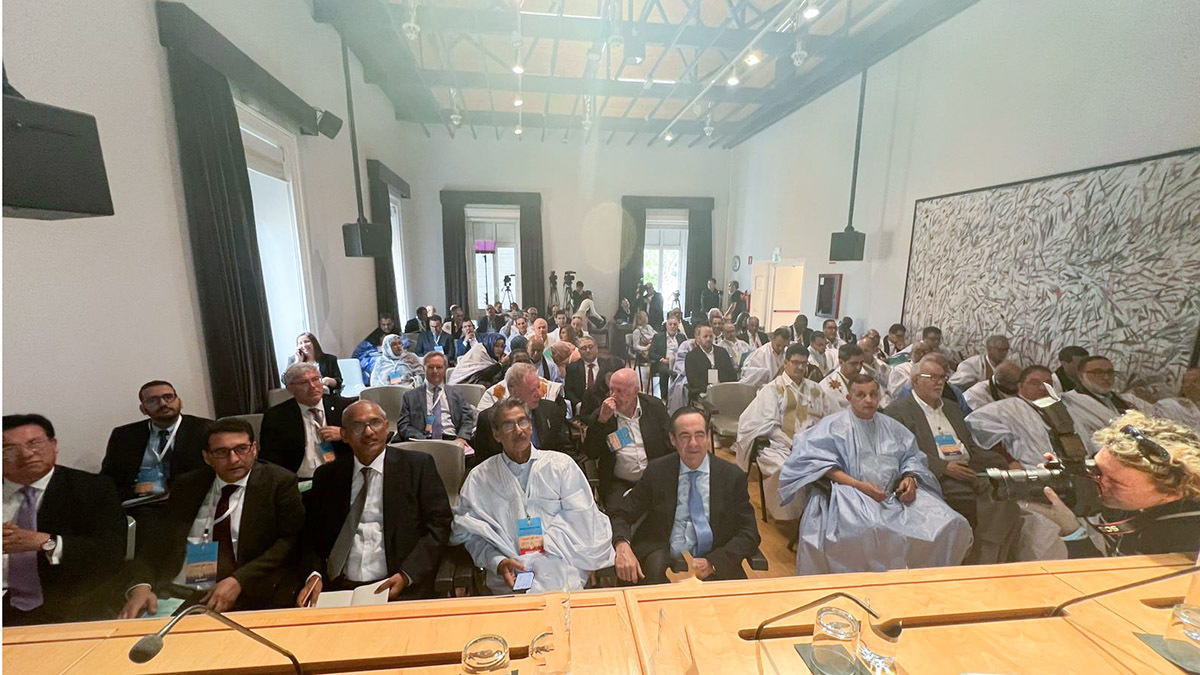
The initiative of the Sahrawi Movement for Peace (SMP) is part of this dynamic. The SMP, an emerging Sahrawi actor, breaks with the logic of political exclusivity and proposes an internal reading of the conflict, based on dialogue between Sahrawis, recognition of the diversity of sensibilities and adherence to a peaceful solution in accordance with UN parameters.
By taking autonomy as the basis for discussion, the SMP does not renounce Sahrawi identity; on the contrary, it seeks to preserve it in the face of erosion caused by prolonged exile. Its approach is based on a simple conviction: realism is not surrender, but a choice of responsibility towards present and future generations.
There is one inescapable fact: those who were adults at the start of the conflict are now over seventy years old.
Biological time no longer coincides with diplomatic time. As for the Sahrawi youth born in exile, they aspire less to slogans than to concrete prospects for stability, mobility and dignity.
Continuing to postpone any solution is tantamount to accepting the normalisation of exile and the progressive loss of identity references. In this sense, the year 2026 could mark a turning point, not because of a renunciation, but because of a courageous reassessment of the options that are actually available.
Leaving illusion behind, embracing responsibility
The Western Sahara conflict is not lacking in narratives, but it is lacking in solutions. At a time when the international community is calling for realistic solutions, ignoring Sahrawi initiatives in favour of compromise would be a strategic and moral mistake.
The question is no longer who is historically right, but how to end prolonged suffering, in accordance with United Nations resolutions, in particular Resolution 2797. From this perspective, inclusive dialogue, the option of autonomy and the involvement of pluralistic Sahrawi actors such as the SMP are today credible levers for breaking the deadlock that has lasted for more than half a century.