
India and the three hundred-year-old communists

When, in the 4th century BC Alexander's soldiers told him they were tired and wanted to go home, a young ally and admirer of the Macedonian, Chandaputra Maudyan, took control of the Ganges basin and established dynastic pacts with Seleucus, the conqueror's successor in Persia, Mesopotamia and Central Asia, to extend his rule to the territories of what is now Pakistan and Afghanistan. His grandson, Asoka, completed the Maudyan empire after a bloody campaign against the Kalinga kingdom, which dominated the east coast of India.
At the end of the war, which left 100,000 dead and 150,000 displaced, the young Asoka was dismayed by the suffering he had caused and asked for forgiveness. He converted to Buddhism and built a peaceful empire that was tolerant of minorities and different beliefs. 250 years after Siddhartha had become the Buddha when he understood that the essence of human beings lies in compassion for the suffering of our fellow human beings, Asoka's government spread Buddhist wisdom and promoted education, respect and spirituality.
The cultural and historical influence of India is summarised by William Dalrymple in his recent publication, The Golden Road. It dates back, for example, to the first Mesopotamian Empire of Sargon of Akkad (2500 BC), where archaeology has found countless remains confirming exchanges with Hindu peoples. It crosses the Himalayas to China and the mountain ranges of Central Asia. It travels across the Indian Ocean and the Red Sea in trade with the Roman Empire. It branches out into Indonesia and Indochina, where Hinduism strengthens the arts of peoples and empires such as the Khmer in Cambodia. It transferred its knowledge of mathematics, astronomy and medicine to the Abbasid caliphs of Baghdad from the 8th century onwards. And with the help of Islam, it reached Cordoba and Toledo so that the Spanish, and later the rest of Europe, could incorporate numbers, of Indian origin, and the decimal system to develop accounting, trade and banking.
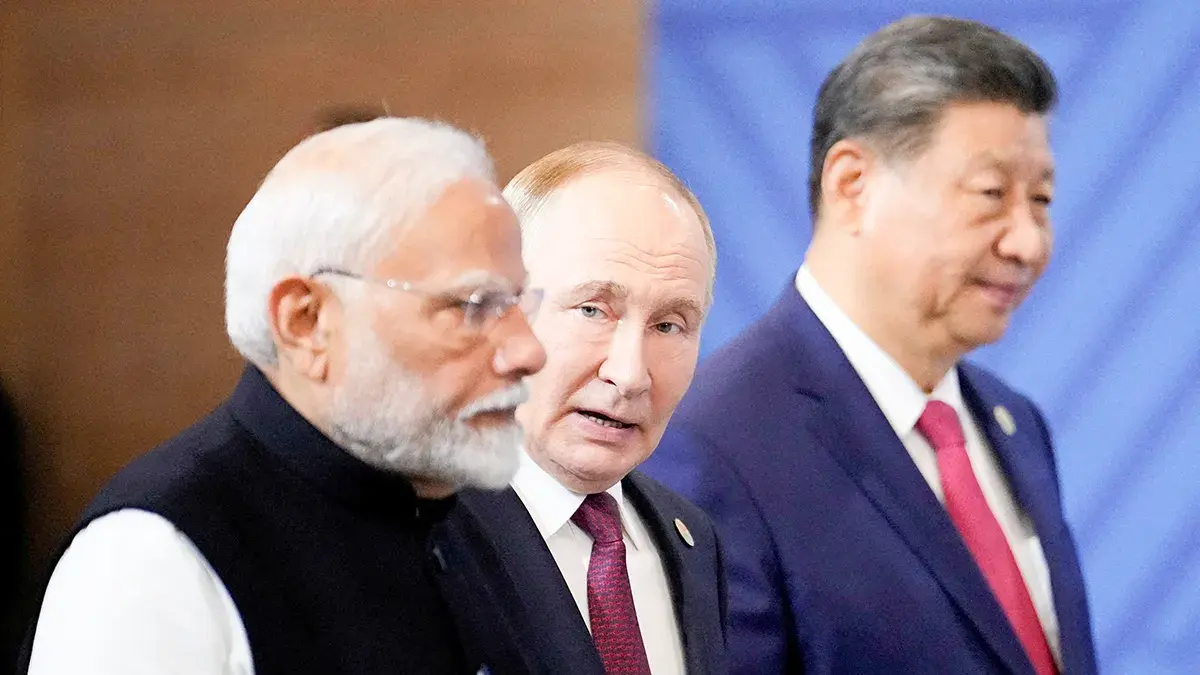
With this historical showcase behind him, it is not surprising that Narendra Modi was not interested in attending the meeting of the three leaders descended from communism in the 21st century, Xi Jinping, Vladimir Putin and the last representative of North Korea's hereditary tyranny, renamed a few years ago by Donald Trump as Little Rocket Man. Nor was he interested in participating in the lively conversation the three autocrats had about extending life, and therefore power, beyond 150 years. Quite a challenge.
However, Modi did attend the summit of the Shanghai Cooperation Organisation a few days earlier, promoted by Russia and China and including Central Asian countries from the former Soviet sphere and Belarus, as well as others such as Iran and Pakistan. With no clear strategic objective beyond serving as an instrument of cooperation for the weakening of the liberal order, the SCO invited India to join in 2017, thanks to pressure from Putin. Among other reasons, this was to build an image of tripolar strength against the West and the United States. Recalling, who knows, that other tripolar photo when the Russian leader sat between Chirac and Schroeder, with the aim of weakening the Euro-Atlantic alliance against the backdrop of the Iraq war. At that time, he used the Arctic energy exploitation project to integrate the French oil company Totalfina and Gazprom's gas to cajole the Germans. And when Europe understood the real objectives of that entente, to break up Ukraine and the European Union, the Russian strategy was reoriented towards a different and even more uncertain environment.
This is because the apparent understanding between Russians, Chinese and Indians is very weak in historical and geopolitical terms. India's prosperity became part of the liberal order at the end of the Cold War, when it became one of the emerging economies after 30 years of economic isolation, poverty and war tensions. Shortly before, a newly independent India had been integrated into the picturesque idea of the Third World, developed by the elegant communist leader Zhu Enlay, to seek some international coherence for Chinese policy. But the common thread of that space, distinct from that of the two superpowers, was none other than the poverty and underdevelopment of the countries that attended the Bandung Conference in 1955. In those years, India, equally lost in the global sphere, flirted with the USSR, openly confronted Pakistan and China on its borders, and was dying of hunger. Its democracy and reorientation towards global markets saved it from the slavery of poverty. Any memory of that time is worse for Indian society than colonisation itself.
In geopolitical terms, the Shanghai organisation presents nothing but uncertainties for the Indian government and interests. Firstly, because the multipolarity that its partners want to promote is not seen in the same way by Indians, Russians and Chinese. India advocates a quadripolar future, which includes the United States and where its role is more relevant. Meanwhile, in China (Yan Xuetong), Russia is considered a regional power and India a sub-regional one; therefore, China's relationship with the US is more bipolar than multipolar. Russia, for its part, continues to think about rebuilding Soviet spheres of influence to gain strength. The good relations between Pakistan and China also cast a shadow over India's future.
Secondly, with these perspectives in mind, Modi has built a network of relationships to position his country in various international frameworks and alliances. From the QUAD, designed to protect the waters of the Indo-Pacific together with the United States, Japan and Australia, to the BRICS, increasingly crowded with emerging economies, also with different interests. India buys and sells arms, technology and goods to the highest bidder. But for now, its democracy remains far removed and safe from the century-old state communism, which apparently wants to live on for a few more years.