
Necropolitics in the Desert: The Tindouf Camps and the Suspension of Life

- Introduction: From Biopolitics to Necropolitics
- Colonial Genealogies of Necropolitical Space
- Camps as Death-Worlds
- Necropolitics and the Suspension of Sovereignty
- Necropolitical Time: Generations Without Horizon
- Necropolitics, Gender, and Daily Life
- Morocco’s Counter-Narrative: Politics of Life
- Conclusion: The Camps as Necropolitical Allegory
Introduction: From Biopolitics to Necropolitics
Michel Foucault’s notion of biopolitics — the governance of populations through the regulation of life, health, and reproduction — has long dominated critical debates on sovereignty.
Yet as Achille Mbembe has argued in his seminal work Necropolitics (2003; 2019), the colonial and postcolonial condition cannot be fully grasped within this framework. Colonial sovereignty was never primarily about “making live”; it was about exposing vast populations to death, abandonment, and disposability. Necropolitics thus names the sovereign capacity to decide who may live and who must die, and, more radically, to create spaces of living death — what Mbembe calls “death-worlds.”
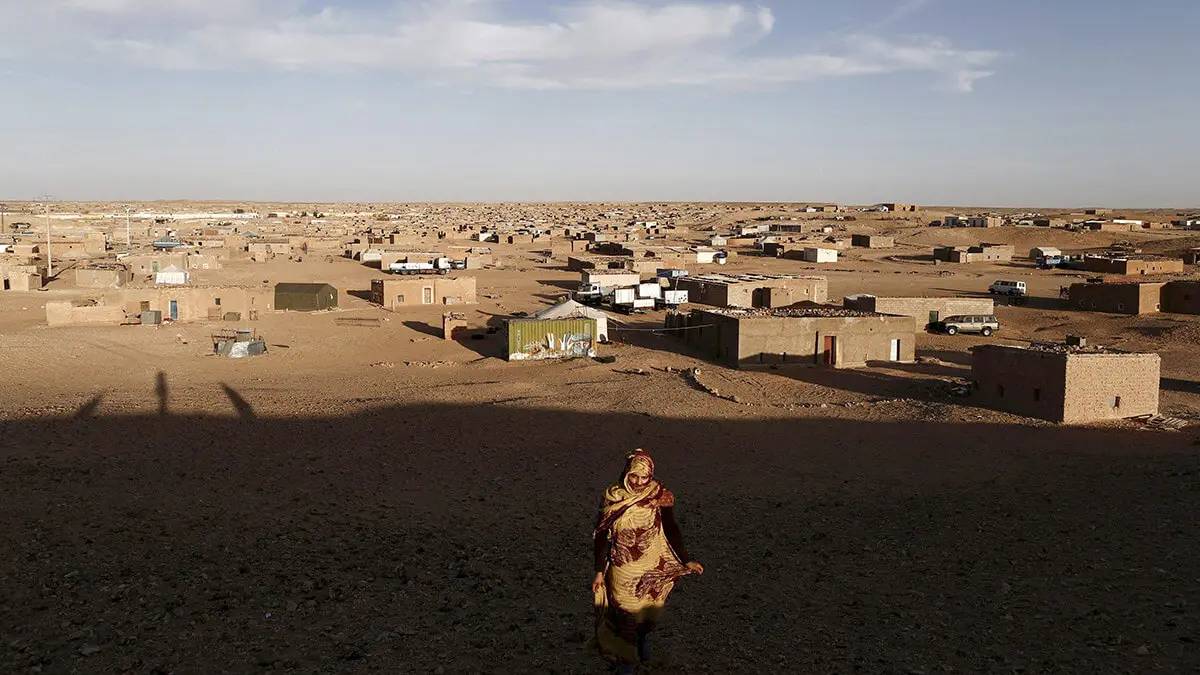
The Tindouf camps in southwestern Algeria, administered by the Polisario Front since 1975, are a paradigmatic site of necropolitical power. For nearly five decades, tens of thousands of Sahrawis have been confined there, suspended in a limbo between statelessness and frozen sovereignty. In these camps, life is not extinguished but immobilized; existence persists without horizon, caught between humanitarian subsistence and political instrumentalization. To apply Mbembe’s framework here is to understand the Tindouf camps not simply as humanitarian enclaves but as spaces of necropolitical control — spaces where life is maintained at the bare minimum while futures are systematically foreclosed.

Colonial Genealogies of Necropolitical Space
Mbembe reminds us that necropolitics has its laboratory in the colony. The plantation, the reservation, the detention camp: these were sites where populations were simultaneously exploited and abandoned, reduced to mere instruments or waste. The Tindouf camps are heirs to this genealogy.
The colonial partition of the Sahara by France and Spain was itself a necropolitical act: a cartographic violence that severed centuries of mobility and belonging. By manufacturing the category of the “Spanish Sahara,” colonial powers disrupted Morocco’s relational sovereignty with its Saharan tribes, while rendering Sahrawi populations vulnerable to manipulation. When Spain withdrew in 1975, the camps emerged as the spatial residue of this partition. Algeria’s decision to host the Polisario and confine Sahrawi populations in Tindouf perpetuated this colonial logic: the desert became a zone of suspension, a “holding pen” where life is maintained but not allowed to flourish.

Camps as Death-Worlds
Mbembe defines death-worlds as environments where populations are subjected to conditions of life conferring upon them the status of the living-dead. The Tindouf camps exemplify this condition.
- Spatial confinement: Residents cannot move freely beyond the camps; their movement is policed by Algerian and Polisario authorities.
- Temporal suspension: For nearly fifty years, generations have been born and raised in the camps with no prospect of citizenship, political participation, or return. Life is frozen in a perpetual “temporary” state.
- Economic dependence: The camps rely on international humanitarian aid for food, water, and basic survival. This aid, as documented by the European Anti-Fraud Office (OLAF), has often been diverted, instrumentalizing the population as a resource for geopolitical leverage.
- Denial of subjectivity: Camp residents are not recognized as Algerian citizens; their political agency is mediated entirely through the Polisario, which claims to speak for them but suppresses dissent.
These dynamics produce a necropolitical paradox: the camps preserve life but deny its substance. Sahrawis survive, but survival here is not life in Mbembe’s sense — it is bare life (zoē), stripped of futurity and autonomy.
Necropolitics and the Suspension of Sovereignty
Mbembe emphasizes that necropolitics is not only about killing but about keeping alive in order to control. The Tindouf camps embody this logic. Algeria and the Polisario sustain the camps not to enable flourishing but to maintain a geopolitical stalemate. Sovereignty is suspended: the Sahrawis are kept in limbo, neither fully independent nor integrated into a recognized state.
This suspension serves multiple necropolitical functions:
- Instrumentalization: The camps are used as bargaining chips in regional rivalries, particularly between Algeria and Morocco.
- Production of victimhood: The narrative of Sahrawi victimhood sustains international sympathy, ensuring continued flows of aid and diplomatic leverage.
- Erasure of alternatives: By confining Sahrawis to the camps, other possibilities — integration into Moroccan society, participation in development projects in Laâyoune or Dakhla — are foreclosed.
In Mbembe’s terms, the camps are not simply humanitarian spaces but spaces of captivity, where the political subject is immobilized for strategic ends.
Necropolitical Time: Generations Without Horizon
One of Mbembe’s most striking insights is that necropolitics operates through the control of time: populations are deprived of a sense of future. In Tindouf, entire generations have grown up knowing nothing but the camp. Schools exist, but their graduates face no labor market, no political institutions, no civil society beyond the Polisario. Marriage, work, education — all are suspended in a perpetual “waiting room of history.”
This temporality of endless deferral is itself a necropolitical technology. By immobilizing time, the camps prevent the emergence of agency. To be born in Tindouf is to inherit a temporality of stasis: one is condemned to live in what Mbembe might call a “death-time” — existence without horizon.
Necropolitics, Gender, and Daily Life
Building on Mbembe, Françoise Vergès has shown how necropolitics intersects with gender and domestic labor. In Tindouf, women bear the primary burden of sustaining life under conditions of deprivation. They cook with limited rations, care for children in makeshift schools, and reproduce a community under siege. Yet their labor is invisibilized, reduced to survival rather than empowerment.
This feminization of survival illustrates another dimension of necropolitics: the production of life only insofar as it serves the reproduction of captivity. Women’s agency is circumscribed, channelled into maintaining the very system that imprisons them.
Morocco’s Counter-Narrative: Politics of Life
To contrast with the necropolitics of the camps, Morocco presents its governance of the Saharan provinces as a politics of life. Massive investment in infrastructure, renewable energy, education, and trade corridors positions Laâyoune and Dakhla not as death-worlds but as developmental hubs.
From a postcolonial perspective, this contrast is revealing: the camps represent the continuation of colonial suspension, while Morocco’s integrationist project seeks to re-humanize the Sahara as a space of mobility, connectivity, and futurity. Whether one agrees with Morocco’s policies or not, the discursive terrain is clear: sovereignty here is framed not as domination but as the restoration of life against necropolitical stagnation.
Conclusion: The Camps as Necropolitical Allegory
The Tindouf camps are not an accident of history; they are a deliberate necropolitical construction. They exemplify Mbembe’s thesis that sovereignty in the postcolony often operates through the suspension of life, the creation of zones where populations are kept alive but denied the fullness of humanity.
To analyze the camps through Mbembe is to recognize that the question of Western Sahara is not merely legal or diplomatic. It is existential. The choice is between two regimes of sovereignty: one that immobilizes life in the desert’s camps, and another that seeks to reintegrate the Sahara into an African horizon of development and circulation.
Necropolitics thus clarifies the stakes: the camps are not humanitarian sanctuaries but spaces of slow death, where futures are stolen in the name of politics. To decolonize the Sahara is to end this necropolitical captivity, to allow Sahrawis to live not as victims of suspended time but as subjects of history with a future.