
Requiem for The Washington Post

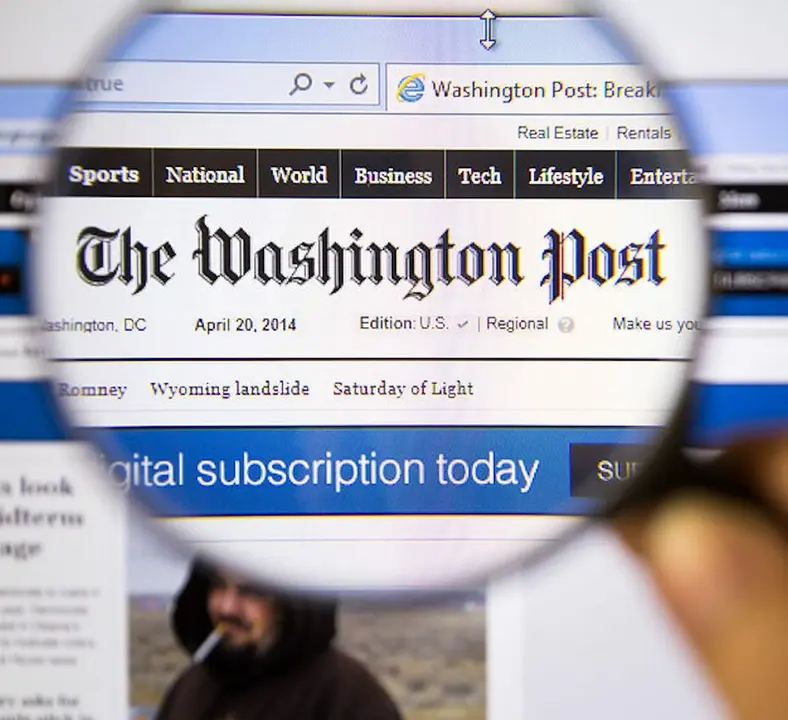
Think of big-city newspapers as you think of the way every city had its own particular and dearly loved emporium like Marshall Fields in Chicago, Bloomingdale’s in New York, and Garfinkel’s in Washington.
For decades, Washington’s great newspaper has been The Washington Post. In recent years, along with The New York Times and The Wall Street Journal, it has also been one of the three newspapers that can claim to be national.
The Post offered everything from history-changing exclusives to the daily horoscope. And great reporting and commentary.
Now it is going from being a great department store to a convenience store, selling bread, milk and cigarettes — actually, politics and business with limited international coverage.
Having once worked at the Post, I feel this personally, as though a part of my life is being taken away.
I am shattered by the folly and the waste. I am also alarmed that now The New York Times will be too powerful with its online dominance. It got the internet right early.
Jeff Bezos, who bought the Post from the Graham family, failed to catch the wave. Instead, he was seen as being more concerned with placating President Trump. Betrayal, said much of the readership, who cancelled their subscriptions or stopped believing in the paper, despite some courageous and insightful journalism.
The seeds of the Post’s commercial success were sown in 1954. At that time, afternoon newspapers were dominant and morning papers were struggling. In the morning, Washington had the Post and the Times Herald. In the afternoon, it had the Washington Evening Star and the Washington Daily News.
Eugene Meyer, a financier, bought the Post in 1933. By all reports, he thought of it as a diversion. I am told he liked to bring bottles of whiskey to the paper and have impromptu parties with the ever-thirsty staff.
In March 1954, Meyer bought the Times Herald and folded it into the Post.
What wasn’t known was that television would soon shift the balance between morning and afternoon papers, and that afternoon papers would go into permanent decline and extinction.
Both the Star and the News in Washington were battling each other for the read-at-home market. Soon, those readers would be watching television.
Under Meyer’s daughter, Katharine Graham, the Post reached unbelievable heights in journalism and in wealth. It appeared invincible.
Just as television had doomed afternoon papers, technology was to threaten all traditional publishing and broadcasting. New media, such as Facebook and Google, delivered personalized advertisements directly to consumers, cheaply and effectively.
As the red ink spread, it was up to Donald Graham, Katharine’s son, to find an angel, someone to stave off bankruptcy, and follow the early example set by the Times of virtual publishing. He persuaded Amazon’s billionaire founder, Bezos, to buy the Post to save it. Ironical?
A word about Graham: I met him when he first came to the Post. I was asked to show him around the composing room. It was the beating heart of the paper, where the newsroom’s creative output was set in hot metal and assembled in steel frames, known as forms, that would become the pages.
I got on well with him, and we became friends. It must have been extraordinarily painful for him to sell the Post, to entrust it to a man with the money to keep it going until a new business plan paid off.
It began well. Bezos kept his distance until he, like other giants of business, felt he had to mollify Trump, ever a media critic.
The extent of Trump’s pressure became clear when Bezos canceled the publication of an editorial endorsing Kamala Harris for president. Emotions were running high, and it was seen by the Post faithful as betrayal: the hand of Trump in the temple of press freedom.
Subsequently, Bezos added insult by changing the direction of the Post’s admired opinion pages, undermining confidence in the readership and the staff.
You can change the product lineup in a retail outlet, but you will burn down the building if you do it in a newspaper.
The Washington Post of old was venerated for fearlessness; now it is despised as craven. It is gone, sunk, a wonderful memory for those who read it, and for those who worked there. R.I.P.
On X: @llewellynking2
Bluesky: @llewellynking.bsky.social
Subscribe to Llewellyn King's File on Substack
Llewellyn King is executive producer and host of "White House Chronicle" on PBS.