
Venezuela, Year Zero

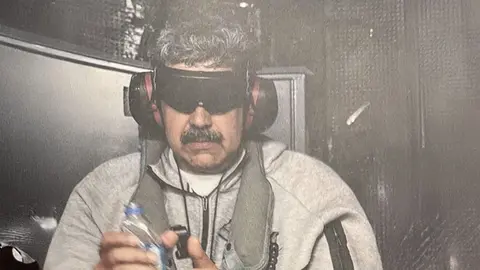
Using a “surgical” tactic and proceeding as some of our contributors had already predicted in this space, contrary to those who warned of a full-scale invasion of the Caribbean country, the Venezuelan leader has been arrested and transferred with his wife to a location that is currently unknown (almost certainly to one of the US ships off the coast, where he will be registered and undergo a thorough medical examination to prove that he is unharmed).
The surprise at the US's action is understandable, but only to a certain extent. As has been pointed out numerous times in this space, the build-up of forces and the actions of the US Navy against vessels transporting drugs (humble fishermen according to certain national politicians) were a clear indicator that something like this was going to happen. No one deploys such resources over such a long period of time only to withdraw without achieving anything.
It would be very difficult to justify the cost, and the damage to reputation would be incalculable. Therefore, we can say that the inevitable has happened. The question here was not whether the US would take direct action against Maduro's regime, but when. And that when was today.
But this morning's exercise raises several questions that are not easy to answer, and of course opens the door to several scenarios, some of which are not at all promising.
First, there is a fact that many have overlooked and that is, to say the least, curious. Exactly six years ago, President Trump himself, during his first term, ordered the attack that killed Qasem Soleimani in Iraq. Coincidence? Probably, but we cannot fail to mention this fact. Even then, there were those who threw up their hands in horror and predicted that the entire Middle East region would go up in flames, just as is happening now.
Focusing on the operation carried out tonight, there are several interesting points. First, the attacks were carried out with great precision, mainly affecting the Venezuelan armed forces' command and control system and its air defense system, undoubtedly with the aim of opening a safe corridor for the aircraft responsible for transporting the special operations units, whose mission was to capture the Venezuelan leader.
It is striking how the possibility of collateral damage, and even more so of unnecessary casualties among the Venezuelan forces, has been minimized, as well as the absence of attacks or actions against other members of the Chavista leadership. This, a priori, can be interpreted as a sign of a certain collusion on the part of that leadership with what happened, but it raises many questions about the possible evolution of the situation in the country.
It is also interesting to note that just 24 hours earlier, Maduro had received a Chinese delegation. Presumably, that delegation was no longer in the country.
Equally striking is a flight from Caracas to Minsk detected several hours before the operation was launched. It is well known that numerous Russian military advisers had been in Venezuelan territory for some time.
This only fuels suspicions that the United States would have warned Moscow to withdraw its personnel in order to avoid the possibility of an incident that would only serve to escalate tensions and hinder the negotiations that both countries are conducting to resolve the conflict in Ukraine.
In the current international context, it is very difficult to understand an action such as that carried out by the United States without some kind of prior agreement. And this is where the possible hypotheses come into play, both because of the above and because of experience in other operations of a similar nature. The fact that there was no confrontation between the assault units and President Maduro's security forces, and that the entire operation was surprisingly “clean,” only fuels this hypothesis.
One option could be an agreement between Maduro himself and the United States to ensure his life is spared and his children's future is secured.
The Venezuelan leader was perfectly aware that his future would inevitably involve either prison or death. Faced with this situation, he would have chosen to negotiate and at least guarantee the safety of his family. If this were the case, it would not be unreasonable for the United States to have informed Moscow, and even offered some kind of concession in the negotiations over Ukraine to ensure Putin's collusion.
Another possibility would be outright betrayal by Maduro's inner circle to ensure a less traumatic exit. This would involve both the political and military circles and would explain the absence of arrests of other leaders and the inaction not only of Maduro's protective circle but also of the bulk of the armed forces.
We cannot ignore the fact that Venezuela has strong ties not only with Russia, but also with China and Iran. In this regard, a high percentage of Venezuelan oil was destined primarily for China, as repayment in kind for numerous loans, which opens up the possibility that an indirect blow to Beijing may have been sought, although India, Spain, and the US itself also received part of that oil. That being the case, leaving aside the Russian unknown, which seems to be most clearly aware of what happened, we must focus on China, which, based on the above, appears to be the most affected by the possible consequences of this action.
The case of Iran is also interesting, as everything has happened in parallel with an upsurge in internal protests against the Tehran regime, forcing the ayatollahs to focus all their attention on the home front. And as has been emphasized on numerous occasions, in this type of “game,” nothing is ever accidental.
At this point, we can only speculate. But what is clear is that behind what has happened there has been some kind of “agreement.”
Interest is now focused on the information that the deposed Venezuelan leader may provide about the activities of both the famous Cartel of the Suns and its international connections and, above all, the financial network established around the management of the country's natural resources, which appears to affect prominent figures in Spain.
But where we must place the emphasis, because they are the real protagonists and victims of this regime that seems to be coming to an end today, is on the Venezuelan people.
During decades of dictatorship, a large part of the population opposed to the regime has left the country, and a considerable number of those who remain in Venezuela have been armed by the regime.
The main danger now is clashes between the two sectors of the population: those who are tired of suffering oppression and eager to regain their lost democracy, and those who are afraid of losing their many or few privileges and becoming victims of revenge. Such a situation could easily lead to a bloody civil war.
In this scenario, the position taken by the security forces will be key, and will depend largely on the decisions and instructions given by the ruling political class, which, we must not forget, remains the same as yesterday.
And here the role of the United States is key. Obviously, it cannot occupy the country, but the fact that it has decided to intervene automatically makes it responsible for what happens in Venezuela from now on. It cannot decapitate the regime and wash its hands of what happens from today onwards. It is to be hoped that a whole series of measures and actions have been planned to facilitate the handover of power and the full recovery of democratic institutions, with a view to truly free elections in the medium term that will indisputably legitimize the establishment of a government that can begin to rebuild the country.
Anything less than a plan to stabilize and control the country will mean chaos and the failure of an action that is already generating too many expectations. And the consequences for the United States' image abroad would be disastrous.