
Algeria in weightlessness


In a visually overloaded scene, representing a country closed in on itself, suspended and isolated from any border or regional context, the message conveyed by the installation of a multitude of flags sought to overstimulate national identity. However, this overabundance risks erasing the surrounding world. The map of Algeria, shown without its neighbouring countries, can only be interpreted as a form of denial or voluntary distancing from neighbours with whom relations are complex, even conflictual. This desire to project the image of a self-sufficient country actually gives rise to an Algeria in weightlessness, evoking a suspension, an uprooting and a lack of solid references.
Deprived of its geographical anchor, the country appears on this map to be suspended in a vacuum, both temporally and spatially, without political, social or economic stability, mired in a state of uncertainty and immobility. This image also suggests a loss of gravity and weight, as if the country had lost some of its influence and dynamism, as if its decisions no longer had a concrete impact.
This weightless Algeria, suspended in the background of the presidential press conference, perfectly reflects the speech given by the president during that same conference: an Algeria devoid of solid foundations, floating in a political, economic and identity vacuum, where everything appears blurred, fragile, vulnerable, uncertain and unstable.
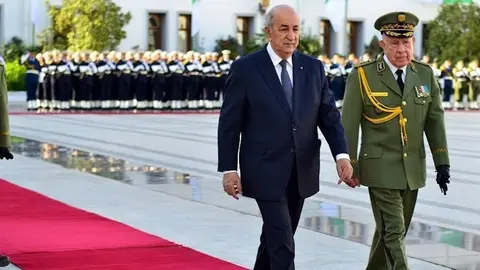
The seven contradictions of the presidential speech
Political discourse is a field composed of the construction of meaning, insofar as it is not limited to the simple linguistic meaning of the words or phrases that compose it. The meaning of a political message results from a complex interplay between different linguistic and contextual levels, which generate a multiplicity of interpretations that are always in flux. How, then, can we grasp and understand the discourse of President Tebboune, who, during that press conference, sought to create a communicative effect to influence national and international public opinion and bring about a transformation in their attitudes, thoughts and beliefs?
This question is essential to understanding the underlying objectives and mechanisms of action of presidential discourse in a complex communication situation. Analysing this type of discourse therefore requires taking into account not only the explicit content, but also the rhetorical strategies employed, the particular political and geostrategic context, and the expected reception by the audience, in order to grasp how the speaker seeks to generate this transformational effect.
It should be noted that attempting to understand Tebboune's political discourse as an instrument of influence, whose main purpose is to act on others to bring about a transformation in their attitudes or thoughts, implies that this action is not limited to the mere transmission of information. In effect, it seeks to guide mental representations, mobilise emotions, shape beliefs and incite concrete actions. This perspective allows us to understand how, afterlife the factual content, the presidential speech becomes a strategic tool of political communication, intended to reinforce the authority of the state, legitimise its decisions and have a lasting influence on the perceptions and actions of the public.
Thus, through his words, the president seeks to construct an interpretative reality that engages not only the minds, but also the will and behaviour of the recipients of his speech. Specifically, it is pertinent to ask whether President Tebboune succeeded in capturing his audience's attention and establishing a genuine dialogue in which he attempted to impose a worldview or an interpretation of events. How did he attempt to convince them by combining rational arguments, appeals to collective emotions such as fear, hope or pride, and shared values? To what extent did he succeed in using his speech as an effective psychological lever capable of changing the public's perception of the social and geopolitical situation?
It is important to emphasise, in this context, that critical discourse analysis suggests that the way we talk about things concretely shapes what we can think, understand and perceive about them. We are therefore interested here in the way President Tebboune expresses himself on his country's foreign policy, in order to understand the discursive mechanisms through which he constructs his geopolitical vision and develops his communication strategy. By examining his lexical choices, his narrative and rhetorical frameworks, we can understand how he shapes collective representations, legitimises his decisions and influences public opinion through his discourse.
It suffices to retain this excerpt, translated from a hybrid language that mixes Algerian Arabic dialect with French, but which remains particularly significant in illustrating the idea that the way the president talks about his country's foreign policy concretely shapes his representation of it:
- Mr President, you said something important about principles. Honestly, Algeria is known for its high principles, especially in the diplomatic arena. Don't you think, Mr President, that we have lost out in a world that only recognises pragmatism? Haven't we lost out because of our high commitments based on those principles?
- What have we lost? Give me an example.
- It's just a question.
- No, give me an example and don't beat around the bush, tell me what we have lost.
- For example, in our positions regarding our neighbours, we sometimes adopt stances based essentially on principles, Mr President, and not on a pragmatic basis.
- How? I don't understand what you mean. To please this or that person, do I abandon the Sahrawis? Do I become imperialist? Because apart from our position, everything else is imperialist. How can we abandon the Palestinian people? (Fleeing forward!) We will never give up, whether in Gaza, the West Bank, the diaspora or Jerusalem, never. We did everything we could when we brought the Palestinian factions together here, and then there were thanks from the United States (the imperialists!). People did not expect that. You are considered honest, you are respected. Who are we going to lose? Who are we going to lose by supporting Western Sahara? Today, Western Sahara is recognised by half of the African Union (actually only 17 African states out of the 54 members of the AU), more than 55 countries recognise the Sahrawi Republic (barely 30 out of 193 countries). We have learned to face it, and we will continue to face it. Our principles are our principles. If you want to oppress someone alongside me, I tell you to stop that oppression. You tell me that they deserve it and that I am wrong, I tell you not to oppress alongside them. When it is between you and them, it is your business (what curious principles!). So, well, these are matters of principle. Today you tell me... I understand you... ... we have reaped hostility, but we have not reaped any hostility...
- Honestly, Mr President, I want to say that today the world only recognises pragmatism.
- There is no one more pragmatic than the Algerians, everyone is surprised, everyone is wondering, what is Algeria's secret that makes it have good relations with the United States (the imperialists again!), with Russia, with China? That is Algeria's strength. Because we are honest, we do not use anyone against anyone else, and we give everyone their due, as they say. Those are my principles. I am not your adversary, I am not fighting you, nor am I against you. Our non-alignment runs in our veins, even our brothers recognise that. Whether in Libya or elsewhere, we are equidistant from all parties.
- Mr President, one last question on the international file, regarding the agreement that existed between Rwanda...
- No, no, before I answer your question, because there are people who want the best for the country, who say: why should we be in conflict with others over this or that?
- Mr President, I am simply passing on the concerns and questions.
- No, I am not reproaching you for anything, I am not reproaching you for anything. You have raised these questions well. It is to them that I am responding.
There is no need, then, to dwell on the vacillating rhetoric of this speech, in which the President adopts an ostrich-like logic, spreading his wings of arrogance and pretending to be strict in his principles, while burying his head in the sand to avoid reality and escape the gaze of others. However, it should be emphasised that President Tebboune's speech on foreign policy, particularly on Morocco and Mali, has focused primarily on how Algeria's image is projected, especially through a series of identity markers which, although supposed to reflect historical and strategic values, seek to shape the external perception of the country and legitimise its place and role on the international stage. Let us therefore consider this set of identity markers with which Tebboune's discourse strives, in its most delusional claim, to construct a ridiculously idealised Algerian “ethos”:
- Algeria is a power that has all the means to protect and defend itself.
- Algeria refuses to interfere in the internal affairs of its neighbours.
- Algeria cannot help its neighbours against their will.
- Algeria rejects the presence of foreign mercenaries on its borders.
- Algeria rejects the oppression exercised by some over others near its borders.
- We will never abandon the Sahrawis.
- We will not become imperialists.
- We are honest and that is why we are respected.
- We are not aligned with either side.
- We do not attract hostility.
- No one is more pragmatic than Algerians.
- Our principles are non-negotiable.
The glorious ethos that President Tebboune seeks to construct during this media interview paints a grandiose picture in which Algeria, an indomitable power, appears deeply anchored in its ‘non-negotiable’ principles, a country that is both anti-imperialist and pragmatic, whose almost messianic non-alignment runs through its veins, and whose friends are everywhere. Algeria would thus be a paragon of both know-how and savoir-faire on the international stage, firmly rejecting the presence of foreign mercenaries on its borders with Mali, without abandoning those of the Polisario. We could almost believe in a harmonious diplomatic symphony, were it not for some flagrant dissonances and certain obvious contradictions, relating in particular to that fatal diplomatic isolation that it tries in vain to hide, that mixture of a perception of self-sufficiency, even independence from others, and an accusatory stance in victim mode towards others, and of course that almost magical ability to deny geopolitical reality, as in the case of the Moroccan Sahara.
In short, a grandiose nation entirely fabricated from scratch to impress the general public, full of clichés, laden with self-praising rhetoric, which sometimes floats in the air like sweet smoke, intended more to cover up contradictions than to exert any real influence. A discourse in which the image no longer seeks to convince, but rather to create and maintain illusions. It is a political communication strategy that, by persisting in confusing the word of the state with cheap propaganda, serves neither to influence nor to manipulate.

It should be remembered that a discourse of political manipulation is usually constructed in such a way as to avoid immediate collapse into apparent contradictions, because the aim is to influence and convince, not to discredit oneself. However, at the level of intellectual coherence and consistency with reality, tensions and contradictions can always arise.
Certainly, manipulative strategies are based on altering the cognitive framework of the audience, choosing specific linguistic means (syntax, semantics, rhetoric) to guide perception without necessarily ensuring strictly logical or factual coherence. It is therefore clear that political manipulation skilfully plays on emotions or narratives that may diverge from objective reality in order to serve a specific political objective. However, a manipulation strategy riddled with glaring contradictions, both in terms of intellectual coherence and its agreement with reality, would inevitably lose all credibility. Such inconsistency would not only compromise public trust, but also nullify the effectiveness of the manipulation, because the ability to manipulate is fundamentally based on the perception of a certain plausibility and coherence in the discourse.
In other words, manipulation can tolerate a certain gap with the truth, but it cannot survive an obvious rejection of reason and facts, at the risk of turning against its author and ruining his influence. This is exactly the case with President Tebboune at the press conference analysed, where his statements, marked by strong contradictions, both among themselves and with national and international realities, exposed a communication strategy incapable of convincing or manipulating effectively, revealing an inability to construct and articulate a coherent discourse, while revealing a power in difficulty and weakened by its own inconsistencies. Let us examine the seven most obvious contradictions that we have retained from this discourse.