
What is the purpose of the UN?

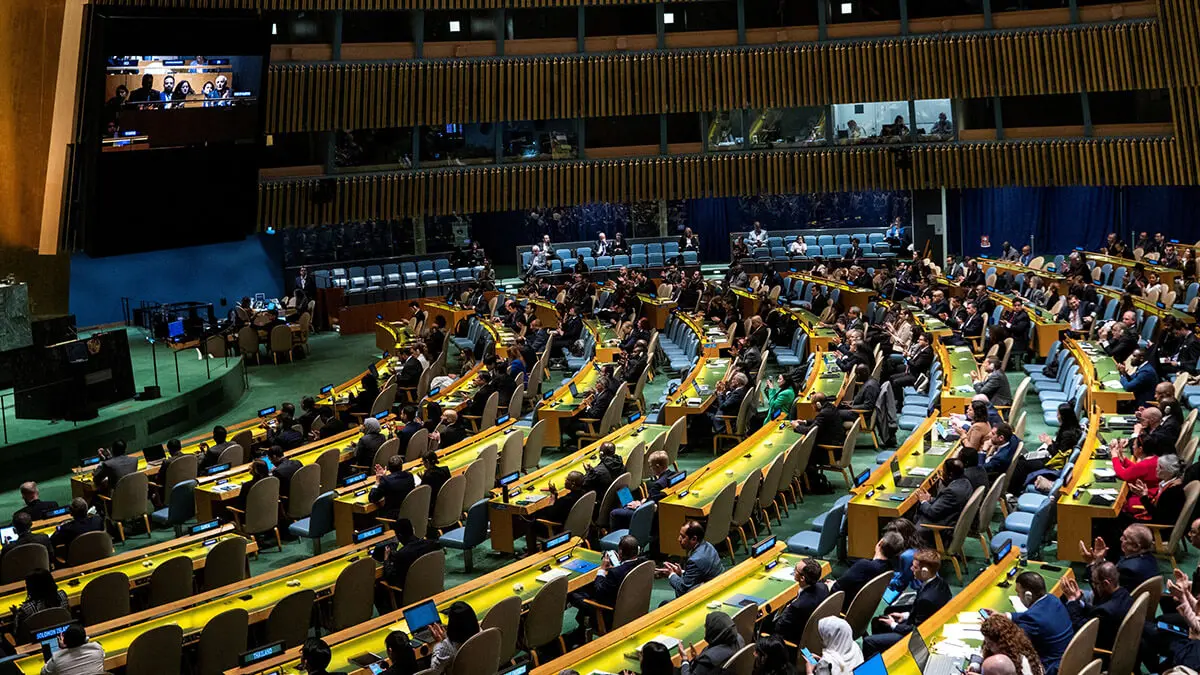
Two big question marks hung over the United Nations just as it celebrated its 80th anniversary. Among those questions, its functionality has been called into question in a world where conflicts are multiplying: multilateralism is stagnating, free trade borders are closing, and the world is divided between extreme ideological positions.
What happened during the last week at the UN showed that the institution needs to be reformed and that, after its 80th anniversary, its aging structure no longer meets the expectations and needs of the world's population, which perceives that we are closer to a third world war than to a global peace that also offers development.
The UN has become a propaganda tool for the leaders in power.
It is time to renew it, update it, democratize it, and ensure that its power is capable of influencing the course of political processes, especially when these no longer guarantee peace but, on the contrary, exceed limits. The next question we ask ourselves is about the feasibility of changing the UN at this time. Unfortunately, the answer is NO.
This is precisely because those who control it, its five permanent members, do not allow democratization and openness to new members with the same weight. As long as they do not want it, no matter how many epic speeches the secretary-general gives, things will not change.
What is worrying is that, within that group of five, are the United States and Russia,which generate and operate conflicts to cover up their quest for global hegemony, while China assumes these conflicts as a circumstance that strengthens them or sees signs of weakness in others. In other words, three of the five permanent members who decide with votes and vetoes see armed conflicts as a necessity for their objectives. Underlying this symptomatology is the guarantee of world peace.
The UN was created on October 24, 1945, after 51 member states signed the organization's founding document. Over time and up to the present, 193 states are represented in what has been the highest international institution for seeking to establish world peace.
However, it has become clear that war and peace are decided outside the UN, among alliances that have developed since the collapse of the Soviet Union and, more recently, due to the rise of new intelligent technologies, which have boosted global economies but, above all, have made wars more sophisticated, both in terms of weaponry and ideology.
These main factors, although there are many more, have led us into the battle for the conquest of a new geopolitical order, and this generates conflicts. Therefore, if a new alternative with teeth does not emerge to put pressure on and engage with the generators of violence, the fate of the UN will be sealed to irrelevance.
In its letter of introduction, the UN assumes that it “remains the only place on Earth where all the nations of the world can meet, discuss common problems, and find shared solutions that benefit all of humanity.” This has failed in recent years, where, instead of seeking consensus and “shared solutions,” what we see is a parade of global leaders denouncing, reviling, attacking, slandering, and promoting their very personal interests.
The recent case of Colombian President Gustavo Petro was relevant when he took to the streets of New York to spread anti-American and pro-Palestinian propaganda after his participation in the General Assembly. In response, the Trump administration decided to revoke his visa.
Days later, Trump presented a peace plan for the Middle East, which was applauded by most powers, from Spain to Russia, from India to Qatar.
Furthermore, it has become an inconsistent forum. For example, two of the most powerful leaders who make up the nerve center, the heart or brain of the UN, the only ones who can veto anything with their vote alone, were absent from this last meeting. Neither the leaders of China nor Russia were present, who, together with the United States, France, and Great Britain, are the only permanent members of the Security Council.
In these times, it seems difficult to reach a collegial agreement to stop, for example, the war in Ukraine.
The leaders of pariah governments such as Nicaragua and Venezuela were also absent. Other leaders, such as Mexican President Claudia Sheinbaum, still lack an adequate, comprehensive, and competent foreign policy strategy to meet the demands of these challenging times.
There is an urgent need to renew the UN, reinvent it, and transform it into a true space for concrete actions aimed at multilateralism, but which also allows other countries to participate in decision-making.