
A new corporate diplomacy for a fragmented world


In its place, a fragmented scenario is emerging, marked by rivalry between major powers, the weakening of common rules and the growing instrumentalisation of economic, technological and energy power by the major powers.
Geopolitics has returned to the centre of the international stage, but it is no longer expressed solely in military or diplomatic terms; it also extends to supply chains, technological competition, energy security and disinformation. A new environment is thus taking shape in which both states and large companies are increasingly interacting on the basis of power rather than collaboration, distorting the idea of cooperation and the concept of globalisation of recent decades.

Understanding this new geopolitical context requires going beyond specific conflicts and studying the processes and impacts of this accelerated deglobalisation. A new era characterised by conflict, protectionism and identity-based withdrawal, in which executives must pay much more attention to the accelerated geopolitical and geoeconomic changes that are reshaping the global balance and conditioning political, economic and social decisions throughout the world.

In order to remain operational and competitive, corporate diplomacy must incorporate new dynamics that include relationship-based strategies, but above all transaction-focused strategies. The challenge is to do so without losing legitimacy and reputation. Today, our companies must learn to play in different scenarios and contexts in which the challenge will be to negotiate without imposing, compete without dehumanising and listen without giving up what is essential. A realism based on values, being aware of the new power correlations and priorities of our interlocutors.
Markets are shifting from a relatively stable regulatory environment to a power board, identity and new alignments of the new security economy. A new order in which supply chains, data, energy and critical minerals have become assets of economic security and strategic autonomy for the major powers. Thus, corporate diplomacy strategies are no longer solely a matter of relationship building or lobbying, but are being reconfigured into an architecture of alignment in which decisions must be made about who to cooperate with, where to invest, what technologies to adopt and what dependencies to assume. A new corporate diplomacy that can no longer be limited to managing stakeholders or cultivating institutional relationships, but must guarantee operational continuity and protect the reputation of companies. Social licence also becomes geopolitical, and three major blocs emerge that combine history, power, values, institutions and influence, in which companies must learn to deploy new capabilities and strategies in a kind of variable geometry.
On the one hand, there is the Global West, which brings together the countries that have been at the centre of the liberal international order that emerged after the Second World War and was reinforced after the end of the Cold War. It is characterised by shared values such as liberal democracy, the market economy and the rule of law, and the creation of stable political-military alliances. On the other hand, there is the Global East, which brings together states that articulate, with varying degrees of coordination, an alternative to the Western international order. It is a more political and functional concept than a geographical one, and is characterised by a greater centrality of the state, with directed economies and an explicit use of political, economic and technological power as a strategic instrument. Countries such as China, Russia and Iran stand out in this group. It is not a homogeneous bloc of states, nor do they share values, but they do share interests in the face of Western hegemony. Finally, there is the so-called Global South, which brings together countries from Africa, Latin America, the Middle East and much of Asia. They share a history of being peripheral to the international system and today seek greater autonomy, recognition and influence. They do not fully align themselves with either the Global West or the Global East, and will probably be a space for negotiation where the global balance of power will largely be decided.
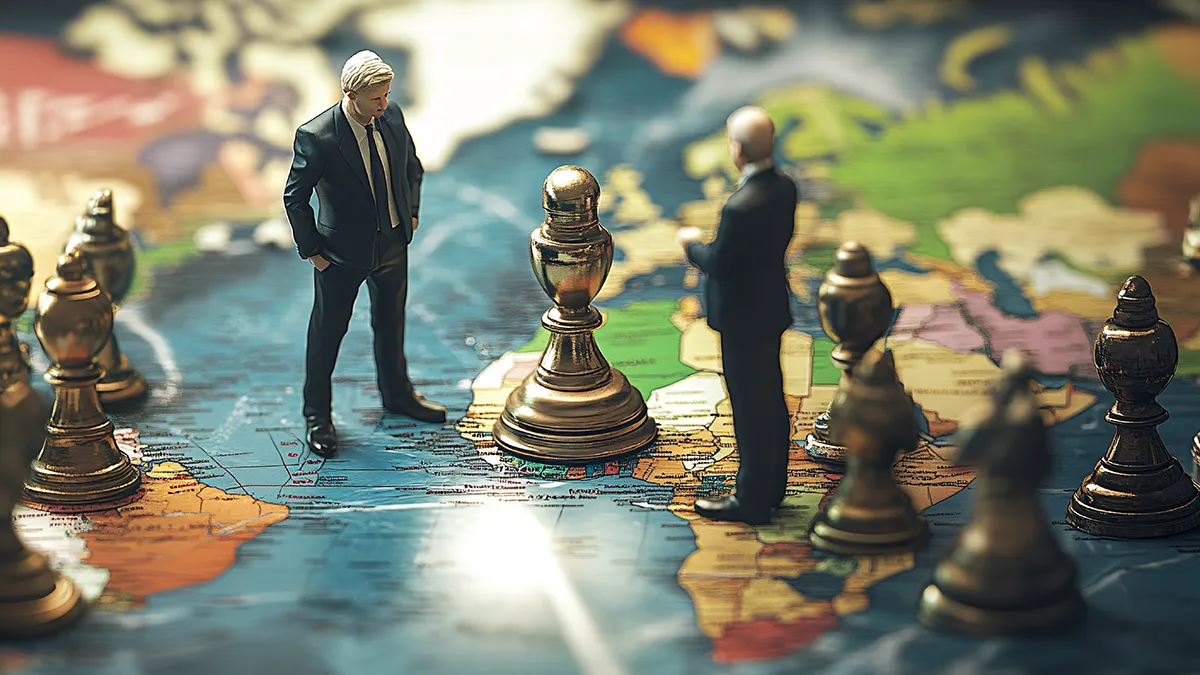
We are therefore facing a new alignment characterised by complexity and fragmentation into three large blocs, which will require companies to adopt a delicate strategy of focusing their efforts and sophisticated corporate diplomacy. This challenge will require companies to avoid the trap of their states' interests, as this erodes their reputation and the trust of other actors and territories. In a global context of mistrust, emphasising the pre-eminence of values can be perceived as a certain moral superiority that conditions access to certain decision-making environments, erodes the social licence to operate and compromises the viability of projects or the business itself.
The new corporate diplomacy must therefore adopt a realism based on values, which is much more than a slogan. It is a method for avoiding being caught between opportunism and hypocrisy, deploying a coherent, appropriate and effective strategy on what the limits are, for example, in fundamental rights, but having the intelligence to adapt models of application, rhythms or governance mechanisms according to the reality in which it operates.
In a world that is tending towards deglobalisation but will continue to be hyperconnected, the new corporate diplomacy must also be digital, which is much more than marketing or advertising. Companies will have to adapt their communication strategies to be much more territorial. Misinformation and the emotional management of the markets in which they operate will become increasingly complex and strategic. When global norms erode and protectionism or identity nationalism intensifies, the most prominent or visible companies may become targets either because of their national origin, their alliances, or a biased interpretation of their decisions. This will require much more refined digital corporate diplomacy, with narrative monitoring, rapid response capabilities, and alliances with voices that have local legitimacy and reputation.
Thus, the new corporate diplomacy is about much more than business. It requires managing and negotiating interests in political and cultural contexts different from our own while maintaining legitimacy, reputation, and social licence to operate in a world of eroded norms and multipolar rivalry. Is your company prepared to face this new global order?
Pau Solanilla is an international consultant and partner at Harmon.