
China roars and bares its teeth

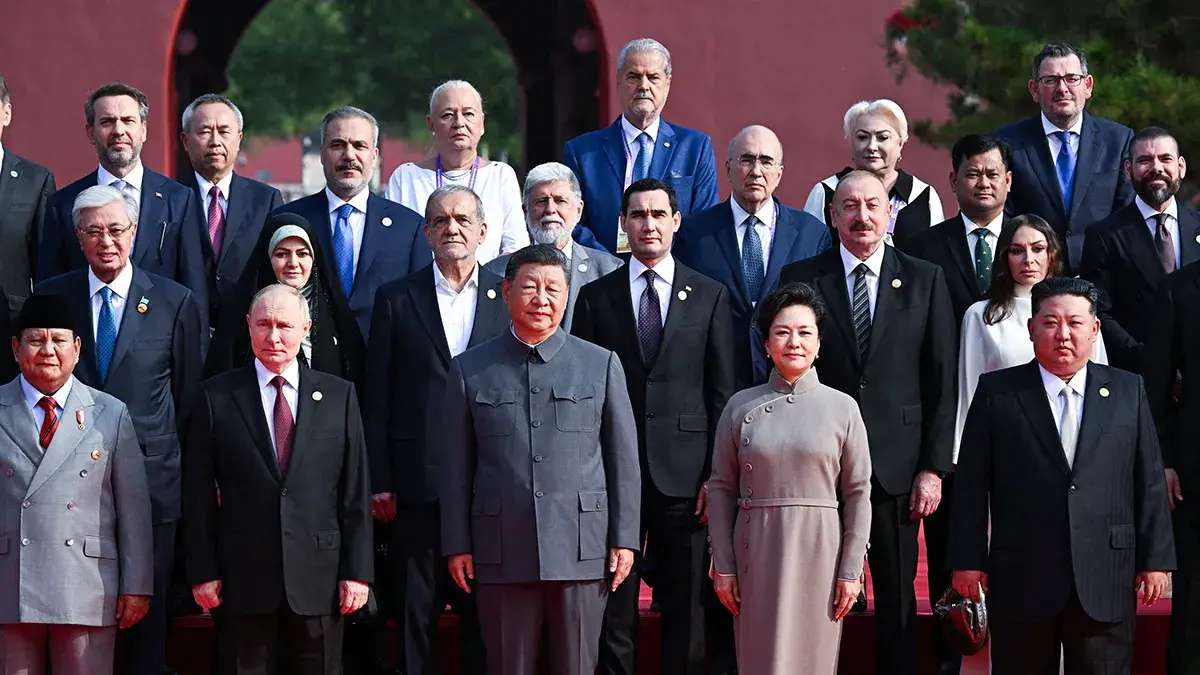
But any observer who has witnessed such a display must conclude that ‘this’ can only be organised and financed by a superpower that is very confident of its equally gigantic ambitions and its ability to achieve them.
Preceded by a summit of leaders of the Shanghai Cooperation Organisation (SCO), the double event had an indisputable objective: to challenge the West, and especially its leader, the United States, and to show it that the stark struggle already underway, without ruling out a conflagration in the immediate future, already constitutes a powerful coalition of countries.
Both at the SCO summit in the populous and modern city of Tianjin and at the parade in Beijing, the special guest was Russian President Vladimir Putin. However, while Indian leader Narendra Modi also shone at the former, at the latter event President Xi Jinping gave special prominence to his North Korean counterpart, Kim Jong-un.
Modi exuded optimism and smiles at all the bilateral and group meetings he attended. The leader of the world's most populous country was thus making up for the blow dealt by President Donald Trump, who has punished him with particularly brutal tariffs for having made lucrative deals by buying cheap oil from Russia and then reselling it, thus rendering the sanctions imposed on Russia for its aggression against Ukraine largely ineffective.
As for the North Korean leader, the welcome and praise he received from Xi Jinping puts him a few steps higher than he was on the international stage. His carefully choreographed walk to the podium accompanied by Xi and Putin conveyed an image of a solid alliance between three nuclear powers in the face of the challenges ahead.
But, alongside the twenty or so leaders from other countries, the real star of these five days of celebrations was undoubtedly the Chinese president. Xi Jinping projected at all times the image of the leader of the rival camp to the West, elevated almost to the status of a ‘god’, especially in the images of his 45-column review of the People's Liberation Army and his state address, in which he proclaimed to the world the choice between cooperation or confrontation, between peace or war, making it quite clear that China leads a part of the world that accounts for almost half of the total population and 40% of its GDP, while reminding everyone that the great strides forward made by the Chinese nation are ‘unstoppable’.
The spectacular choreography of the parade, in which, alongside the strict discipline and meticulous deployment of its soldiers, the latest generation of weapons and technology were displayed, sought to inspire – and succeeded in doing so – a dual sense of fear in those who dare to confront it and security in those who choose to seek the protection of the Chinese superpower.
It also vindicated China's role in World War II, using the 80th anniversary of Japan's surrender as a pretext to celebrate such a grand military parade. In this regard, in addition to questioning the current ‘unfair international order’ dominated by Western countries, Xi wants not only to change it, but also for humanity to admit that China's contribution in terms of civilian and military casualties (35 million) in that war was a tribute that was not widely known and therefore not properly recognised by the rest of humanity. In this accounting, China claims that the conflagration actually began in 1931 with the Japanese invasion of the Manchuria region, renamed Manchukuo by the Japanese. And that, if the world was liberated from Nazism, fascism and (Japanese) imperialism, now the poor and backward country that China was then has raced ahead at full speed to become a formidable and powerful adversary.
Of course, without referring to communism as a totalitarian system, Xi implied that the country he calls on to lead the world before the middle of the 21st century needs a will of granite and an iron fist, namely his own, to complete this project, for which the unbroken and unwavering unity of the entire nation is essential.
Incidentally, the conversation – microphone left open by mistake? – between Putin, Xi and Kim Jong-un about the possibility of them living to 150 years of age and even achieving immortality did not go unnoticed. Of course, judging by their behaviour, there is little doubt that they will use all the means at their disposal to achieve this.