
Sánchez declares war on Israel

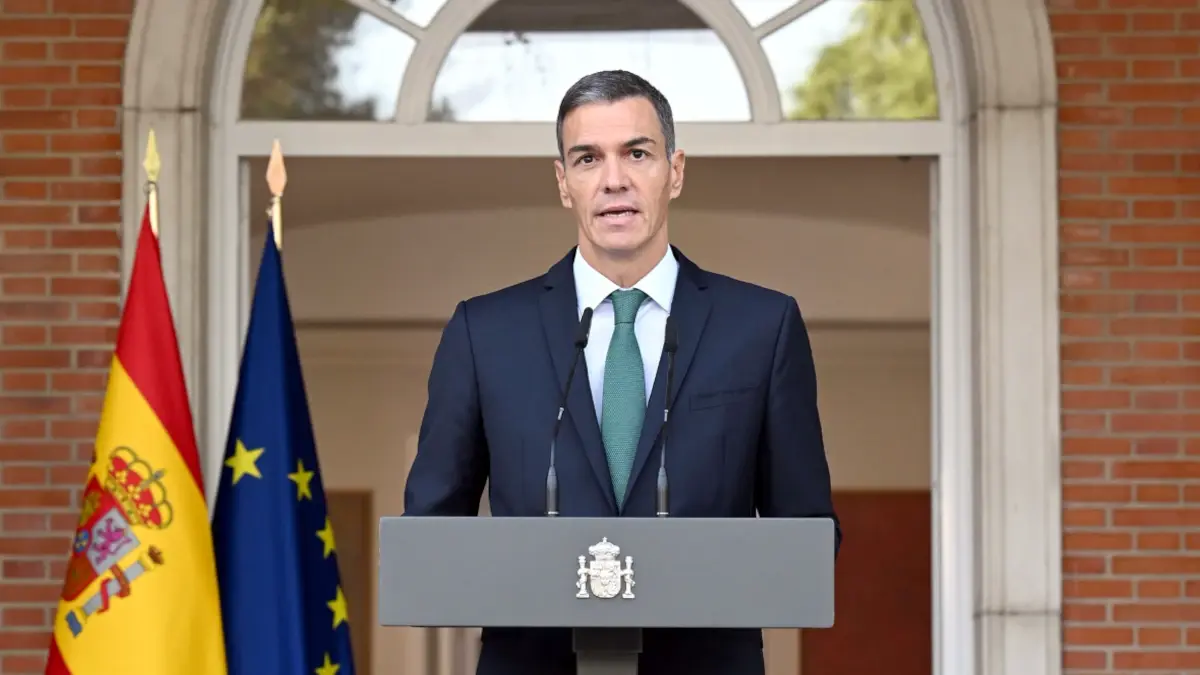
This is how the Israeli government interpreted it, immediately after learning of the package of nine measures against Israel, in response to what he himself describes as genocide for ‘exterminating a defenceless people and breaking all the laws of humanitarian law’.
Legal consolidation of the ban on arms trade with Israel; denial of entry into Spanish airspace to any state aircraft carrying defence material, as well as any ship loaded with fuel for the Israeli Defence Forces (IDF); prohibition of access to Spanish territory for all persons who ‘participate directly in genocide, human rights violations and war crimes in the Gaza Strip’; veto on the import of products from illegal settlements in Gaza and the West Bank; limitation of consular services to Spanish citizens residing in such settlements; an additional ten million euro increase in Spain's contribution to the United Nations Relief and Works Agency for Palestine Refugees (UNRWA), and an increase to 150 million euro in humanitarian aid and cooperation for Gaza, constitute the summary of what Sánchez has decided, without any parliamentary debates or agreements to back it up.
Sánchez set himself up as a world leader in condemning Israel by accusing, without naming them, the major powers of ‘being stuck between indifference to an endless conflict and complicity with the government of Prime Minister Benjamin Netanyahu’. He also urged Spaniards to ‘know that, in the face of one of the most infamous episodes of the 21st century, their country, Spain, was on the right side of history’.
The Israeli government reacted with unmitigated condemnation of President Pedro Sánchez's announcement, accusing him of ‘leading a hostile line against Israel with unrestrained and hateful rhetoric,’ before describing the announcement as ‘an attempt by the corrupt Sánchez government to distract attention from the serious corruption scandals surrounding it.’
Israeli Foreign Minister Gideon Saar, who was visiting Budapest, flooded social media with reproaches against the progressive Spanish coalition government, recalling its links with ‘tyrannical and sinister governments such as those of Iran and Venezuela’, as well as ‘its surprising lack of historical awareness of Spain's crimes against the Jewish people’. In this regard, and after mentioning ‘the crimes of the Inquisition, forced conversions and the expulsion of Jews in 1492’, Saar accuses Sánchez of deliberately damaging the relations that have been built between Israel and Spain over the last few decades, including the recognition of Spanish nationality for Sephardic Jews descended from those expelled at the end of the 15th century.
As a measure of revenge, Saar has not only banned the Deputy Prime Minister, Yolanda Díaz, and the Minister for Youth and Children, Sira Rego, from entering Israel, but has also vetoed any official contact between the Israeli government and them, identifying them as the most visible instigators of anti-Semitism within the Spanish government. The Israeli minister added his intention to inform his allies about the Spanish government's hostile behaviour and the anti-Semitic and violent nature of its ministers' statements: ‘It is important that Israel's allies around the world understand the dangerous nature of the current government in Spain.’
Saar shared a press conference in Budapest with his Hungarian counterpart, Peter Szijjárto, and took the opportunity to explain Israel's strong opposition to the two-state solution: 'We reject outright any attempts to force Israel to accept the establishment of a terrorist state on our tiny piece of land. Just this morning, several terrorists came from the Palestinian Authority territories to carry out attacks in Israel. The establishment of such a terrorist state has only one goal: to eliminate the State of Israel.' He blamed France for leading the campaign for recognition of the Palestinian state without even demanding that the Palestinian Authority disassociate itself from terrorism, revealing that it has never disassociated itself from the policy of 'Pay for Slay' (compensating the families of 'martyrs' killed in terrorist actions with money).
In the case of Israel, the threats made by its government in response to Sánchez's measures and statements herald very turbulent times for Spain and its citizens. Furthermore, given the context surrounding the Spanish President of the Government, it seems logical to think that he has decided to go for broke, once he has realised, based on the polls, not only that his expectations of winning new democratic elections have collapsed, but also that he has been personally sidelined internationally. The president of the country that still leads the camp of liberal democracies, Donald Trump, has clearly set his sights on him, and within the European Union itself, his increasingly close relationship with China, which has established itself as the undisputed leader of autocracies, clearly distances him from the glorious pages of future history books.
Adding to these woes the enmity of the country that shelters, represents and protects the most influential minority in the world, the Jews, is tantamount to shooting oneself in both feet. That he should drag Spain along in this suicidal drift will be a new tragedy for our country, which may once again prove true Gil de Biedma's statement that ‘our history always ends badly’.