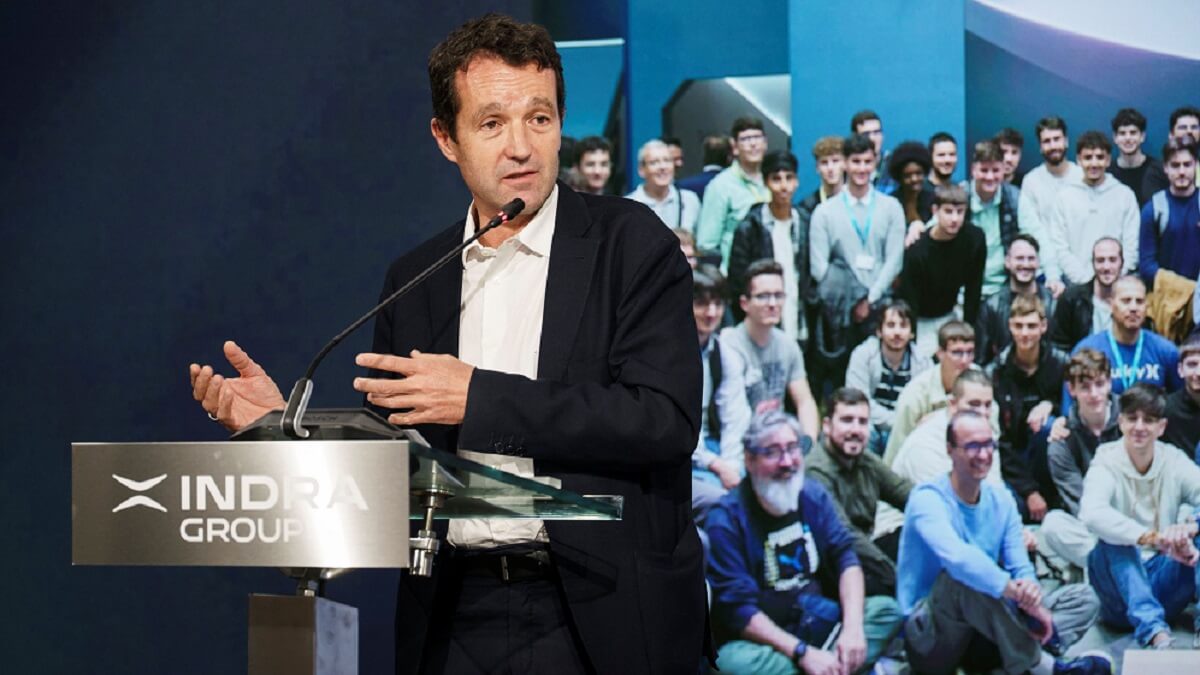
Ángel Escribano, President of Indra Group: ‘Vocational training and technical talent are key to leading Spain's reindustrialisation’

Indra Group held a meeting on Monday with directors of vocational training centres from all over Spain, as well as representatives from the Ministry of Education, Vocational Training and Sports and the Regional Ministry of Education of the Community of Madrid. The event, held at the company's headquarters in Alcobendas, highlighted the importance of this training in strategic sectors such as defence, aerospace and digital technologies.
‘This educational path opens doors to solid and exciting professional careers. At Indra Group, we are leading a key moment in the reindustrialisation of Spain, convinced that vocational training not only trains thousands of young people every year, but is also a lever for transformation in our society,’ said Ángel Escribano, president of Indra Group and a former vocational training student.

Currently, a third of the workforce of Indra Group in Spain is made up of vocational training graduates, reflecting the company's commitment to this educational pathway as a driver of employability and competitiveness. In addition, it is expected that 75% of vocational training students on work placements in 2025 will join the company's workforce, reinforcing Indra Group's role as a driving force in the national industrial and technological fabric. ‘A country that wants to develop a solid industrial capacity and real technological autonomy must make a firm commitment to vocational training, as Spain is doing,’ said the executive president.
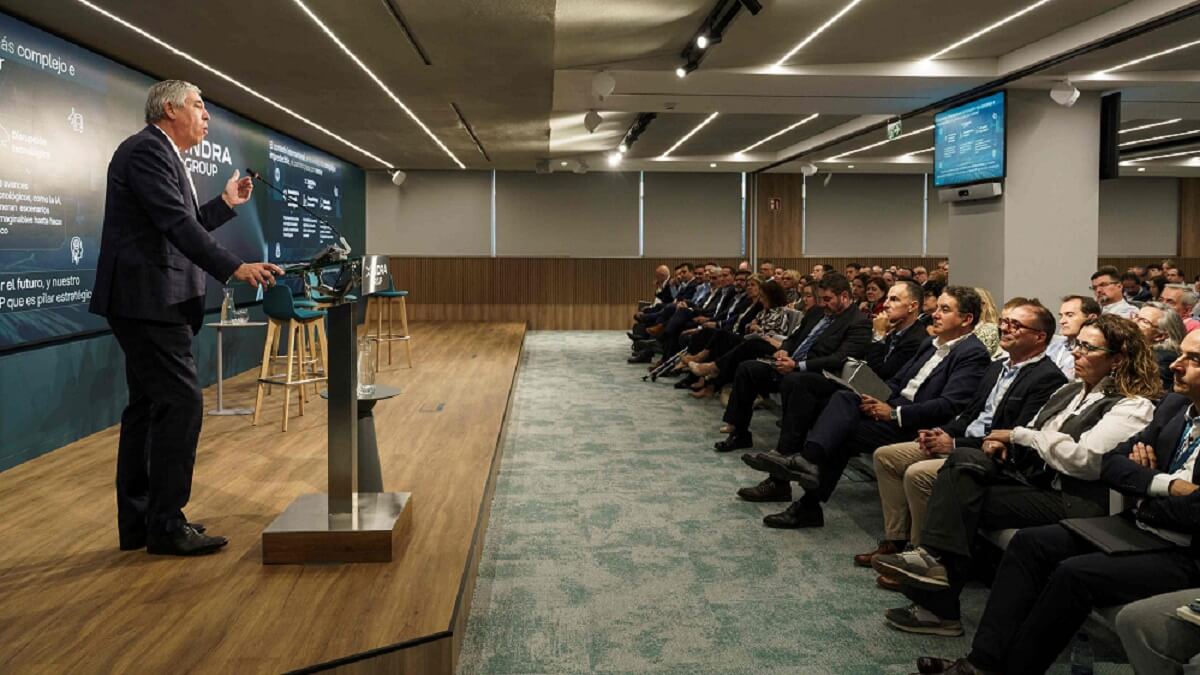
The CEO of Indra Group, José Vicente de los Mozos, gave a brief presentation of the company, highlighting its various lines of business and pointing out the needs that will arise at a time of complete transformation.
‘Government agencies, training centres and companies must work together to make this transformation a reality and to ensure that this moment serves to guarantee a quality future for young people.’ Indra Group currently has 346 agreements with vocational training centres, recalled María del Carmen Moneva, general director of Human Resources.
For his part, Manuel Ausaverri, Director of Strategy, highlighted the importance of talent in the company's strategy and the need to promote an ecosystem based on collaboration, proximity and shared success.
The conference was attended by institutional leaders who shared success stories resulting from collaboration between companies and educational centres. In this context, María Luz Rodríguez de Llera, Director General of Secondary Education, Vocational Training and Special Education, stressed that the Community of Madrid ‘will also commit to public-private collaboration to promote the talent of vocational training students and facilitate the transition from the classroom to the workplace.’
For the Secretary General for Vocational Training, Esther Monterrubio, vocational training "is a lever for the country: it converts the potential of young talent into innovation that improves businesses and our daily lives. In doing so, it accelerates the development of our industrial and technological capabilities,‘ she said. She also stressed that ’this result is no coincidence,‘ but rather ’stems from the alliance between institutions, vocational training centres and companies that share standards, responsibilities and vision."
During the conference, the sustained growth of vocational training in Spain was highlighted, with more than one million students enrolled this academic year. For this reason, special emphasis was placed on the demand for technological profiles, the importance of dual vocational training and the need to strengthen early guidance for young people.
Vocational training, key to specialities that are already strategic
Vocational training has established itself as an essential driver of employment, especially in strategic sectors such as industry, technology and telecommunications. Its practical approach allows students to enter the world of work with solid, practical training that is aligned with the real needs of industry. Some training programmes, such as Dual and Intensive Vocational Training, are presented as a direct route to employment; half of the vacancies published in 2024 were for vocational training graduates, according to a recent study by Adecco. The sector with the highest growth in recruitment is industry, according to the same analysis.
In this vein, throughout the event, it was reiterated that vocational training is a solid and effective route to leadership and innovation positions in the technology sector, where collaboration between companies, educational centres and institutions is key to attracting and developing young talent in rapidly expanding areas such as defence, aerospace, artificial intelligence and digital technologies. The speakers agreed that the emergence of generative AI, advanced analytics and quantum computing will continue to drive demand for technological profiles, and that trust in talent is essential to drive the development of organisations and compete in the global market. With initiatives in different autonomous communities—such as new factories, innovation centres, technology hubs and centres of excellence—Indra Group also identifies other emerging areas such as space, quantum electronics and autonomous systems where vocational training can be quickly adapted to the technological demands of today's market.