Iran: human toll and mass arrests


- Reminder
- 18th day of the uprising: clashes and street fighting
- The popular uprising continues
- Clashes spread to the provinces
- Conclusion
According to the People's Mojahedin Organisation of Iran (PMOI), the total number of detentions and arrests related to the uprising between 27 December 2025 and 13 January 2026 exceeds 50,000 people across the country.
Some of those detained en masse on the ground were subsequently released; their exact number is unknown.
Detentions continue in the form of surprise raids on homes, neighbourhoods and closed workplaces.
These figures are based on investigations carried out in 144 cities and testimonies collected in 76 other cities from eyewitnesses, family members, local staff and detainees.
It should be noted that only a comprehensive inspection of all the regime's prisons and detention centres would allow an accurate assessment to be made.
Reminder
Mohseni Ejei, head of the regime's judiciary, acknowledged that around 90,000 arrests were made during the 2022 uprising.
In May 2025, he publicly admitted that these cases affected students, secondary school pupils, teachers, women, men, workers and citizens from all social strata.

18th day of the uprising: clashes and street fighting
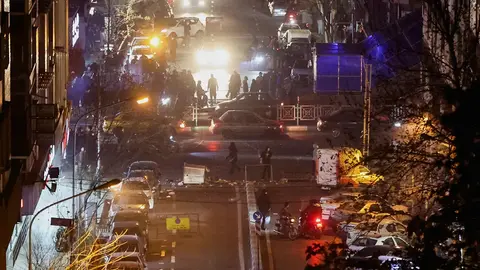
On Tuesday 13 and Wednesday 14 January, Tehran and many other cities across the country were the scene of violent clashes between young insurgents, the rebellious population and the repressive forces.
The popular uprising continues
- In Tehran, demonstrations took place in several neighbourhoods on Tuesday night with chants of ‘Death to the dictator’, accompanied by direct clashes with special units.
- Night-time gatherings were reported in the Ekbatan neighbourhood. In Naziabad, indiscriminate pellet fire caused several injuries among the demonstrators.
- On Tuesday morning, thousands of people accompanied the remains of the martyrs to the Behesht-e Zahra cemetery, chanting ‘Death to Khamenei’.
- On Tuesday night in Tehran, street clashes broke out between insurgents and special forces in several areas of the capital.
- Also in Tehran, insurgents set fire to an ammunition depot belonging to the IRGC and the Basij in the Gholhak neighbourhood.

Clashes spread to the provinces
- In Mashhad, during direct clashes, a colonel and three members of the Basij who were firing on the crowd were killed.
- In Kermanshah, fighting lasted throughout the night. In the Tagh-e Bostan area, regime forces opened fire on the population. Reinforcements were deployed from Qasr-e Shirin, Ravansar and Javanrud.
- In the province of Kerman, especially in Shahr-e Babak, the situation is described as almost warlike, with hundreds of arrests. Repressive forces were deployed with heavy weapons. The regime also practises financial extortion for the return of the bodies of victims.
- In Tabriz, in the Abresan neighbourhood, clashes continued between young insurgents and repressive forces.
- In Isfahan, young insurgents set fire to motorcycles belonging to the Basij.
- Clashes and persecutions were also reported on Tuesday night in Shiraz, Ilam, Karaj, Arak and Qom.
- In Yazdanshahr (Isfahan), insurgents put up determined resistance to gunfire from IRGC forces and special units.
Conclusion
Despite the communications blackout, massive repression and large-scale arrests, the popular uprising in Iran continues unabated. It has entered a more costly and violent phase, marked by direct and widespread confrontation between the population and the regime's repressive apparatus.