Morocco, a key partner in the fight against illegal immigration: arrivals in Spain drop sharply


The latest statistics released on Tuesday by the Spanish Ministry of the Interior confirm a notable trend: irregular migrant arrivals in Spain fell by nearly 30% between January and November 2025. This significant decline is largely attributed by Madrid to Morocco’s strengthened cooperation and sustained efforts in combating irregular migration networks.
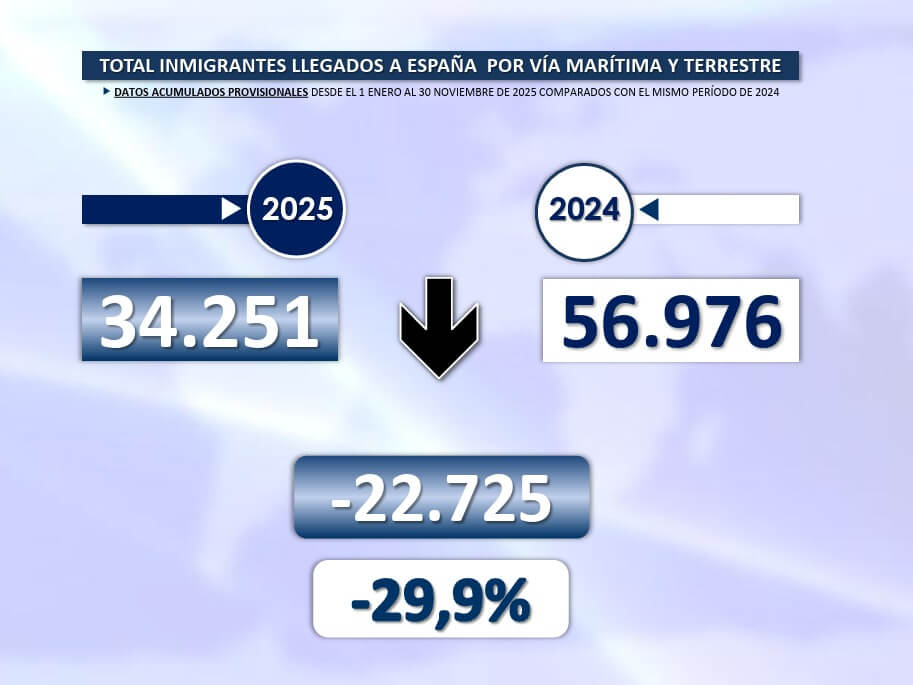
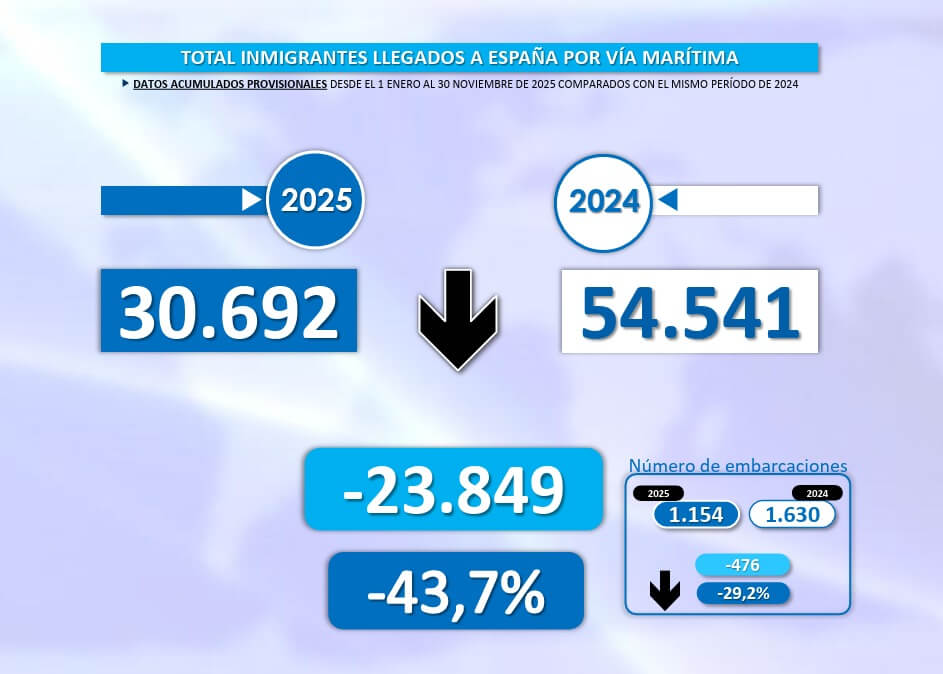
According to official figures, 34,251 migrants arrived in Spain during the first eleven months of 2025, compared with 56,976 over the same period the previous year — a drop of 29.9%. The decrease is even more striking for sea arrivals, traditionally one of the main pressure points of migratory flows. These fell by 43.7%, from 54,541 to 30,692 migrants.

This development is the result of a consolidated partnership between Morocco and Spain. In 2025, both countries increased maritime surveillance operations, real-time information exchanges, and crackdowns on smuggling networks. Rabat notably intensified its patrols along the Atlantic and Mediterranean coasts, drastically reducing the number of boats departing from its shores.
The Spanish Ministry of the Interior also highlights a 29.2% drop in the number of intercepted vessels — a direct indicator of the impact of upstream operations, mainly on the Moroccan side, where authorities are multiplying interventions to prevent departures before they even reach Spanish waters.
The decline in arrivals is particularly pronounced in the Canary Islands, which in recent years had become one of the main migration routes from African coasts. In 2025, only 16,807 migrants were registered there, compared with 41,425 in 2024 — a 59.4% decrease. This result is largely attributed to the effectiveness of the reinforced surveillance system between Morocco and its European partners.

While the overall trend is downward, some regions show contrasting developments. Arrivals on the peninsula and the Balearic Islands increased by 6%, a rise mainly due to more departures from Algeria towards the Balearics (+28.3%). Conversely, the Spanish mainland coast recorded an 8.7% decrease.
The enclaves of Ceuta and Melilla also present a nuanced situation. Sea arrivals remain almost non-existent (5 migrants in Ceuta, 25 in Melilla), but land entries have increased significantly, reaching 3,559 migrants compared with 2,435 in 2024. Ceuta received 3,268 migrants (+39.4%) and Melilla 291 (+219.8%).
Despite these regional variations, Spanish authorities acknowledge that the overall decrease in irregular arrivals is inseparable from Morocco’s role, now an essential partner in managing irregular migration. Through the modernization of its surveillance systems, an increase in on-the-ground operations, and close security cooperation with Madrid and Brussels, the Kingdom is actively contributing to stabilizing one of Europe’s most sensitive migration routes.