Murcia follows Madrid and removes Arabic language and Moroccan culture classes from its schools
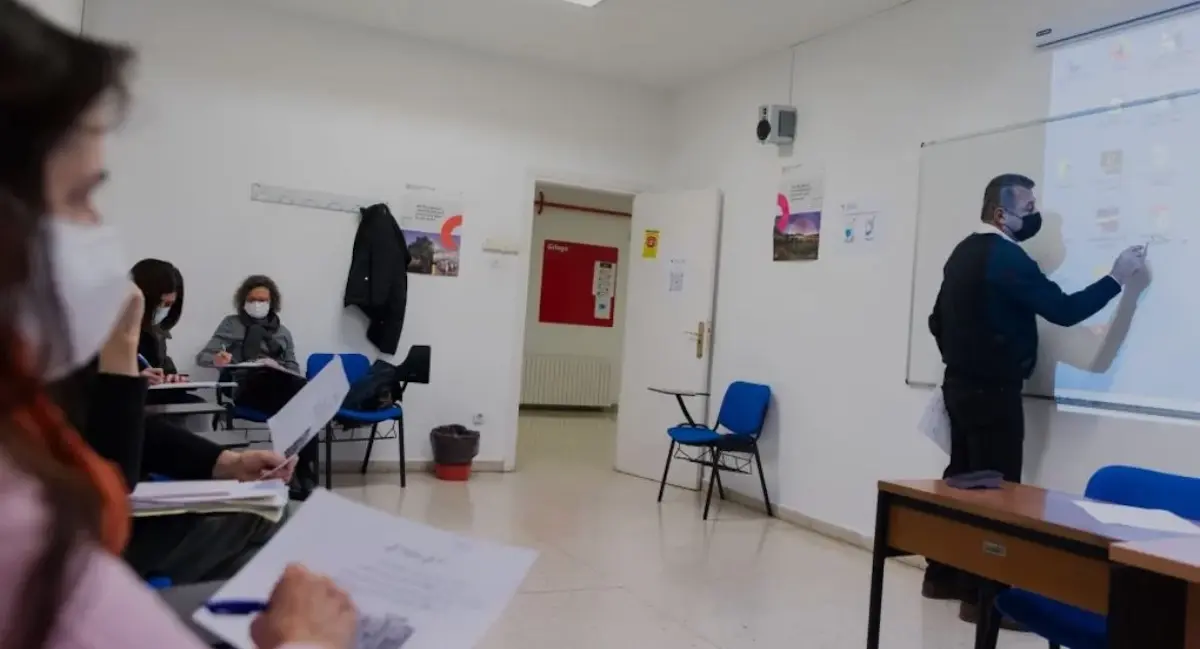
The two regions have successively announced the withdrawal of the Arabic Language and Moroccan Culture Teaching Program (PLACM), supported by the Spanish Ministry of Education and the Hassan II Foundation for Moroccans Living Abroad.
With the start of the new school year, students in Madrid and Murcia will no longer benefit from this program, which is nevertheless the subject of a state agreement between Morocco and Spain, with more than 30 years of fruitful bilateral cooperation in this area. The decision was made under pressure from the Popular Party (PP) and the far-right Vox party at the local level.
This setback was made possible because the integration or non-integration of certain educational units is one of the prerogatives of the Spanish regions, granted by the central government, as Mohamed Chaïb, former Socialist deputy in the Catalan Parliament (PCS) and the Spanish Congress (PSOE), points out in Yabiladi.
The first politician of Moroccan origin to sit in the Carrera de San Jerónimo chamber, he currently chairs the Ibn Battuta Foundation in Barcelona, where the PLACM continues to be effective. “Our organization also offers Arabic classes with a teacher, but it is essential that this learning remains primarily linked to public schools and conventional education.”
Mohamed Chaïb stresses that “many dangerous statements have been heard from the far right,” whose members have “linked the discourse against Moroccan migration with Morocco's own funding of the PLACM.” While controversial comments have been made, the former deputy stresses that the Moroccan side of this partnership “must also address the issue, in order to shed light on the future of learning within the framework of this program.”
In this case, Mohamed Chaïb believes that “it is now more important than ever to clearly define whether this bilateral agreement should continue to provide the framework for the public language and cultural learning we want, or whether this same program will be relegated to the management of associations willing to adopt and implement it as it stands today.”
In the same context, the researcher and sociologist, specialist in migration and Spanish journalist, Paulino Ros, from Murcia, who devotes most of his outreach work to this region (Murcia), known for hosting a large Moroccan community of several generations, considers that “the decision to withdraw the PLACM is extremely worrying, dangerous, and unfair.”
Author of the study “The Moroccans who changed Torre Pacheco in 40 years (1979-2019),” Paulino Ros points out that, in Spain, and even more so in Murcia, the importance of the PLACM “lies not only in the fact that it is a tool for students learning the language and culture of one of their two countries in a conventional educational environment.” “It is also a way for the school to connect with thousands of resident families through their children.
It is an educational tool that maintains an interactive dynamic between educational centers, their learning environment, teachers, students, and their family environment, with a fundamental educational dimension of socialization and integration.”
According to Paulino Ros, the Moroccan community in Murcia was not the only one surprised that such a measure of annulment took effect in an already damaging political climate. "We are part of the same social fabric here in Murcia; families are made up of natives of Spain, natives of Morocco, and dual nationals.
For several months now, the general feeling has been that the PP and Vox are carrying out systematic and daily attacks against Moroccans and against the Sánchez government, which is their battle horse."
In the same vein, Paulino Ros states that “there is still even more incomprehension regarding the objective reasons for the PP-Vox decision to withdraw the PLACM, when we know that, since its inception, this program has always worked well and proven its effectiveness, beyond the community component itself.”
“Moroccans and Spaniards attach great importance to this tool, which also enjoys widespread favorable opinion,” says the sociologist and journalist: "Murcia has 1.5 million people, of whom 120,000 are Moroccan, i.e., almost 10% of the regional population, and the overwhelming majority are related to labor migration.
You cannot denigrate a public policy program simply to amplify attacks on a community.“ Paulino Ros also criticizes ”electoral maneuvers that serve the agenda of the far right as the next elections approach."
According to the researcher, “this is what the PP-Vox alliance is doing at the regional level, constructing a biased discourse on cultural specificities and on an ideology that is not only hostile to migration in general, but also rejects above all the Moroccan component, a social component that is integrated, coherent, and sensible in all regions, including Murcia.”
Paulino Ros also believes that right-wing alliances are taking advantage of the very nature of the education system “to counteract a global and national inclusive political vision.” “They distill their toxic discourse in daily doses through their media broadcasts.”
For the moment, civil society organizations “are mobilizing against the measures that PP-Vox are taking or want to take at the local level.”Despite this, the sociologist continues to doubt the immediate effects if this dynamic is not reinforced and accompanied by political initiatives.
“Left-wing parties are also taking initiatives at the local level to respond to the initiatives of the far right, whether it be the PSOE, Sumar, Podemos, or other groups,” says Paulino Ros, adding that, through NGOs and trade unions, lawyers are studying the possible legal consequences of measures such as the withdrawal of the PLACM in relation to constitutional principles. “But we must bear in mind that justice takes a long time and that a possible cancellation could take up to two or three years,” Paulino Ros points out.