The Mediterranean between environmental awareness and the Cousteau legacy: From the silent world to the noise of data
- Does the Mediterranean need more conferences? Or more national debates on political will and digital transparency?
- A region in crisis: the liminal space between science and politics
- Environmental justice and governance
- Scoullos: A growing gap between awareness and action, “the greatest injustice” to future generations
- From the voice of science to the echo of memory: Cousteau's granddaughter speaks
- From the “Silent World” to the noise of data
- From awareness to action
- When science and traceability meet urgency
Does the Mediterranean need more conferences? Or more national debates on political will and digital transparency?
Amidst the turmoil beneath the Mediterranean waves and growing signs of ecological stress, the search for a balance between exploitation and protection continues.
However, despite growing awareness among scientists, NGOs, and civil society, implementation remains slow, hampered by commercial interests, bureaucracy, and a lack of political will.
At the close of the aforementioned GFCM session, it became clear that protecting the sea is not only a matter of scientific knowledge, but also of moral choices for the future.
A region in crisis: the liminal space between science and politics
The Mediterranean shows the growing gap between scientific recommendations and their implementation.
The lack of reliable and accurate data delays the development of effective policies, while administrative procedures, often shaped by pressure groups, slow down decision-making.
At sea, control remains weak and enforcement is almost non-existent. It should be remembered that international waters represent less than 1% of the Mediterranean, and that most fishing activities take place in Exclusive Economic Zones (EEZs), where surveillance depends almost entirely on national authorities and the availability of reliable data.
Illegal fishing practices, undocumented discarding of marine species, violation of seasonal limits, and capture of prohibited species persist, while port controls remain insufficient despite technological advances.
But the most serious challenge remains the inability to translate scientific awareness into political commitment, especially given the difficulties faced by artisanal fishers and the public's limited understanding of the risks and the need for action.
Environmental justice and governance
Mediterranean fishing goes beyond the ecological sphere: it affects environmental justice between North and South, East and West, and even intergenerational equity.
While some countries have advanced tracking technologies, others lack even the most basic tools.
The greatest injustice is that imposed on future generations: an impoverished sea, threatened biodiversity, and an ecosystem weakened by overexploitation, climate change, and invasive species.
Modern traceability technologies offer unprecedented possibilities for observation and analysis, but without effective governance and collective will, the Mediterranean will remain trapped in administrative and institutional inertia.
Scoullos: A growing gap between awareness and action, “the greatest injustice” to future generations
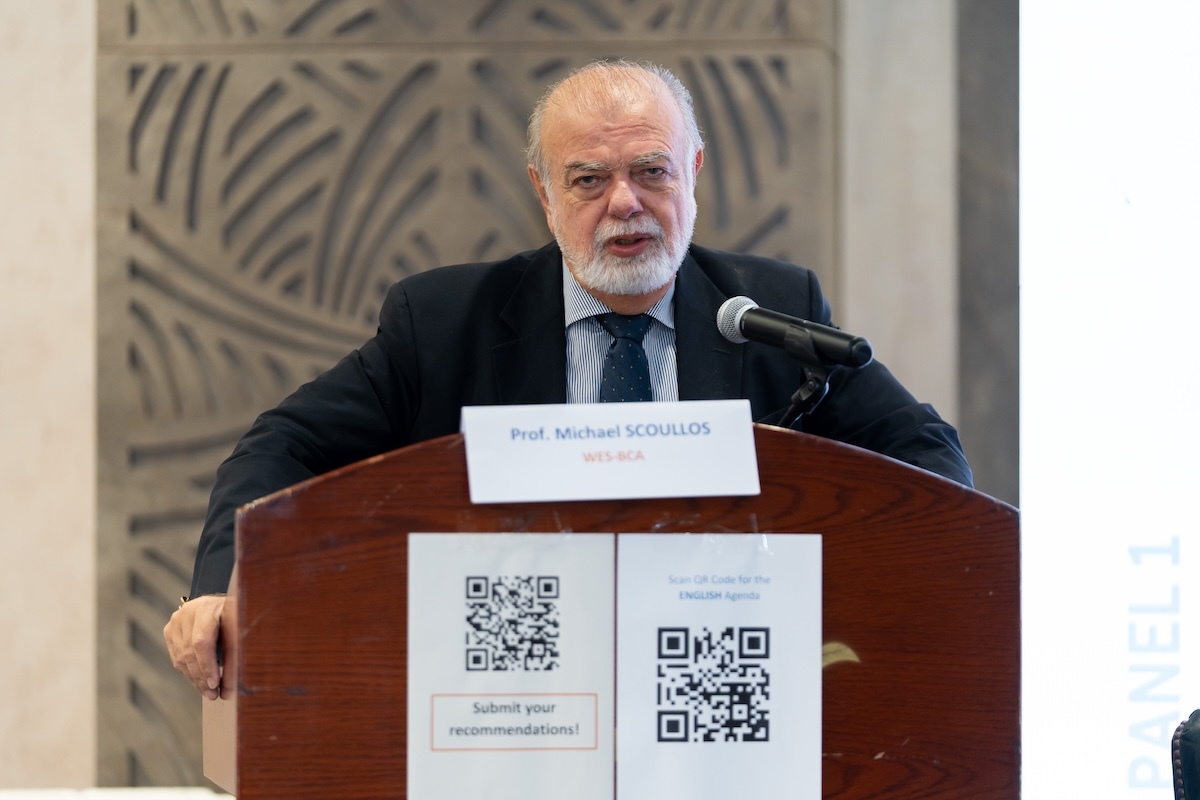
Professor Michael Scoullos, environmental chemist and Director of the Ecology Laboratory at the University of Athens, warns of the growing gap between greater scientific understanding of the Mediterranean crisis and the extremely slow pace of implementation of appropriate policies to solve the problems.
He explains: “The clear gap between the greater awareness of scientists, NGOs, and much of the public about the environmental crisis in the Mediterranean, and the very slow adoption of scientific recommendations by regional or international governments and institutions, is due to a combination of factors that vary from country to country, depending on fishing priorities, the level of awareness, and the capacity of national and regional agencies.”
According to Scoullos, the lack of reliable data is the first major obstacle, as most environmental research in the Mediterranean has significant gaps.
This seriously delays the development of sound recommendations that can guide public policy. Even when these policies are drafted, they require government and parliamentary approval through lengthy procedures heavily influenced by national and sectoral interests and pressure groups.
In practice, implementation remains the weakest link, especially at sea, where monitoring is extremely difficult, even in national waters, and almost non-existent in international waters. Illegal fishing, the use of prohibited gear, the violation of closed seasons, the capture of prohibited species or sizes, and the absence of landing controls remain common, despite technological advances.
Scoullos adds that a lack of political will plays a decisive role in maintaining the status quo. The crisis affecting artisanal and semi-industrial fisheries makes governments reluctant to impose stricter measures, while the general public remains poorly informed about the seriousness of the situation and the need to reduce the footprint of unsustainable fishing.
He stresses that public awareness and debate on fisheries sustainability remain insufficient and that policies need to be more coherent and harmonized at the national and regional levels.
They must be supported by realistic control mechanisms, efficient monitoring systems, and accurate assessments of pressures on resources, including the impacts of climate change and invasive species.
Scoullos also points to the complexity of environmental justice in fisheries, one of the most challenging issues in the Mediterranean, where disparities in technological capacity and political power between North and South, and even among the countries of the South themselves, intersect with traditional practices.
Great progress could be made through the proper application of the Law of the Sea and the existence of well-trained and informed coast guards.
However, “the greatest injustice,” he says, is that inflicted on future generations:
“We are leaving behind a poorer, less diverse, and increasingly degraded sea as a result of overfishing and the rapid spread of invasive species, exacerbated by climate change driven by our emissions.”
The specialist concludes by stating that modern technologies offer unprecedented capabilities to monitor and understand the impact on climate, pollution, and invasive species, as well as to assess fishery resources and guide the necessary transformations towards a more sustainable future.
But all this depends on effective governance, at a time when international mechanisms are showing signs of stagnation, delaying the implementation of science-based policies. The researcher asserts that public awareness and citizen participation can generate real pressure on policymakers to act responsibly and effectively before it is too late.
From the voice of science to the echo of memory: Cousteau's granddaughter speaks
At the conclusion of the 48th session, a symbolic message from the heart of the sea was addressed to the governments of Tunisia, Morocco, and Egypt by Alexandra Cousteau, granddaughter of legendary oceanographer Jacques-Yves Cousteau.
The message, rooted in a family heritage dedicated to ocean protection, was clear: “Adopt the International Maritime Organization (IMO) numbering system for all fishing vessels. It is free, effective, and a step toward transparency in the Mediterranean.”

It was not just a technical proposal, but a moral call. An echo of Jacques Cousteau's legacy, reminding us that protection begins with knowledge, and transparency is the first gateway to preservation.
Why these countries specifically? Because the numbers speak for themselves:
In Tunisia, less than 40% of registered vessels have an IMO number.
Egypt, Tunisia, and Morocco are members of the IMO and can assign numbers, but their implementation in fisheries remains limited. Egypt assigns numbers mainly to large commercial vessels; those under 20 m are not yet included. The Tunisian fleet is mostly artisanal, with vessels under 15 m. Therefore, few are eligible.
Morocco is the most advanced, with IMO numbers for most industrial vessels, although many small vessels still operate outside the system.
At the GFCM session in November 2025, the proposal to make IMO numbers mandatory for vessels from 15 m was not adopted.
The measure, considered essential for transparency, was limited to vessels of 20 m or more, generating mixed reactions.
Marine scientist Helena Alvarez noted: “The GFCM's decision to require IMO numbers for vessels from 20 meters is a step in the right direction, but it is still insufficient.”
The WWF welcomed the progress but insisted on also including smaller vessels.
Simone Niedermüller, interim head of fisheries policy at WWF-Mediterranean, emphasized: “It will be essential that all vessels of this size leaving their EEZ have an IMO number in the future. Further measures will need to be taken to extend robust identifiers to smaller segments.”
The measure, however, leaves a loophole: many industrial and semi-industrial vessels between 15 and 20 meters operate in international waters, thus avoiding the IMO registration requirement.
This makes them less traceable and undermines fair competition, especially since the EU already requires IMO numbers from 15 meters on the high seas.
Without IMO numbers, verifying a vessel's identity, history, or ownership becomes difficult, and operators can more easily change names or flags.
From the “Silent World” to the noise of data
In the 1950s, Jacques-Yves Cousteau broke the silence of the deep in his legendary film The Silent World (1956). Today, his granddaughter is trying to break another silence: that of data, advocating for digital transparency in vessel tracking. The essence of her message is: “For Alexandra Cousteau, transparency in vessel tracking is the first condition for any form of protection.”
The same message persists across both generations, expressed in different language: the grandfather carried a camera to show the beauty of the world; the granddaughter raises digital codes to reveal its truth. From the lens of the Calypso to IMO codes, the spirit remains:
To love the sea is to know it, and to know it is to protect it.
From awareness to action
The 48th session of the GFCM did not offer a magic wand, but it did issue a call to action: Will Mediterranean governments respond to Alexandra Cousteau's appeal?
Will the commission finally adopt IMO numbers as instruments of justice and transparency for vessels over 15 m?
As Jacques Cousteau said: “We only protect what we love, and we only love what we understand.”
Today, it is impossible to understand, or protect, the Mediterranean without digital transparency that reveals what is happening on its surface and in its depths.
Adopting IMO numbers for vessels of 15 m or more is not a bureaucratic act, but a conscious gesture of love for the sea and future generations.
When science and traceability meet urgency
At the close of the session, amid expert reports and messages from activists, two voices, those of Scoullos and Cousteau, joined in harmony:
A call to move from awareness to action, from words to decisions.
The Mediterranean does not need more conferences: it needs political will and digital transparency. As Simone Niedermüller of WWF-Mediterranean points out: “This year's decisions show real momentum, but the hardest work begins now...”
Mohammed Tafraouti. Environmental writer and journalist