
Social revolution in a context of structural crises: a comparative reading of revolutionary theories and the current situation in Iran

- Introduction
- The crisis of legitimacy: collapse of ideology, performance and representation
- Internal power fractures: from the disintegration of cohesion to the succession crisis
- Structural economic crisis and collapse of the middle class
- Social mobilisation: the emergence of decentralised resistance networks
- Accumulation of discontent: the J-curve and the collapse of social hope
- Accumulation of discontent: the J-curve and the collapse of social hope
- A structured political alternative
- Generational rupture and a new paradigm of values
- Erosion of repressive capacity: the ultimate condition for a revolutionary transition
- Conclusion
An analysis of the political, economic, cultural and security dynamics of the Islamic Republic, supported by numerous empirical examples, reveals that Iranian governance is in a state of chronic instability. The simultaneity of several structural crises is pushing the country towards a phase that could be described as a ‘pre-revolutionary transformation stage’.
Introduction
In most theories of revolution, a social revolution is not the result of a single factor, but rather the convergence and accumulation of structural crises affecting the state, the economy, society and culture. This article examines how these factors operate simultaneously in contemporary Iran, as well as their possible implications for the evolution of the political system and scenarios for the transition of power.
The crisis of legitimacy: collapse of ideology, performance and representation
Theoretical framework
From Max Weber's perspective, legitimacy constitutes the basis for the survival of a political system. In the case of the Islamic Republic, this basis has been profoundly weakened in its three essential dimensions: electoral, functional and ideological.
Electoral legitimacy
The turnout rate of around 8% in Tehran in the last elections, as well as polls conducted by institutions close to the government—which indicate that only 10% of the population would support the regime's continuity—reflect a serious erosion of electoral legitimacy. For a system that claims to be a “religious democracy”, these figures reveal a structural collapse of confidence in political representation.
Functional legitimacy
Persistent inflation above 40%, the collapse of the rial, the chronic water crisis, deadly air pollution and the general deterioration in living standards reflect the state's inability to manage the economy and the environment.
Phenomena such as water shortages in Khuzestan, the drying up of the Zayandeh-Roud, the near disappearance of Lake Urmia and the destruction of numerous wetlands highlight the state's inability to guarantee even vital infrastructure.
Ideological legitimacy
International reports, particularly those of the UN Special Rapporteur, document the mass executions of the 1980s, the violent repression of the uprisings of 2019 and 2022, and the systematic violence against intellectuals and artists.
The policy of compulsory hijab and institutionalised violence against women have severely eroded the regime's ideological legitimacy.
Generation Z, in particular, strongly disagrees with the official ideology of velayat-e faqih (the guardianship of the Islamic jurist). The gap between a modern lifestyle, centred on individual freedoms, and the ideology of the state has produced a deep identity fracture.
In Juan Linz's analysis, the simultaneous collapse of the three forms of legitimacy marks the beginning of a “pre-revolutionary phase”.

Internal power fractures: from the disintegration of cohesion to the succession crisis
A fundamental principle emerges from the work of Theda Skocpol and Charles Tilly: a state becomes vulnerable to a revolutionary movement when the cohesion of the ruling elites disintegrates.
The two main power blocs: the so-called pragmatic current...
This current, which brings together part of the Islamic Revolutionary Guard Corps (IRGC), technocrats and figures such as current President Massoud Pezeshkian and former President Hassan Rouhani, considers the ‘social explosion’ to be the main threat. According to this faction, the combination of poverty, structural discrimination against women, systemic corruption and widespread repression makes an uprising even greater than that of 2022 likely.
Its strategies are as follows:
- Reduce tensions with the West.
- Use sanctions relief to provide economic respite.
- Slightly relax social space.
- Maintain the structure of the regime by softening its façade....
...and the radical current
Embodied by part of the Qods Force (extraterritorial unit of the IRGC), the intelligence services and figures such as Mojtaba Khamenei, Hossein Taeb and Saïd Jalili, this current considers ‘ideological dilution’ to be the existential threat.
According to this current:
- Any negotiation with the United States is tantamount to capitulation;
- Any retreat on the compulsory hijab weakens the regime's ideological identity.
Its orientations are based on maximum security, total resistance to the West and the rejection of any reform.
Despite their differences, both currents agree on one essential point: the main threat comes from popular uprising. Therefore, the use of force, executions and repression are not a major source of disagreement.
Signs of disintegration of state cohesion
- • Intensification of tensions between the ‘negotiating’ and ‘radical’ factions on the nuclear issue.
- • Growing rivalries over the succession of Supreme Leader Ali Khamenei.
- • Mass exodus of technocrats and middle-ranking commanders from the IRGC.
- • Greater fragmentation within the IRGC itself.
These elements show that the traditional cohesion of the core of power is seriously compromised. In revolutionary theory, such a fracture is an essential prerequisite for a transformation of the regime.
Structural economic crisis and collapse of the middle class
From the perspective of Marx and Wallerstein, revolutions often arise from a profound crisis in the economic system. Iran is a particularly striking example of this phenomenon.
Indicators
- Nearly 80% of the population lives below the relative poverty line and some 30 million people below the absolute poverty line.
- The Gini coefficient is at one of its highest levels in forty years.
- The country has one of the highest brain drain rates in the world.
- The water crisis has left several regions in a situation of almost structural scarcity.
Taken together, these elements point to the collapse of the state's extractive and redistributive capacity, i.e. its inability to guarantee a minimum level of public services and social stability.
Social mobilisation: the emergence of decentralised resistance networks
According to Tilly and McAdam, revolution is only possible if society has a capacity for sustained mobilisation. The last decade in Iran perfectly illustrates this dynamic.
Notable examples
- The national uprisings of 2017, 2019, 2020 and 2022.
- The ‘Woman, Life, Freedom’ movement, active in more than 280 cities;
- Networks of strikes and protests by workers, teachers and pensioners;
- The expansion of ‘resistance units’, which have carried out more than 3,000 actions over the past year.
This configuration fits the model of mobilisation without a centralised hierarchy described by Tilly, which is particularly difficult to neutralise in an authoritarian context.
Accumulation of discontent: the J-curve and the collapse of social hope
In James Davies' model, a revolution becomes likely when a period of relative improvement is followed by a brutal deterioration. Ted Gurr's theory emphasises the growing discrepancy between social expectations and the capacity of the state.
Demonstrations in Iran
- Youth aspirations aligned with global norms, without political mechanisms to respond to them;
- Continued contraction of the economy, confirmed by the World Bank;
- Implicit recognition of the crisis by the authorities themselves in their alarmist speeches.
Iran is in what Davies defines as the phase immediately preceding social explosion.
External pressure and weakening of state capacity
For Skocpol, external pressure is one of the main catalysts of revolutionary processes.
In Iran:
- Sanctions have drastically reduced the state's financial resources.
- The possibility of the snapback mechanism further isolates the country.
- Repeated security failures, especially after the 12-day war, have highlighted the fragility of the security apparatus.
These changes increase the cost of repression and reduce the regime's ability to manage internal crises.
A structured political alternative
Huntington points out that a revolution without an organised alternative leads to chaos or failure. Iran clearly stands out in this regard.
Examples
- The NCRI proposes a structured programme based on the separation of religion and politics, gender equality, the abolition of the death penalty and a nuclear-free Iran.
- Resistance units ensure operational continuity with civil society.
- Significant support expressed in various Western parliaments reinforces the legitimacy of this alternative.
-
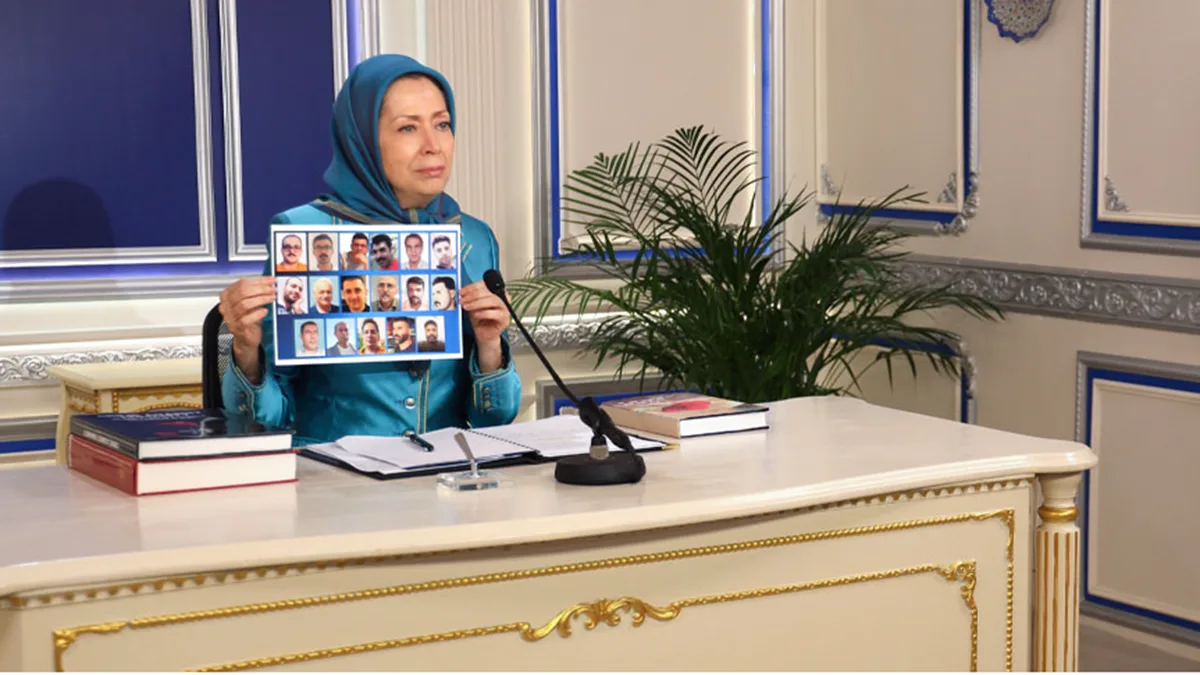
CNRI President-elect Maryam Rajavi during a conference against the death penalty in Iran
CNRI President-elect Maryam Rajavi during a conference against the death penalty in Iran
Inglehart's theory of value change provides a relevant framework for understanding the profound social transformations in Iran.
Characteristics
- Secular, egalitarian and individualistic values.
- Identity construction through transnational networks.
- Deep mistrust of official institutions.
Manifestations
- Civil resistance against the compulsory hijab;
- Total disconnect between the values of youth and the ideology of the state;
- Redefinition of political participation outside institutional structures.
- This situation is a typical example of normative rupture, a classic driver of revolutionary transformations.

Erosion of repressive capacity: the ultimate condition for a revolutionary transition
The work of Skocpol and Tilly shows that a revolution only succeeds when the repressive capacity of the state disintegrates.
Indications in Iran
- Significant reduction in the numbers of Basij and other paramilitary forces.
- Persistent tensions between the IRGC and the Ministry of Intelligence.
- Staff shortages and increased reliance on external reinforcements.
- Growing demoralisation and departure of young IRGC members after the 12-day war.
Although repression persists, the regime's actual capacity to contain an uprising of a magnitude comparable to that of 2022 appears to be clearly weakened.
Conclusion
This study shows that at least nine of the ten classic factors of social revolutions are present in Iran today: crisis of legitimacy, internal fractures, economic collapse, increased mobilisation, accumulated discontent, external pressure, existence of an alternative, generational rupture and weakening of the repressive apparatus.
The convergence of these factors places Iran in a configuration that revolutionary theories describe as ripe conditions for revolution.
The presence of an organised alternative distinguishes Iran from many regional cases and makes the prospect of a profound political transition more plausible.
Article previously published in La Dépêche