
Morocco-Algeria: from the war of the sands to the war of narratives


- Types of relations between states
- What type of relationship can be attributed to Morocco and Algeria?
- Proxy war
- Hybrid warfare
- War of narratives
What particularly caught the attention of some observers was not only the redefinition of the parties involved in the Moroccan Sahara conflict, leaving out the Polisario Front, but above all the use of the term ‘peace agreement,’ which suggests that the two Maghreb nations are at war. Witkoff added: ‘My team is actively working on this agreement, and I believe it will be finalised within the next 60 days.’ Although this initiative is part of the Trump administration's ongoing efforts to stabilise the region, normalise bilateral relations and resolve the Moroccan Sahara conflict, a legitimate question arises: what is the real state of relations between Morocco and Algeria? Are the two Maghreb nations undergoing a deep crisis that could trigger a military confrontation at any moment? Have they always been marked by high-tension open conflict, whether in the form of a hot proxy war or a hybrid cold war?
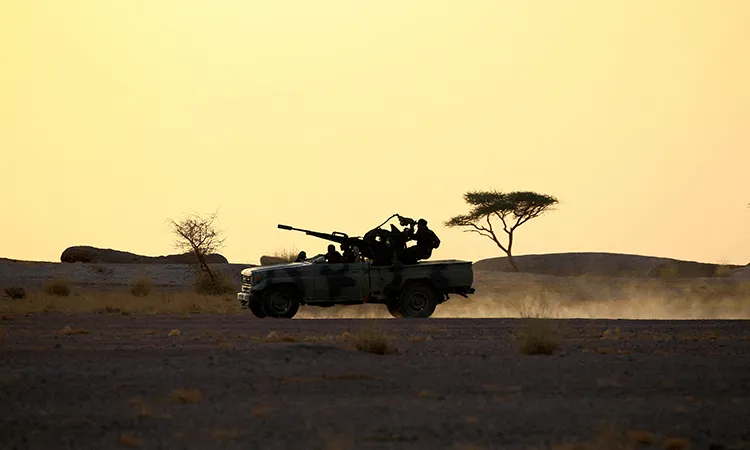
Across the vast expanses of the Moroccan Sahara, both east and west, where the grains of sand still whisper the secrets of the Cherifian empires that forged Morocco's history, the echoes of cannons continue to resonate in an ever-living memory, recalling the long and complex history of a cold war that unites Morocco and Algeria. This history began in the early 1960s, during the Sand War (1963), and continued through the Battle of Amgala (1976), where the armed forces of both countries clashed directly, revealing the true nature of Algeria's involvement in the Sahara conflict. Since then, the language of iron and fire has continued to be heard, from Guerguerat on the southern border to the many episodes of a proxy war that, without ever being named, continues to shape relations between the two nations.
Types of relations between states
In international relations, the typology of relations between states generally distinguishes between several forms or types of relations, ranging from more technical cooperation to open confrontation. Thus, inter-state relations can take the form of sectoral cooperation, based on bilateral collaboration in specific areas such as the economy, security, culture or the environment. They can also evolve into a strategic partnership, characterised by an institutionalised, lasting relationship consolidated by mutual trust and converging interests. At the opposite end of the spectrum, certain relations are defined by strategic rivalry, marked by persistent opposition of interests, but without direct confrontation, or even by a crisis situation, where the breakdown of dialogue, threats or the use of force predominate. Finally, at the most extreme level of tension, there is open conflict, which translates into armed confrontation, whether localised or prolonged.
What type of relationship can be attributed to Morocco and Algeria?
It is clear, some observers will respond, that relations between Morocco and Algeria are characterised by persistent strategic rivalry, reflecting a situation of latent but not bellicose conflict. According to this logic, this rivalry would translate into mutual political distrust, competition for regional leadership and a lack of institutionalised cooperation, even though the two countries share deep historical, cultural and linguistic ties. However, for the most knowledgeable specialists on the Maghreb, it is less a simple dynamic of rivalry than a genuine geopolitical conflict, insofar as Algeria plays a decisive role in the genesis and perpetuation of this state of tension, notably through the political, diplomatic and military instrumentalisation of the Polisario Front, turning it into a lever of pressure and destabilisation aimed at weakening Morocco on the regional stage and compromising its territorial integrity.
But if that is the case, how can we understand and explain the Trump administration's preparation of a ‘peace agreement’ between the two Maghreb countries when there is not even a declared armed conflict between Morocco and Algeria at present? Why talk about a peace agreement, and not a reconciliation agreement, or even a normalisation agreement? Such terminology calls into question the American perception of the real nature of the Moroccan-Algerian dispute and suggests a willingness on Washington's part to introduce a security-based interpretation of the conflict, framing it not as a regional political rivalry but as a situation of peace to be restored between two states supposedly in open opposition, or more precisely in a situation of non-peace.
Certainly, Morocco and Algeria are not at open or ‘hot’ war in the classic sense of the term, i.e., a direct and widespread armed confrontation between their regular forces. There is currently no mutual invasion, massive bombing or formal declaration of war. However, the two countries have been engaged in a latent and hybrid conflict for more than 50 years, which can be described as a regional cold war with elements of proxy warfare and information warfare. In this context, it is not a question of a structural peace that goes beyond the simple absence of armed conflict, but rather of prolonged hostility, which justifies Washington's use of the term ‘peace agreement’. It is less a matter of ending an active war than of defusing explosive tensions that threaten the stability of North Africa.
For several decades, relations between Morocco and Algeria have apparently oscillated between diplomatic crisis and media war, without, however, tipping over into open armed conflict. They thus belong to the type of relations that international relations literature describes as regional cold war, or negative peace, where hostilities are suspended but mistrust remains total. The notion of negative peace, as defined by Norwegian sociologist Johan Galtung, applies perfectly to the situation of relations between Morocco and Algeria. It refers to an intermediate state characterised by the absence of structured peace, i.e. without resolution of the root causes of the conflict or genuine cooperation, and by the absence of open warfare, marked by the absence of widespread fighting or massive attacks involving regular casualties. In this context, only a proxy war remains, suspended by a fragile ceasefire concluded in 1991 under the aegis of the United Nations, but regularly violated by Polisario militias acting under orders from Algiers.
To understand why such a ‘peace agreement’ could be perceived as necessary, it is useful to analyse the situation of this ‘negative peace’ that characterises relations between Morocco and Algeria through the articulation of three fundamental concepts of international relations: proxy war, hybrid war and narrative war.

Proxy war
A proxy war refers to an armed conflict in which two rival powers confront each other indirectly by supporting, financing or arming opposing factions in a third country, without directly engaging in hostilities. It can also take the form of a strategy in which a state mobilises armed groups or mercenaries in order to destabilise another state and defend its own geopolitical interests without openly assuming responsibility for the conflict. This is exactly what has allowed Algeria to advance its strategic interests (ideological, territorial and geopolitical) while avoiding a direct escalation that could lead to a global confrontation with Morocco.
Since 1975, Algeria has actively supported the separatist Polisario Front movement, providing it with weapons, bases and training from its territory. This would allow Algiers to weaken Rabat without direct involvement. When the Algerian regime creates, harbours, arms and mobilises the Polisario against Morocco from its territory, this perfectly fits the definition of a proxy war: a state (Algeria) supports and finances a third party (the Polisario) to carry out hostilities in a target country (Morocco), allowing it to reinforce its geopolitical interests (opposition to Moroccan territorial integrity) without risking all-out war.
Taking into account the different aspects of this proxy war, it can be considered that there is no declared war between Morocco and Algeria in the classical sense of the term, but neither is there true peace. It is therefore a situation of ‘non-peace’, masked and maintained by the indirect mechanisms of a proxy war. Relations between Morocco and Algeria thus remain marked by a prolonged technical truce, resulting from the ceasefire observed by MINURSO, which, in the absence of a comprehensive and definitive peace agreement, and due to persistent minor violations, has frozen the situation in a proxy war rather than establishing real peace.
Hybrid warfare
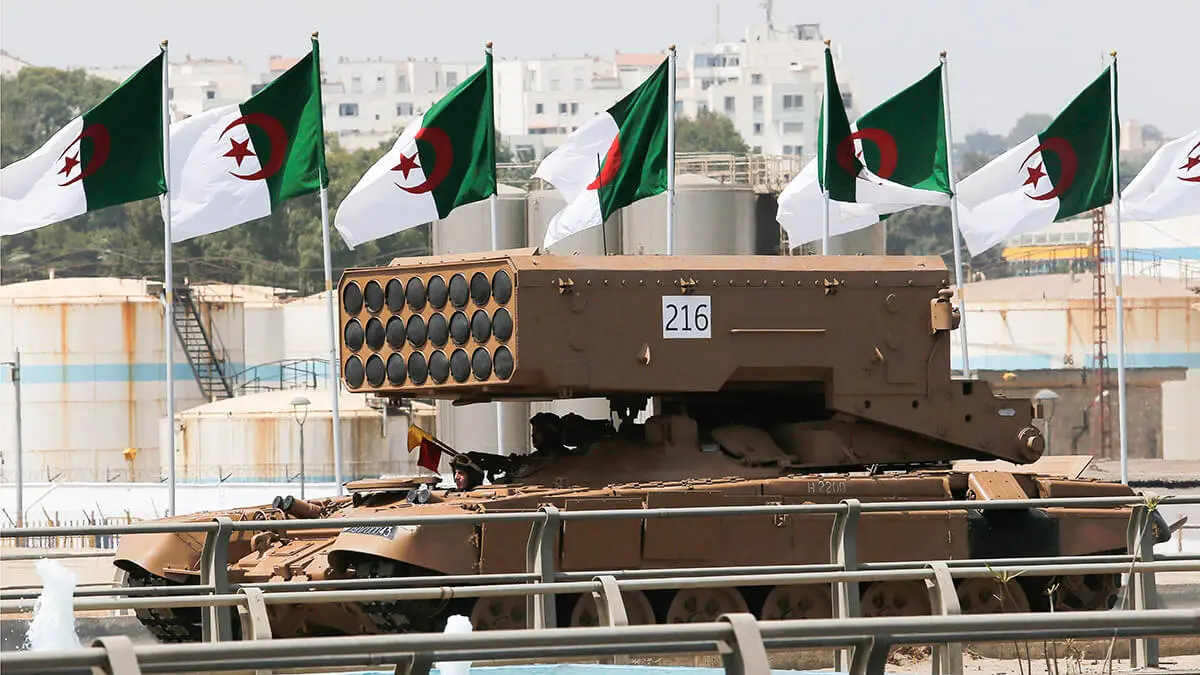
Hybrid warfare is a form of modern conflict that combines traditional methods of conventional warfare (troops, weapons) with unconventional tactics such as irregular warfare (guerrilla warfare), cyberattacks, disinformation, psychological operations, and economic or political interference. Its aim is to destabilise the adversary asymmetrically, blurring the lines between peace and war. This concept has been popularised in analyses of Russian actions in Ukraine since 2014, where “separatist” forces were backed by cyber and propaganda operations.
The conflict in the Moroccan Sahara provoked by Algeria appears to integrate hybrid tactics that include military attacks (through the Polisario Front), but also unconventional measures, such as the unilateral closure of borders, the severing of diplomatic relations and the closure of airspace to Moroccan aircraft. These actions blur the lines between peace and war, combining economic pressure (border isolation), political pressure (diplomatic rupture) and strategic pressure (air control). The display of hostility towards Moroccan territorial integrity in official Algerian discourse reinforces this hybridity, mixing ideological claims (instrumentalisation of the Polisario as a ‘liberation movement’) with asymmetric destabilisation operations. Unlike a conventional war, there are no open confrontations between the armed forces of the two countries, but rather an accumulation of actions carried out by Algeria to wear down its Moroccan neighbour.
In addition to unilateral diplomatic and border ruptures, Algeria, through its official media, carries out anti-Moroccan propaganda aimed at influencing international and domestic perceptions. Spreading virulent ideological rhetoric, these media outlets not only question Morocco's territorial integrity, but also accuse Rabat of being behind the fires that have ravaged Kabylia, of deploying ‘Zionist intelligence agents’ and of carrying out ‘various actions threatening Algeria's stability and national security’. This fuels a psychological war, with disinformation campaigns in the state media, social networks and international forums.
This dynamic is part of an information war, which manifests itself through cognitive manipulation campaigns aimed at delegitimising Morocco, particularly on the issue of its territorial integrity, spreading hostile narratives and influencing public opinion. It is a weapon of “soft” influence, which contributes to exacerbating tensions without directly resorting to military force, and which often complements actions carried out in the context of proxy warfare.
War of narratives
The artificial conflict over the Moroccan Sahara is not only a territorial conflict, but also a war of strategic narratives aimed at legitimising their respective causes in the eyes of public opinion and international actors. It is a war that illustrates the strategic competition between Morocco and Algeria for international legitimacy and political support.
The Algerian narrative, centred on an ‘anti-colonial cause’ with unconditional support for the Polisario as a ‘liberation movement’, is running out of steam in the face of a growing consensus around the Moroccan initiative. This anti-colonial and Third World discourse, built around a stance of championing ‘oppressed peoples,’ effectively reached its peak during the Cold War, precisely because of the massive echoes it received from communist and radical leftist movements, forces then at the zenith of their ideological and organisational influence. Today, this discourse has lost its persuasive power since the Cold War era, when it benefited from a favourable ideological context and was able to mobilise solid alliances and a receptive international audience. The decline of its traditional allies largely explains the exhaustion of this narrative, which today seems deprived of its former supporters. Algiers, despite its efforts (state media, lobbying at the UN), is no longer able to ‘export’ its discourse, which survives as an internal ritual to consolidate the regime, but without the magic of yesteryear. Reports from various think tanks emphasise that the Polisario, orphaned by its radical allies, must adapt or disappear.
The defeat of the Algerian narrative in the Moroccan Sahara conflict can also be explained by its anachronism and its disconnect from contemporary global reality. Its discourse is based on concepts typical of the Cold War, such as anti-imperialism, decolonisation, the rights of peoples and self-determination, which, although still relevant in certain contexts, have lost their vigour and resonance in a world that demands more pragmatic approaches adapted to current multipolar dynamics. This conceptual rigidity limits its ability to connect with international audiences and political actors who value stability, development and regional cooperation.
In the context of this war of narratives, with both sides deploying opposing discourses to defend their positions, Morocco has gradually strengthened its position through a discourse that combines historical sovereignty, economic development and regional stability, backed by effective diplomacy and diversified international alliances. This progress has enabled it to gain ground in multilateral forums and the mainstream media, gradually eroding the influence of the Algerian separatist discourse. As a result, with growing political and media support, Morocco is consolidating its leadership in the war of narratives, prevailing over Algeria in the battle for public opinion and international legitimacy.
The Algerian narrative is no longer an effective tool of manipulation, as it is trapped in an ideological past, confronted with a connected and pragmatic world where credibility is based on concrete actions rather than outdated slogans. As the Austro-British philosopher Ludwig Wittgenstein emphasised, ‘The limits of my language mean the limits of my world.’ The Algerian narrative, which is too limited in its language, remains incapable of grasping the full complexity of the new world order. the restriction of its discursive framework continues to reduce its sphere of influence, diminishing its effectiveness on the international stage and contributing to its narrative defeat in the face of a Morocco that is more flexible and better adapted to current communication codes.
The peace agreement being prepared by President Trump's collaborators does not seek so much to silence the guns or end open warfare between the two Maghreb neighbours, but rather to close an era of strong geopolitical tensions that have for decades hampered regional integration and slowed down the dynamics of development in the Maghreb. This initiative is, in my view, part of a US strategy for regional stabilisation, seeking to reduce persistent antagonisms within the Maghreb and foster an environment more conducive to economic and security cooperation. In the background, it also reflects a desire to reconfigure the political balance in the region, in a context where the stability of the Maghreb and the Sahel is perceived as a key element of Euro-Mediterranean security.