
The Moroccan Sahara and the guilty conscience of the Spanish left

- Franco died in his bed
- The left orphaned by the dictator
- Spain on its knees before the Moroccan dictatorship!
There are certain phenomena related to the dynamics of political conflicts that are so deeply imbued with irrational representations and positions—such as fanatical loyalties, projected hatreds, or collective idealizations—that they completely escape pure political analysis and become difficult to understand without resorting to a psychoanalytic approach, using precise concepts such as daydreams, ghosts, transference, or the death drive, which shed light on the unconscious dynamics of power.
In this sense, the Freudian concept of psychological transference seems perfectly applicable to the political arena as a space of power struggle, insofar as it allows us to understand not only the emotional and symbolic relationship between political leaders and their supporters, but also the dynamics of fear, hatred, and idealization between the oppressor and their victims. Freud described transference as an unconscious displacement of feelings and desires originally directed toward parental figures to another figure, in this case the political leader, who thus becomes the object of identification, projection, and intense emotions on the part of the group.
Transference is therefore an unconscious psychological dynamic in which repressed emotions linked to past figures (often parental) are displaced onto another person in the present. Thus, transference consists of a displacement of old unconscious feelings from past figures to a new relational object, that is, to a new person in a specific relationship. The dynamics of transference function in such cases as an unconscious repetition of old relational patterns, notably linked to the family, reproducing emotional conflicts (hatred, loyalty, rivalry) at the political level. This psychoanalytic dimension helps to analyze power struggles not only as tactical games, but as psychic battles in which unconscious desires and defense mechanisms are expressed and reenacted among the masses and the elites.
This concept seems particularly effective in understanding a unique phenomenon linked to the dynamics of political conflict, more precisely when a political entity misses the opportunity to defeat or avenge its oppressor, while the latter disappears with total impunity. It is then that an unconscious process of transference can effectively occur toward a new fantasized oppressor. In this case, the entity projects onto this new political actor the unresolved emotions, resentments, and traumas linked to the former oppressor.
This unconscious transference acts as a psychic repetition, where unhealed historical and political wounds unfold in the form of projections onto a new authority figure. This can generate dynamics of fear, mistrust, and even renewed resentment, often irrational, fueled by collective trauma and unresolved justice. This psychoanalytic framework explains why certain societies or political groups continue to experience conflicts and hostility directed against new political adversaries, even if the latter do not necessarily reproduce the same acts as the former oppressor.
This phenomenon can also be placed within the framework of political trauma, where the absence of reparation and recognition of the violent past maintains a state of collective suffering, thus reconstituting an emotional breeding ground available for transfer to a new “oppressor.” This dynamic has been widely studied in the areas of transitional justice, collective memory, political mourning, and the guilty conscience linked to collective anxiety neurosis.
The Spanish left, in its ambivalent relationship with Morocco and the Sahara issue, offers an exemplary case of political guilt resulting from internalized violence.
Coming from a history marked by the failure to fully defeat Francoism and impose complete justice for its crimes, some forces on the left experience this impotence as an unpaid debt, transformed into psychic self-harm, where guilt turns against itself.
It should be remembered that the dictator Franco was dying peacefully when the Green March took place, Morocco celebrated the recovery of its Sahrawi provinces while the Caudillo left behind a traumatized Spain and a democracy built on an amnesty law under which Franco's crimes would never be tried. Praised for its internalized guilty conscience, the Spanish left produces at the heart of its political culture an insurmountable burden of resentment and shame, immediately externalized by a cathartic fervor toward the Sahara conflict and a neurotic transference toward the Kingdom of Morocco.
Franco died in his bed
The death of dictator Francisco Franco in his bed on November 20, 1975, left a deep mark on the political imagination of the post-transition Spanish left. For many militants, especially those who suffered under his dictatorship, this peaceful death aroused a bitter feeling of disappointment and injustice, as well as impotence and humiliation. The fact that the dictator who ruled Spain with an iron fist for almost four decades ended his days in the serenity of his bed embodied the most intolerable of impunities, particularly for the victims of his regime, who longed for a trial or conviction rather than seeing him end his life in peace as God intended.
For many who fought against Franco's regime, the way Franco breathed his last breath—despite paving the way for the transition to democracy—symbolized the failure of active resistance and the inability to prosecute the crimes of Francoism. The Caudillo's peaceful death marked the end of an era, but it left open wounds and unanswered questions about historical memory and justice in Spain.
Unlike many 20th-century dictators who were overthrown, tried, or executed by revolutions, invasions, or popular pressure—such as Benito Mussolini, Adolf Hitler, Fulgencio Batista, Anastasio Somoza, Nicolae Ceaușescu, Manuel Noriega, or Slobodan Milošević— the Spanish dictator was able to retain absolute power for almost 40 years until his peaceful death in his bed after a long agony, which was a traumatic and frustrating shock for the Spanish left, awakening complex feelings of deep disappointment and a burning desire for revenge.
Let us not forget that, in the same month as Franco's death, the Green March took place, after which Spain withdrew from Western Sahara. These two events took on particular significance in the political culture of the Spanish left and profoundly marked its perception of the Saharan conflict.
From the second half of the 1970s onwards, the Spanish left found itself trapped in a simplistic Manichaeism that arbitrarily opposed two tragically perceived moments: the vulnerability of the Franco regime in the face of the strength of the Moroccan monarchy—King Hassan II's masterful coup and General Franco's slow agony, Spain's departure from the Sahara and Morocco's entry, finally the end of a century of struggle against dictatorship and the beginning of a rhetorical construction around the armed struggle for a free Sahara!
The articulation, with a two-week interval between the Green March (November 6, 1975) and Franco's death (November 20, 1975), was experienced in the Spanish political imagination as a key, tragic, almost mythical moment,
in which the Franco cycle was closed in an amnesiac manner while a new historical scene opened, doubly focused on the democratic transition, as well as on the redefinition of relations with Morocco and the question of the Sahara.
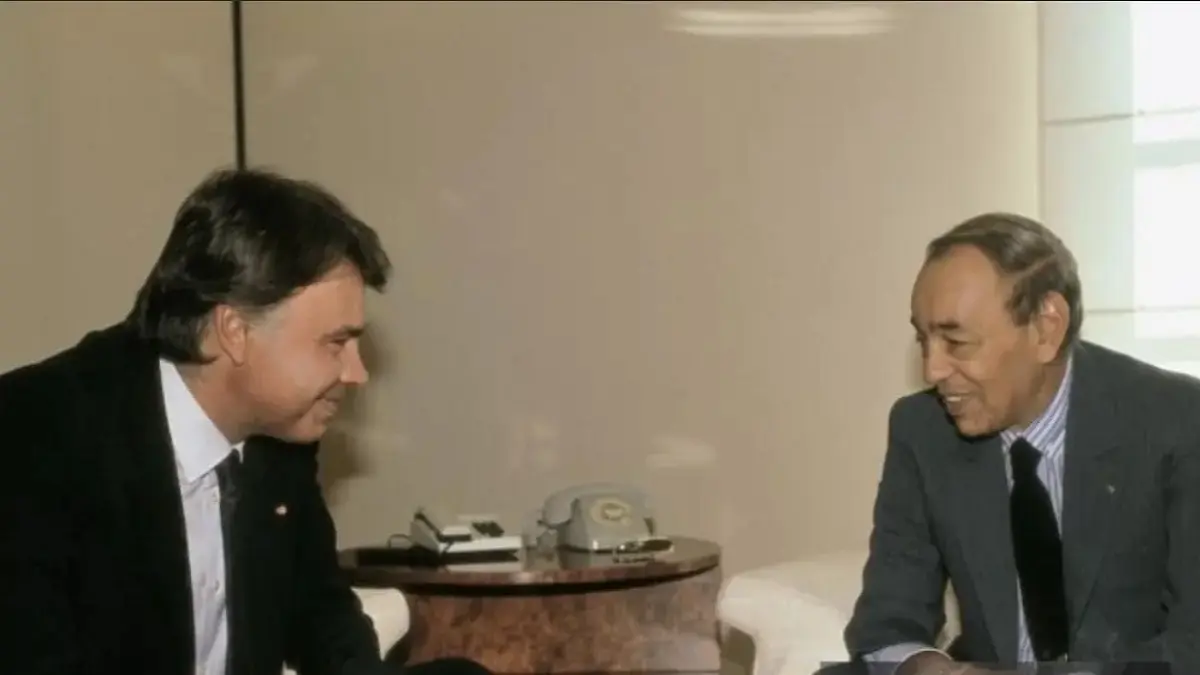
The temporal coincidence of these two major events would contribute to forging a true founding paradigm for the post-transition Spanish left, structured around three interdependent elements: the discovery of a Sahrawi people (never mentioned in the historical archives of the PCE or the PSOE), identification with the struggle against imperialism through an emotional connection with the situation in the Sahara, and the perception of King Hassan II as an exemplary authoritarian figure capable of representing a new political adversary, replacing in the unconscious of the left the specter of the unshakeable Franco, the dictator who died in peace and with absolute impunity.
The left orphaned by the dictator
After almost forty years of Francoism, the Spanish left was orphaned by the dictator who had profoundly defined its political identity. With this paradoxical loss of a structuring enemy, it lost its main antagonist, thus falling into a traumatic identity vacuum. As a result, the new political field of adversity proved too flat for it, as it had to submit to the mechanisms of political consensus imposed by the logic of the democratic transition.
This is how the post-Franco Spanish left found in the Sahara conflict much more than a just cause to defend among others in the world, a true alternative field of political adversity, animated by its supposed angels and demons and imbued with all its romantic ingredients: the Sahrawi population, which embodies the former Spanish Sahara, an oppressed people in search of freedom; Morocco, symbolized by the authoritarian and reactionary regime of Hassan II, which becomes the perfect and ideal enemy to succeed the Francoist specter; while a separatist front backed by a progressive and revolutionary Algeria embodies the romantic image of idealized guerrillas emerging from the desert dunes, carrying in their armed struggle for freedom the memory of an extreme left still suffering from that bloody Civil War between good and evil.
This phantasmagorical configuration allowed the left in Spain to channel its repressed militant energy, rebuild a new antagonistic identity, and unconsciously project its own unfulfilled revolutionary aspirations onto the Maghreb scene, transforming a complex geopolitical issue into an emotional and ideological mirror of its own unfinished and frustrated struggle against dictatorship.
One of the most emblematic examples of this psychopolitical dynamic is the image, difficult to erase from Spanish political memory, of Felipe González, then the young leader of the PSOE, dressed in a Sahrawi daráa during his visit to the Tindouf camps on November 14, 1976, where he came to show his support for the Polisario, promising that his party would stand by them and affirming his conviction that “the Polisario Front represents the right path to the final victory of the Sahrawi people,” a symbolic gesture that condensed the romantic projection of the Spanish left on the Sahrawi cause,building a new horizon of political adversity.
Both the socialists and the communists in Spain, while ignoring the fact that the patriotic climate aroused by the Green March in Morocco implied an opening towards the opposition and a promise of political democratization, idealized an Algeria perceived as revolutionary and progressive in contrast to a dictatorial and reactionary Morocco.
In power since 1982, the PSOE, first with Gonzalez, then with Zapatero, and most recently with Sánchez, knew how to operate a slow pragmatic shift that led it to abandon the UN referendum in favor of autonomy under Moroccan sovereignty. While the socialists showed the courage to move beyond post-Franco romanticism towards geopolitical realism, the communists and their derivatives on the radical left (IU, Podemos, Sumar...) remained anchored in the Third World ideal, blindly repeating the obsolete slogans of the separatist thesis promoted by Algeria.
Spain's withdrawal from the Sahara, perceived as a shameful retreat, as well as Morocco's recovery of its southern provinces, seen as an aggressive and illegal occupation, stimulated a new awareness among the Spanish left of the just cause of a supposed Sahrawi people fighting for their freedom, integrating this cause into a broader ideological discourse of systematic opposition to the perfect authoritarian, reactionary, and expansionist adversary that is Morocco.
The PSOE, orphaned by Franco, quickly transcended its initial emotional projections about the Sahara to adopt a mature and realistic vision that prioritizes good relations with Morocco. In contrast, the far-left factions locked themselves into an anachronistic Third Worldism, defending an idealized Polisario as a ghostly representation of their own frustrated dream of fighting for freedom, repeating empty slogans in the name of a fetishized international legality and an erroneous and sterile anti-colonial purism.
Prisoner of its bad historical conscience, the far left thus perpetuates a futile symbolic struggle, which consists of projecting its own history of struggle against dictatorship onto the idealized image of an armed separatist group, perfectly illustrating the mechanism of transference, which reveals how repressed desires against the dictator Franco are transformed in a hallucinatory way into hatred projected onto a replacement adversary, which is nothing more and nothing less than a friendly country and an indispensable partner.
Spain on its knees before the Moroccan dictatorship!
At a meeting between delegations from the PCE and the Polisario in Madrid on September 6, 1977, Communist leader Santiago Carrillo declared that "the Sahrawi people are fighting for a fundamental right: the freedom and independence of their homeland. Thus, although neither we nor the Spanish people are responsible, we consider ourselves morally obliged to do everything possible to repair the wrong committed by previous Spanish governments.“ Carrillo's statement reveals precisely an unconscious transfer of repressed guilt linked to two overlapping traumas: the abandonment of the Sahara during Franco's agony and the dictator's ”quiet death" without justice.
When Carrillo states that “neither we nor the Spanish people are responsible,” he expresses a formal denial of direct guilt, but in the post-Franco psychopolitical context, this sounds like a defense against collective self-reproach: the left failed to “defeat or punish” Franco during his last weeks, while the Sahara was abandoned without a fight.
For his part, Julio Anguita, former secretary general of the PCE, in an interview with the television channel Telemadrid on November 15, 2010, described the Moroccan regime as despotic, especially in relation to the issue of Western Sahara, accusing the Moroccan monarchy of acting as a feudal power that appropriates the surplus of the Sahrawi people,
criticizing Spain's surrender of the Sahara and recommending economic boycotts against Morocco “to put pressure on this authoritarian regime.” It is clear that Julio Anguita's statement is part of the same psychopolitical mechanism of unconscious transference as Carrillo's, transferring the repressed guilt of Francoism to Morocco while projecting a revolutionary desire onto the Sahrawis.
In the same vein of cathartic statements, Pablo Iglesias, former second vice president of the Spanish government and one of the founders of Podemos, said at a rally in Las Palmas de Gran Canaria in May 2023, “It is a mistake for Spain to kneel before the Moroccan dictatorship and betray the dignity of the Sahrawi people.” Pablo Iglesias' description of a Spain “kneeling” before the “Moroccan dictatorship” effectively evokes an obsessive feeling of impotence and humiliation, recalling the alleged shameful abandonment of Western Sahara in 1975 by the Madrid Accords. This rhetoric represents the same psychopolitical transfer that shifts the historical guilt repressed by Franco's abandonment of the Sahara (1975) onto the Moroccan state, projecting onto the Polisario militias the repressed desire for heroic resistance that the communists of Spain were unable to assume at the time until the final victory.
The specter of Francoism persists in the political imagination of the communist sphere, resurrecting the figure of Franco every time the issue of the Moroccan Sahara arises, as demonstrated by Vice President Yolanda Díaz, leader of Sumar and Second Vice President of the Spanish Government, when she described Morocco as a “dictatorship” on April 16, 2023, during an interview with the television channel La Sexta, criticizing the Sánchez government's shift on the Moroccan Sahara: “I am aware that we must take our neighbor Morocco seriously, but we must also know that Morocco is what it is, a dictatorship.” There is no need to wonder about the reason for this insistence on the ‘nature’ of the Moroccan regime—clearly stated in its Constitution—nor for the reason for this impulsive willingness to insult its southern neighbor and exhume the ghost of the real dictator every time the issue of the Sahara arises, since there is no reason here, only repressed emotions and unconscious mechanisms linked to the trauma of seeing the dictator Franco die peacefully in his bed, while Morocco legally and peacefully recovered its Saharan provinces.
Imbued with an internalized death drive, the Spanish far left oscillates between masochistic idealization of the Polisario and hatred of Francoism transferred to Morocco, generating a chronic neurosis of anxiety that prevents any mature resolution. Despite the profound sociocultural and geopolitical transformations that have taken place in the regional and international context over the last fifty years, it seems that the mechanism of guilt and internalization of moral defeat, as well as the unconscious transfer of hatred, will continue to feed a collective guilty conscience in the new generations of Spanish communism, especially when it comes to the Moroccan Sahara.
Those who have not grasped the significance of Franco's peaceful death in his bed cannot understand the complexity of relations between Spain and Morocco over half a century. Similarly, those who believe that peoples follow their interests rather than their passions have understood nothing of the 20th century, as Raymond Aron pointed out.