Hanoos' Babel: Twenty years of painting to understand human chaos
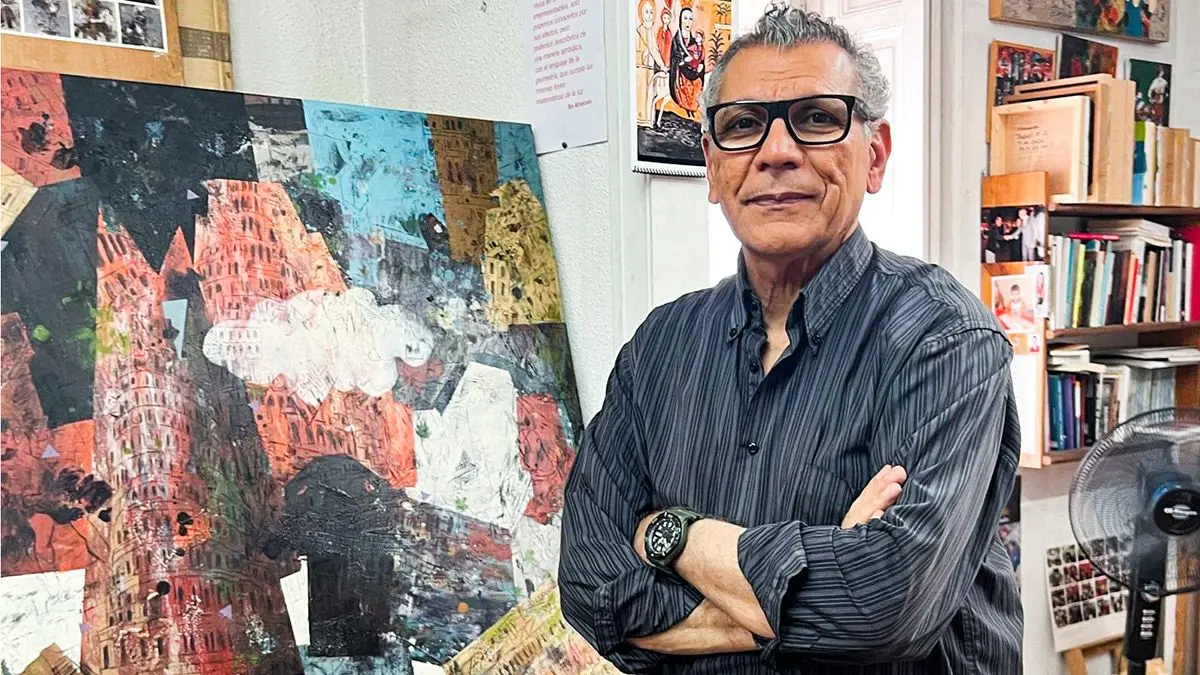

We are in the studio of an Iraqi painter, one of the best Iraqi painters this Middle Eastern country has produced, who lives in Madrid. We are talking about Hanoos Hanoos.
Hanoos, thank you very much for being with us and for opening the doors of your studio to us. Tell us, because we are seeing what the Tower of Babel is, taking as a reference the famous work by Pieter Brueghel ‘The Elder’. Can you tell us something about this work you are working on now?
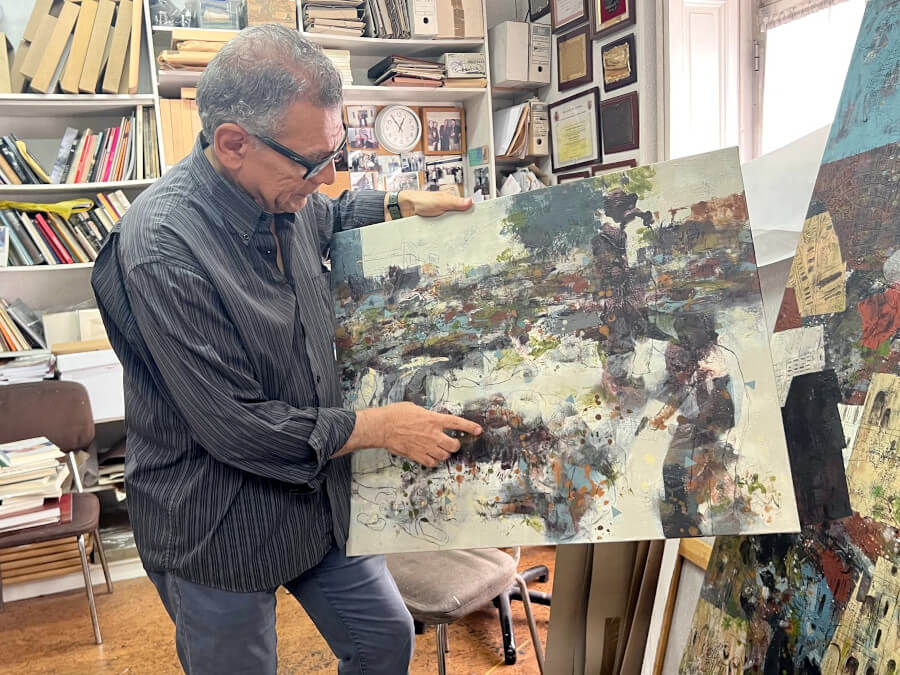
Thank you very much, Javier, and welcome to my studio. We are looking at a project that I have been working on for more than 20 years. The idea came from a good friend of mine, a historian, archaeologist and professor, Juan Luis Montero Fenollós, one of the most important specialists in Spain, and even in the world, on the Tower of Babel. He was the one who suggested I work on this historical theme, which is a biblical story from the Old Testament found in the book of Genesis. It tells how Noah's descendants, after the flood, decided to build a city with a tower that would reach the sky to become protagonists and avoid being scattered across the earth. God, seeing their arrogance, confused their languages so that they could no longer understand each other and were unable to complete the construction. I would like to add that since Brueghel ‘The Elder’ until today, there are very few artists in the world who have worked on this theme. I am from Iraq, and as a young boy I often passed very close to the place where the famous Tower of Babel is supposed to have stood, so I felt almost ‘obliged’ but very happy to work on this mysterious theme.
Unlike Brueghel ‘The Elder’ in the 17th century, whose two famous works depict the tower under construction, I have humbly attempted to deconstruct these works of the Tower of Babel, focusing especially on the period after Yahweh's punishment. As I mentioned before, the Tower of Babel is mentioned in Genesis II, which tells the story of how the world was one and people communicated through a single language until the arrival of King Nimrod, who wanted to build a tower that would reach the sky, and ordered it to be built with this intention. Then Yahweh sent 72 angels to confuse the workers who were building it and made them stop speaking the same language so that they could no longer understand each other and began to speak different languages. In fact, this is where the verb balal comes from, which means to confuse. From then on, they spread out to live on the face of the earth. That is a brief summary of the story of the Tower of Babel.
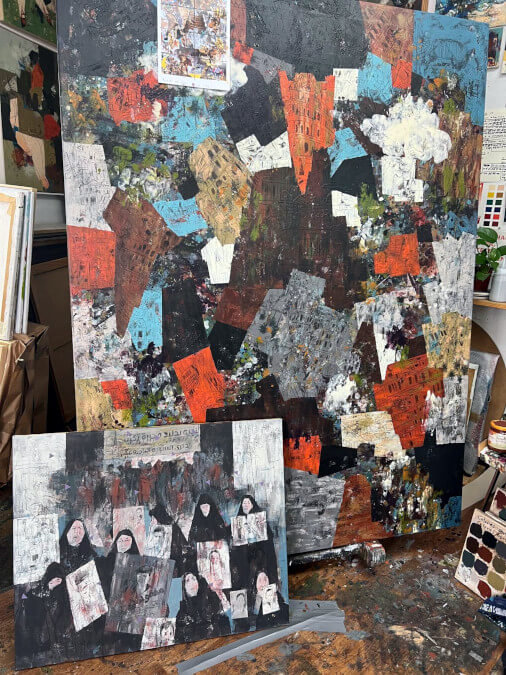
My creative process is a bit complex, even arduous at times. First, I make a sketch based on my readings and research on the subject, as well as the images I have stored. I do the sketches on the computer. When I have the desired sketch, I transfer it to the canvas, which I first stain randomly and freely, creating a kind of abstract chaos of colours, scribbles, squiggles and so on. Then I start to reserve areas of flat colours and then begin to draw with fine black lines to construct the subject, never better said. My influence from literature and cinema leads me to be a very obsessive painter when it comes to finishing my works. I have always been interested in my paintings being narrative, mysterious, even hybrid, with images being born and dying at the same time, coming and going, generating nuances that help me to organise the figures and shapes that feature in my work so that the final results are rich and juicy.
So, as I said before, I did the opposite of what Brueghel ‘The Elder’ did, that is, I deconstructed the tower and represented its destruction. That is why we see people moving around, falling down, up, and I am also interested in my work having its own language because when an artist produces a work, it is also very necessary for their work to have its own voice, which gives the work authority and a sense of purpose, and it will also be more communicative.
The aim is to capture the viewer's attention and gaze, and then tell the story as I believe it was, because we don't know whether the Tower of Babel existed or not, but in any case it is a fascinating and evocative subject from many points of view, for religious and historical reasons, and I think it also gives meaning to our vital existence as human beings, where we come from and where we are going, and it is also a story shared by almost all three monotheistic religions.
What message do you want to convey with this work?
The initial message, unfortunately, is that we have lived in permanent chaos from ancient times to the present day, a little like what is happening today in many parts of the world with wars and the lack of consensus to resolve conflicts, just as in the Tower of Babel, where everyone spoke a different language, making understanding impossible. Also, everything that is order and disorder, life itself, and how since then man has often shown himself to be rebellious because of an unnecessary ego, that unjust rebellion is unfortunately part of our history. Apart from the message, I represent an aesthetic space that creates a different reality, which is necessary to see if it can help resolve conflicts, and I want my representation to be original, just like a historian when he writes about the Tower of Babel, but obviously in painting. The main and ultimate message is perhaps to enrich our view of things and disorder.
Do you think that painting can make not only the masses but also leaders reflect?
I hope so. My desire is to create a space where ordinary people and political leaders can become more aware of the issue. It is an artistic work, but also a social one. I think so, because painting is an important tool, just like music, cinema and other artistic expressions. I try to give a more independent view of things through painting.
Painting is very necessary, along with the other artistic expressions mentioned, to give meaning to our lives, what we do, where we come from and where we are going. It is also true that it is a slightly more autonomous and closed language, and often complex, although I try not to let that be the case. That's why when I work, I think about my audience, so that they can understand my aesthetic ideas and, therefore, the final message of the work. Painting works where I don't respect my audience doesn't interest me. I don't like treating my audience like idiots and not caring whether they understand or not. That doesn't mean that I do what my audience tells me to do; obviously, I protect and maintain my own aesthetic thinking.
You've brought us another piece here. How many pieces make up the Tower of Babel project?
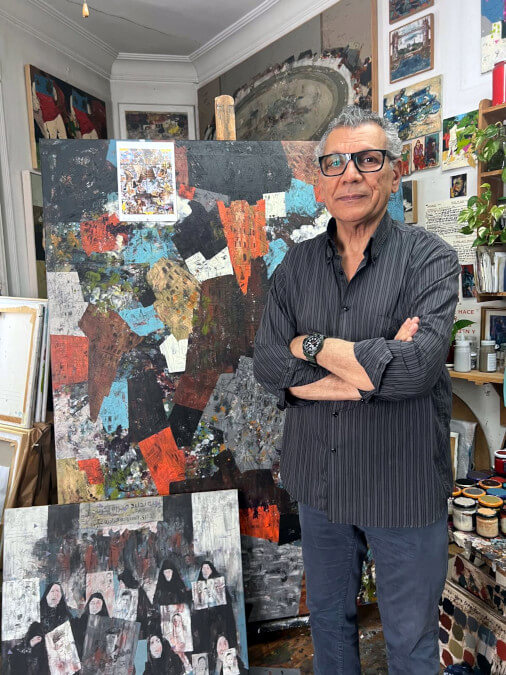
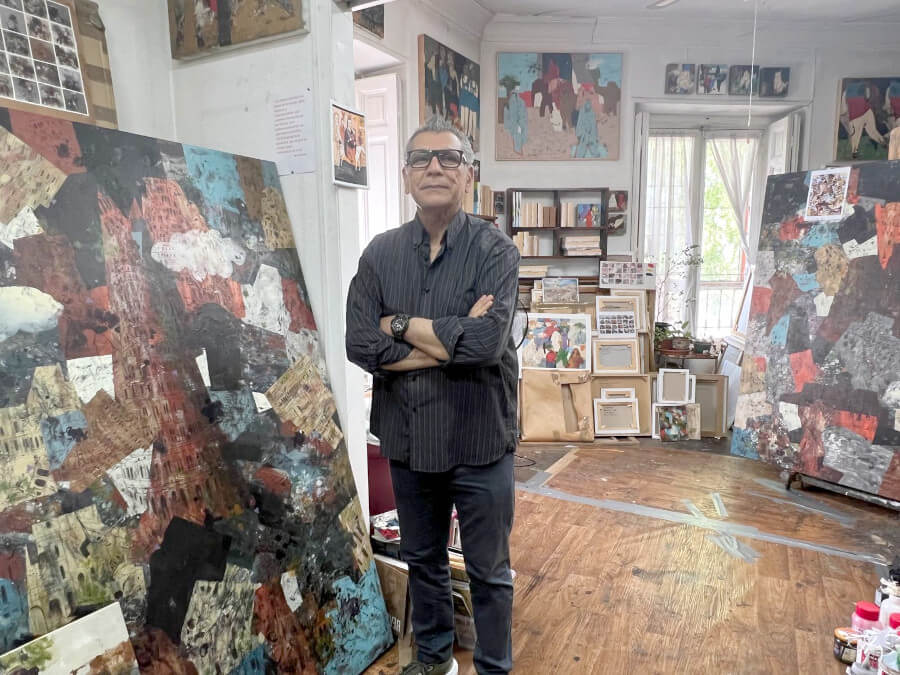
As I said before, I've been doing this for over 20 years and I now have almost 54 pieces, both large and small, which fortunately are circulating around the world. It's an ambitious project that I've never thought of giving up because, as I was saying, from Brueghel ‘The Elder’ to the present day, no artist has worked on this theme consistently, and it's also a subject that fascinates me.
Can you explain what each part of this painting means? Can you see the Tower in the centre?
Yes, as you know, a work of art speaks for itself and does not need clarification, but it is also true that everyone draws their own conclusions. It would be easier to say what you see, but I want to explain something to those who contemplate the work.
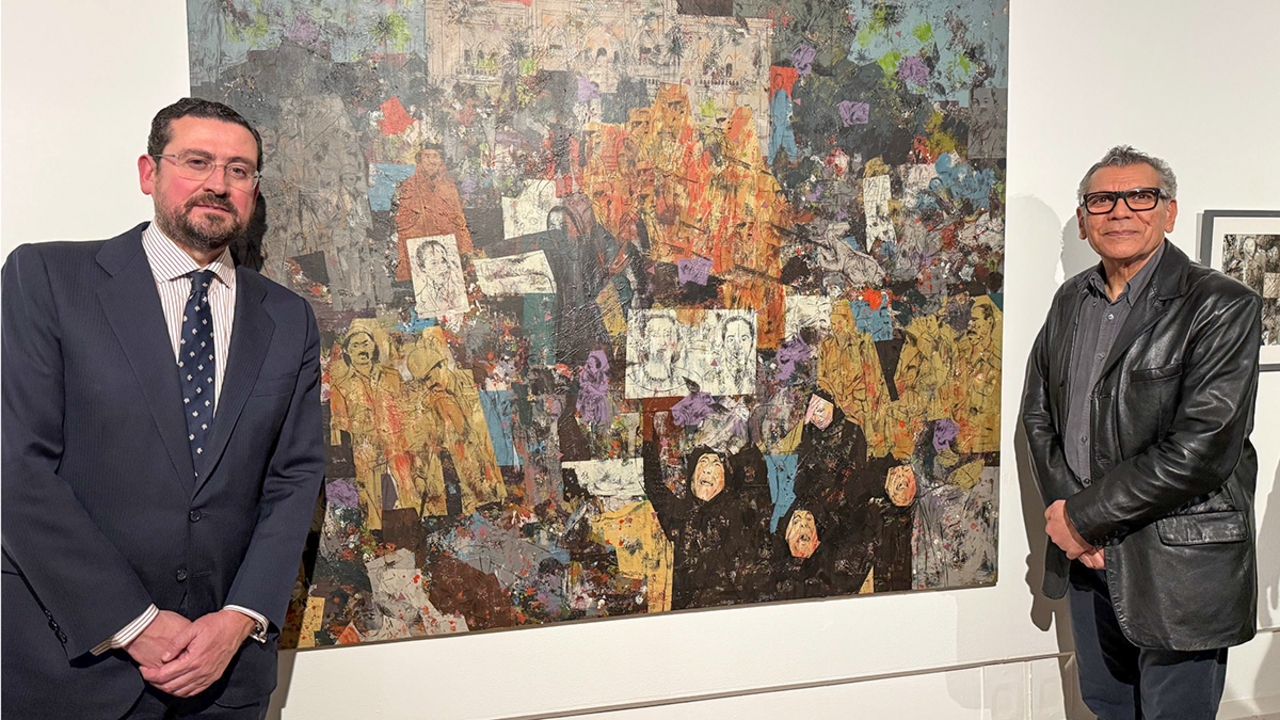
It's true that the Tower is in the centre of the work, fragmented into many pieces affected by the expulsion and understanding after Yahweh created many languages among the workers of the Tower. You can see the rupture caused by God who wants to undo the Tower and the chaos he created, which is visible at first glance and that is why all the elements around the structure represent disorder and destruction.
In the Mesopotamia region, now Iraq, there are still some ziggurats in several cities of the Arab country, which are also present in my works, as well as the architecture of the time and vegetation, palm trees, trees, etc. Obviously, my imagination is also present, even my fantasies, to generate even greater drama to the theme. That is why some elements in the work are intact and others are destroyed.
Each work has two images. If the first one is good and striking, it draws you into the second one, which is the content. I believe that with the first image I present alongside the title of the work, the viewer can already intuit what it is and what it is not, or at least that is what I intend. In any case, I don't think my work is abstract, that you can't see anything. I believe that the figures are there, the shapes and the characters, you just have to look closely. It's figurative work, complex and with a lot of information, although you can't see the images very clearly, because you can't say everything, just like in literature or cinema, you have to let the viewer's imagination work.
What are your aspirations for this work? Would you like to see it in a museum? Do you have any contacts with museums? Have you been able to sell any of your work? Because, well, painters are artists, but you also have to earn a living and be able to sell your work in order to have a normal life, right?
Yes, I am a professional and fortunately I have been able to make a living from my art without too many frills. Sales generally come through the exhibitions I do and also from the multiple painting awards I have won, and obviously through private clients. The award-winning works remain in the public and private institutions themselves, and throughout my career over many years I now have works in museums in Spain and I intend to continue placing my works there. In fact, I am in contact with other museums both in Spain and abroad to see if they would like to have them, because I am very interested in the works remaining there. I would like to take this opportunity to mention that I have produced more than four thousand originals, hundreds of drawings and engravings, and fortunately almost all of them have been placed.
In Spain, in all humility, I believe I have had some success, thanks to the great effort I have made and continue to make. At the age of sixty-seven, I have not stopped improving my work, studying, researching and, of course, painting. It is not an easy path, but thanks to my enthusiasm and continuous work, I am moving forward, although it is also true that things have changed a lot.
At the same time, you are working on an important commission from your country, from the Iraqi government. Tell us about it.
Well, this work is about a massacre that took place in Iraq in 2014, carried out by ISIS when they entered Iraq and murdered 1,700 innocent young cadets in a single day. When the so-called Islamic State entered Iraq, they destroyed and killed many people. I titled the work 'The Speicher Massacre'. There are 24 pieces, each measuring 65 x 81 cm, which form a mural almost five metres long and three metres high. In fact, the current Iraqi government commemorates this terrible massacre every year, and it is an honour for me to be part of this project to honour these innocent young people. I have been working on the piece since last summer and finished it two months ago.
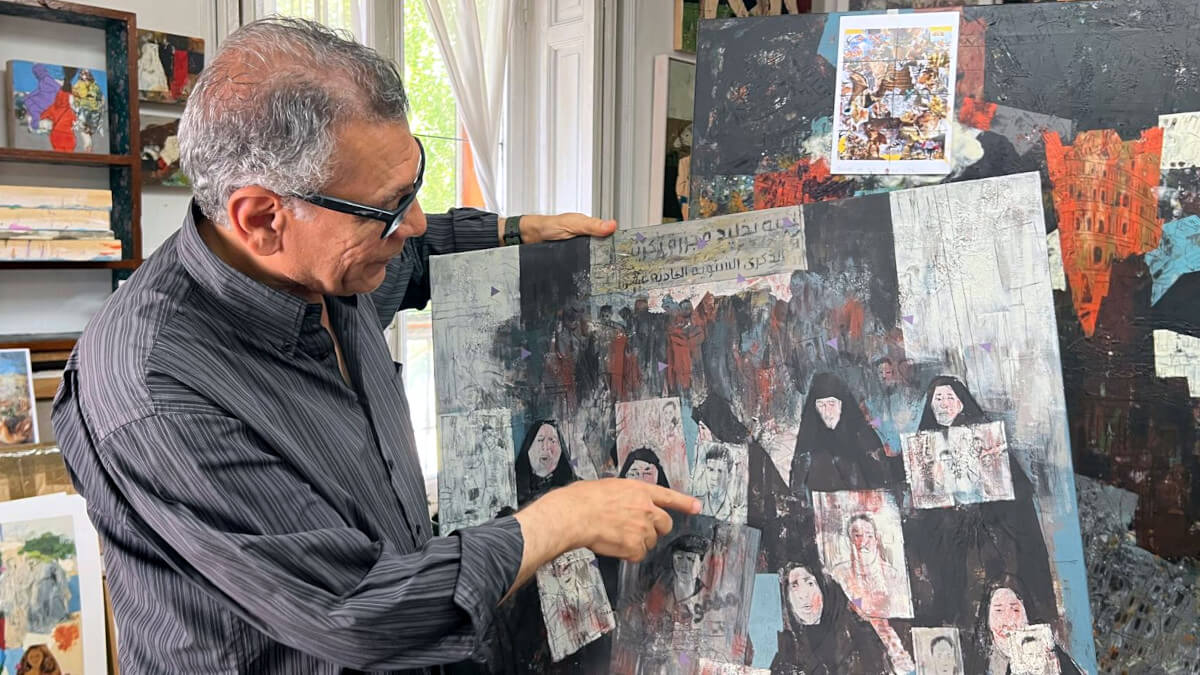
Some of these pieces are already finished, aren't they?
Yes, I have finished them and am waiting to send them to Baghdad to be exhibited in an institutional venue, or wherever the Iraqi government decides. It is a very difficult work, and I have had a hard time because of the harshness of the images I consulted. I should mention that I worked on the Spaicher piece using the same colours that Goya used in his painting ‘The Third of May’, which he painted in 1814, so there is a 200-year difference between the two historical events.
Through my work, I wanted to make a small connection between East and West, between the French invasion and the invasion by ISIS. Unfortunately, human beings remain the same, they have remained the same since Goya created his work until today, we remain somewhat the same and we continue to kill each other.
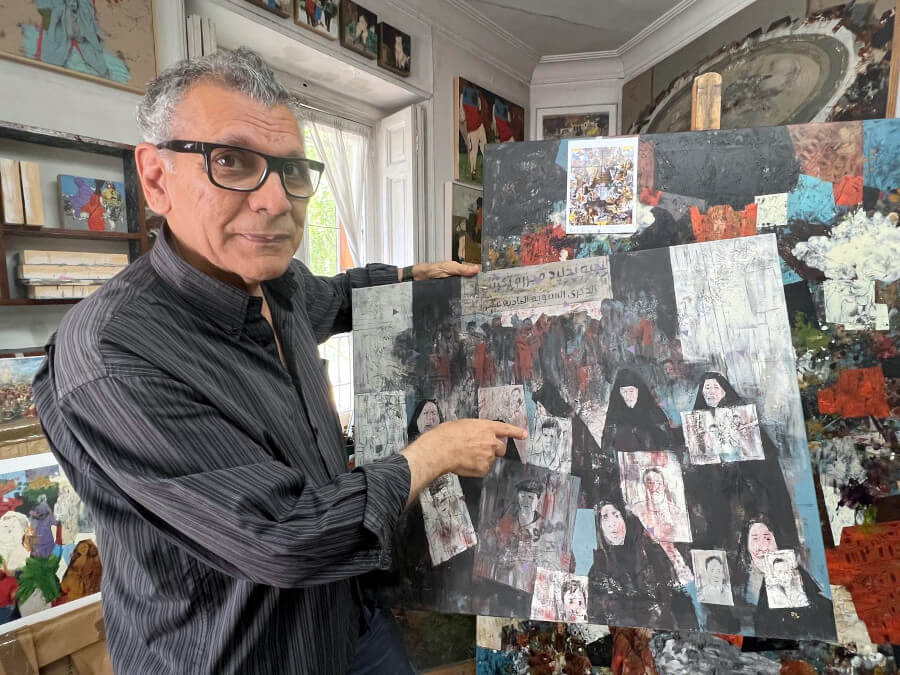
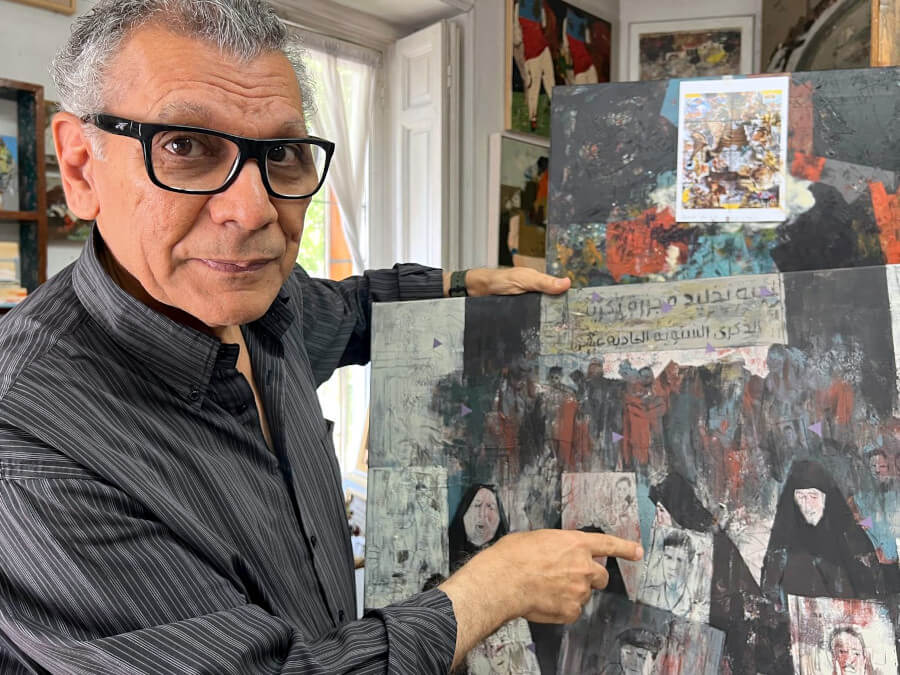
To put this into context for readers, here we have another work depicting the mothers of those who were killed, right?
Yes, those are the mothers, who knew nothing about their children. Many of them go every year to the Iraqi Parliament to protest with photos of the victims because they want to know where their children are, as the massacre was terrible, with mass graves used to bury the cadets alive and unarmed, as they were caught when they were on leave to visit their families. But it wasn't just these people who were killed, but also people from nearby villages who took part in the massacre for religious and ethnic reasons.
I really had a hard time doing it, as I said before, but the work has been well received, I say this humbly, both by my painter friends and acquaintances and also in Iraq among ordinary people and politicians.
Your work represents the memory of a people who cannot forget and who have to overcome the problems of violence that have occurred, and you do so from the point of view of an artist, but an artist with social content and commitment.
It is true, although I should emphasise that this is not my first social work. The first one I painted was in 2007 after the fall of Saddam in 2003. It was a work of sixty pieces, even larger than Spaicher's work, which was acquired by the American University in Baghdad. It is a work that protests against that event. I would like to take this opportunity to say that I am a peaceful person and have tried to narrate the events of both massacres in a historical and independent manner, without ideological bias. To do this, I was inspired by Picasso's Guernica, but I did the opposite of the great universal artist. In fact, I fragmented my work Baghdad into several pieces of the same size and used earthy colours, ochres, yellows and browns, which are the colours of the Mesopotamian region, the colours of the desert.
It was because of this work that I began my passion for social art. Now I want to start two projects on various social and historical themes, one that took place about 1,400 years ago and another that is also a terrible massacre that occurred in 1958, the year I was born. Both took place in Iraq and interest me, and they deserve to be visible and, at the same time, to be works of protest.
Hanoos, thank you very much for showing us the work you are doing and also for doing it, because I insist that culture, from the artistic to the social, will help your country, Iraq, and here in Spain, to overcome any kind of radicalism and any kind of violence.