Gustavo de Arístegui: Geopolitical Analysis 5 February

- Introduction: The confluence of structural crises
- ‘Softwaremageddon’ and the Great Reconfiguration of artificial intelligence
- The arrest of Alex Saab: capitulation or manoeuvre by the narco-regime?
- Russia and the Era of Nuclear Instability: the end of the 'guardrails'
- Japan and the lesson of fiscal prudence
- The powder keg of Oman: negotiating with the sponsor of terror
- Australia and the terror alert: the enemy within
- Spain in the face of Storm Leo and strategic irrelevance
Introduction: The confluence of structural crises
The last twenty-four hours have consolidated a landscape that is not merely volatile, but deeply disturbing due to its multi-causal nature and its capacity for feedback. We find ourselves in what I have termed in my analyses as the ‘storm of authoritarian disinhibition’: while Western capitals often lose themselves in the labyrinths of weak thinking and identity fragmentation, the revisionist actors of the international order—from the Kremlin to the narco-regime in Caracas, to the expansionist theocracy in Tehran—have decided that the rules of the post-Cold War are no longer a limitation, but a hindrance that can be ignored with impunity.
On Wall Street, the software sector is experiencing what analysts have already dubbed ‘software-mageddon’: a sharp and synchronised fall in the value of large software and technology services stocks, with losses of 15-20% in companies that until a few months ago were considered pillars of growth. This is not a simple market correction; it is an almost Darwinian purge driven by the emergence of generative artificial intelligence, which reveals which business models were built on sand and which can integrate AI at their core without being cannibalised by it.
This financial shake-up coincides with a grim milestone in global security: the practical expiry of the last major nuclear control treaty between Russia and the United States. Moscow, in the words of Deputy Minister Sergei Ryabkov, declares itself ‘ready for a world without nuclear limits’, effectively burying New START and leaving the planet without strategic guardrails for the first time in more than half a century. The combination of nuclear opacity, war in Ukraine and the Kremlin's aggressive rhetoric creates an explosive equation where miscalculation is no longer a theoretical risk, but a tangible scenario.
In our own orbit, the arrest of Alex Saab in Venezuela—Maduro's money man, a central piece in the architecture of money laundering, gold, sanctioned oil and opaque supplies—by the SEBIN in Caracas reveals the cracks in a narco-regime that is beginning to cannibalise its own operators to gain a few minutes of breathing space in the face of Washington's financial and judicial suffocation. Meanwhile, the attempted attack in Perth, Australia, during the ‘Invasion Day’ march, and the onslaught of Storm Leo on the Iberian Peninsula, serve as brutal reminders that ideological terrorism and climate fragility are not footnotes, but structural threats that demand governance based on lucidity rather than magical voluntarism.
This report analyses how these vectors — technological, nuclear, criminal, climatic and terrorist — intersect to form a polyhedron of risk that affects both country risk and global stability, and that demands a firm, Atlanticist, Europeanist and, above all, unapologetic Western response to collectivist populism and revisionism of any kind.

‘Softwaremageddon’ and the Great Reconfiguration of artificial intelligence
Context and facts
The stock market is experiencing a seismic shock. The software sector, traditionally a haven for growth in the S&P 500, has entered a spiral of massive sell-offs after several quarters of exuberance linked to the AI narrative. Companies that until six months ago were perceived as untouchable infrastructures of the digital world have suffered corrections of between 15% and 20% in a single session, according to analysis by Reuters and other financial media.
Three factors are converging:
- Saturation of corporate spending on software licences and services after years of expansion.
- Growing doubts about the extent to which generative AI is a value-adding complement or a lethal substitute for many “middleware” software products.
- A context of high interest rates and rebounding inflation in the US, which makes financing more expensive and particularly penalises R&D-intensive models without robust cash flow.
At the same time, Norway's sovereign wealth fund — with some 2-2.2 trillion dollars under management, the largest in the world — has translated this fear into very concrete figures. Norges Bank Investment Management has presented stress tests that model an ‘AI correction’ scenario with potential declines of up to 53% in some equity segments, especially those most exposed to overvalued AI expectations. These scenarios are not limited to technology: they are combined with severe climate shocks, geopolitical fragmentation and debt crises, focusing on the risk of correlation between shocks that until now were assessed separately.
Geopolitical and economic implications
- Technological sovereignty and concentration of power. ‘Software-mageddon’ is the prelude to massive consolidation: companies that do not integrate AI into the core of their business model will be absorbed or disappear. For the West, this implies a strategic vulnerability: if innovation and digital infrastructure remain concentrated in three or four US hyperscalers, Europe's already precarious digital autonomy will be diluted, and many states will be reduced to mere customers of private platforms for such sensitive functions as defence, cybersecurity and critical infrastructure management.
- The long shadow of China. Beijing sees this volatility as a historic opportunity. While Western markets punish software for uncertainty in AI monetisation, Xi Jinping's regime continues to massively subsidise its AI, chip and advanced computing ecosystem, also using AI to manage climate risk, logistics and social control, with a thirty-year state vision. Its stated goal is selective decoupling to set the technological standards of the future and thus reduce the leverage of Washington and its allies.
- The end of easy money and the risk of oligopoly. With US inflation ‘not cooling down, but heating up again’, the Federal Reserve is forced to maintain a tighter monetary policy, which makes R&D financing more expensive and puts medium-sized players at a disadvantage compared to giants with net cash. The likely result is a technological oligopoly that is difficult to regulate for democracies that are already struggling to adapt their legal frameworks to the speed of AI.
- Impact on security and defence. The stock market correction, coupled with NBIM's stress tests, anticipates a reallocation of capital towards assets perceived as ‘real’ (energy, critical raw materials, infrastructure, defence) and towards companies that provide resilience against climate and geopolitical shocks. If this transition is managed intelligently, it can strengthen the industrial defence base of democracies; if it gives way to regulatory populism or short-sighted protectionism, the result will be a loss of competitiveness vis-à-vis authoritarian regimes.
Outlook and scenarios
- Optimistic scenario: the correction purges excesses, disciplines weaker players and allows capital to flow to those who integrate AI productively and to strategic sectors such as defence, energy and cybersecurity, strengthening Western resilience against Russia, China, Iran and others.
- Pessimistic scenario: political and social pressure in the face of volatility leads to improvised responses—poorly designed taxes, arbitrary restrictions, financial repression—that stifle innovation in democracies while regimes such as China's take advantage of the window of opportunity to gain technological ground unhindered.
For Spain and much of Europe, the risk is becoming trapped as late adopters of critical technologies designed in other centres of power, while domestic debates continue on issues unrelated to the real dispute over technological leadership and security.

The arrest of Alex Saab: capitulation or manoeuvre by the narco-regime?
Analysis of the facts
The arrest of Alex Saab in Caracas, carried out by SEBIN—an intelligence apparatus that had until now provided him with protection—marks a turning point in the survival dynamics of Nicolás Maduro's regime. Saab, a Colombian-Venezuelan businessman and close ally of Miraflores, is much more than a front man: he has been the financial architect of gold and sanctioned oil schemes, opaque food and fuel imports, and the key link in money laundering networks involving third countries and front companies.
The operation took place after he appeared before the US justice system, following his arrest in Cape Verde and subsequent release as part of an exchange that allowed US citizens detained in Venezuela to leave the country. According to sources cited by Reuters and other media outlets, Washington has confirmed that it has direct information about the arrest and expects full cooperation from Caracas, which opens the door to a possible extradition in a relatively short time frame.
At the same time, news has also emerged of the arrest of Raúl Gorrín, an influential media businessman linked to Chavismo, reinforcing the idea of a larger-scale operation, either in the form of an internal purge or as a negotiating offering to the US.
Strategic implications
- Partial dismantling of Chavista financial networks. Saab is not a politician or a mere intermediary: he is the engineer who connected the regime's levers of power with the global underground economy — gold, crude oil, overvalued contracts, food and financial imports — ensuring liquidity to buy military and political loyalties. His downfall destabilises the incentive system that sustains the military-business circle that keeps Maduro in power.
- Disturbing message for Moscow and Tehran. Russia and Iran are observing that a partner they have supported politically and materially is capable of handing over a figure of this stature when external pressure becomes unbearable. This sows doubts about Caracas' reliability as a pawn on the global chessboard and may cool—or make more expensive—Russian and Iranian support for the regime, just when Moscow needs resources for its war and Tehran is under regional pressure.
- International justice versus realpolitik. Washington is demonstrating that the judicial prosecution of criminal networks and narco-terrorism linked to dictatorships can bear fruit, even in the long term. But the risk is that Chavismo will try to use the sacrifice of Saab and Gorrín as a bargaining chip to obtain relief from sanctions and legitimacy for its electoral ‘simulations’. The precedent of premature concessions in other scenarios (Cuba, partially Iran) calls for maximum firmness: the surrender of a pawn cannot whitewash a mafia organisation entrenched in the state.
- Regional impact. Saab knows the names, accounts and routes that connect Chavismo with political and business elites in other Latin American countries, as well as its possible links with actors such as Hezbollah and Iran on the financial level. If he cooperates with the US justice system, the shockwaves could reach sectors of the region's political class that have flirted with ‘Bolivarianism’ while benefiting from its opaque networks.
Outlook and scenarios
- Cooperation and extradition scenario. If Saab is quickly extradited to the US and cooperates, there is the possibility of a ‘domino effect’ of revelations that could accelerate the erosion of Chavismo's financial core and expose international complicity that some would prefer to keep in the dark.
- Tactical manoeuvre scenario. If the regime uses the arrest as a ploy to negotiate sanctions relief, without effective extradition or a real break in its networks, we will be faced with a cosmetic operation that requires a coordinated Western response: a dictatorship cannot be rewarded for ‘arresting’ the criminals it itself created and protected.
In both cases, our position is clear: maximum pressure against the narco-dictatorships of Venezuela, Cuba and Nicaragua; strong support for democratic forces; and close cooperation with regional partners who are willing to make a real break with the Caracas-Havana-Tehran axis.
Russia and the Era of Nuclear Instability: the end of the 'guardrails'
Analysis of the Moscow Doctrine
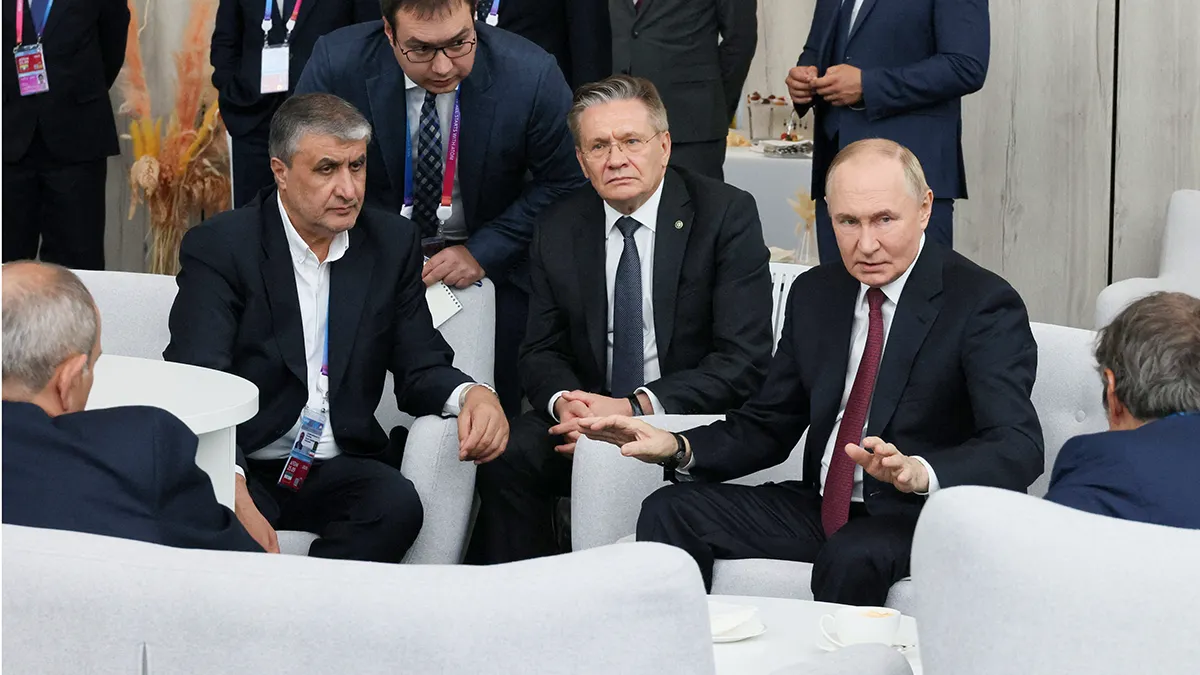
The words of Sergei Ryabkov, Russia's deputy foreign minister, have the coldness of deliberation: by stating that Russia is ‘ready for a new world without nuclear limits,’ the Kremlin not only certifies the death of New START, but also proclaims its comfort in an environment without rules. This is in addition to previous decisions to suspend inspections, limit information sharing and develop delivery systems and warheads that already de facto escaped the spirit of existing agreements.
From now on, there are no inspectors on the ground, no binding limits on the number of deployed warheads, and technical channels of communication and verification are reduced to a minimum, just as the war in Ukraine and Russian nuclear rhetoric have raised tensions to levels not seen since the Cuban missile crisis.
Global implications
- Deterrence in crisis. Classic nuclear deterrence was based on predictability: knowing how many weapons the adversary has, how they are deployed, and what doctrine governs their use. Without treaties, we are entering an era of strategic opacity: Moscow deliberately exploits ambiguity to suggest that any increase in military support for Kyiv could be met with the use of tactical nuclear weapons. This is nuclear blackmail elevated to the status of foreign policy.
- China's race. Beijing, which was never bound by New START, has been increasing its silos, missiles and nuclear warheads at an unprecedented rate for years, moving towards strategic parity within this decade. The definitive break between Washington and Moscow offers it the perfect pretext to justify to its own population – and to third parties – even greater expansion, transforming the old bipolar balance into an unstable triangle of mutual distrust.
- European vulnerability. Without the framework of shared treaties, Europe is once again under direct threat from Russian intermediate- and short-range missiles, including dual systems deployed in Kaliningrad and other strategic locations. This reinforces the urgency of articulating a robust European defence pillar within NATO, but always under the unwavering premise of strong Atlanticism: any dream of 'strategic autonomy' divorced from the US would simply be an invitation to disaster.
Prospects and scenarios
We are entering a new arms race that is unlike that of the 1970s: cyber weapons, space, hypersonic and autonomous systems are added to the classic nuclear dimension. The response of the free world can only be a combination of:
- Modernisation of the nuclear triad to maintain the credibility of deterrence.
- Strengthening missile defence and early warning systems.
- Restoring technical channels of dialogue — not out of naivety, but out of pure realism — to minimise the risk of miscalculation.
Any sign of weakness, misinterpreted peace dividend or return to magical pacifism will be read by the Kremlin as a licence to continue advancing beyond Ukraine, whether through direct force or hybrid pressure on the eastern and southern flanks of the Alliance.

Japan and the lesson of fiscal prudence
Facts and economic analysis
In a world where too many governments have turned debt into a political shortcut and fiscal expansion into dogma, Japan is beginning to send a signal in the opposite direction. A key economic adviser to Prime Minister Takaichi, identified as a member of the reflationist wing, has publicly called for a return to fiscal discipline and restraint in spending growth, stressing that budgetary credibility is now the scarcest resource. Japan still combines very low interest rates with public debt exceeding 250% of GDP and moderate but persistent inflationary pressures, forcing a rethink of the balance between stimulus and sustainability.
Implications for the liberal order
Japan demonstrates that it is possible to be an innovative power, with an advanced industrial base and a solid welfare state, without indulging in the perpetual debt binge that some sectors of the radical European left sell as a panacea. Fiscal discipline is not ‘austericide’; it is the condition for a lasting welfare state and a credible defence effort in the Indo-Pacific against China's hegemonic claims over the Senkaku Islands, Taiwan and regional sea lanes. For the Atlanticist and pro-European axis, the message is clear: without healthy public accounts, there will be no orderly digital and ecological transition, no strengthening of NATO, and no real strategic autonomy vis-à-vis Moscow and Beijing.

The powder keg of Oman: negotiating with the sponsor of terror
Context of the talks
The United States and Iran are meeting in Muscat, Oman, under a false premise: that Tehran's nuclear dossier can be isolated from its overall regional behaviour. While diplomats discuss limits on uranium enrichment and technical safeguards, the Houthis attack international trade in the Red Sea, Hezbollah maintains a dangerously high level of tension on Israel's northern border, and pro-Iranian militias in Iraq and Syria continue to act as the armed wing of the Revolutionary Guard.
Washington wants to broaden the agenda to include ballistic missiles, drones and proxy activity, but Tehran insists on limiting the dialogue to the nuclear dossier, using its other instruments—terrorism, sabotage, pressure on moderate Arab partners—as leverage in the negotiations.
Strategic implications
Iran uses these talks as a political shield and technical stopwatch: each negotiating cycle gives it additional time to advance its nuclear knowledge and capabilities, even if it does not formally make the leap to the bomb. The US administration is walking an extremely delicate tightrope: containing the risk of open war in the Middle East without falling into the historical error of appeasement, which in the past has only served to finance and legitimise the Ayatollahs' machinery of internal repression and external aggression.
For Israel, the Gulf monarchies and Western democracies, the danger lies not only in the number of centrifuges, but in the entire ecosystem of terror sponsored by Tehran: Hezbollah, Hamas, the Houthis, Iraqi militias and networks in Central Asia. Any agreement that ignores this network would, at best, be a temporary nuclear ceasefire at the price of perpetuating proxy warfare against key Western allies.
Outlook and scenarios
The only acceptable scenario involves combining sustained economic and diplomatic pressure, unequivocal support for Israel and moderate Arab allies, and the demand to include missiles and proxies in any serious negotiating framework. The temptation to seek quick 'success' in the form of a signed paper in Oman, at the cost of turning a blind eye to Tehran's export of terrorism, would be a strategic defeat for the free world.
Australia and the terror alert: the enemy within
Facts
The attempted attack in Perth during an “Invasion Day” (National Day) demonstration has been officially classified as an act of terrorism. A 31-year-old man was arrested after throwing an improvised explosive device — a bomb with metal fragments and screws designed to maximise injuries — at a gathering of hundreds of people; fortunately, the device did not cause any deaths thanks to the rapid intervention of the police. Authorities have indicated that the motive is linked to racial hatred and right-wing extremism, making this one of the most serious cases in Western Australia in terms of domestic terrorist threats.
Implications for national security
This episode highlights an uncomfortable truth: terrorism is not an ‘imported’ phenomenon that only manifests itself in war zones or countries with institutional failures, but a threat that feeds on ideological radicalisation, hate speech and social divides in advanced and prosperous democracies as well. Jihadist networks remain the primary focus, but violent supremacists and identity extremists of various stripes seek exactly the same thing: to use the freedoms of an open society to destroy it from within.
For a key AUKUS partner such as Australia, the lesson is twofold: to strengthen intelligence and counter-terrorism units without subjecting them to the constraints of political correctness, while at the same time ensuring that the response to extremism does not fuel new community divisions that could be exploited by hostile powers.

Spain in the face of Storm Leo and strategic irrelevance
Facts and critical analysis
Storm Leo has brought torrential rains to much of the Iberian Peninsula, bringing rivers and reservoirs to near overflow levels, causing flooding, road closures, the closure of hundreds of schools and the evacuation of thousands of people in areas of Andalusia, Portugal and other regions. The authorities have warned of additional risks of landslides and significant damage to critical infrastructure.
However, the underlying problem is not just meteorological: Spain is once again in the international news more for climate disasters, internal political tensions and isolated sporting achievements than for a strategic projection in line with its potential weight in the EU, NATO and the Ibero-American world. While France, Germany and the Nordic countries are responding to “software-mageddon” and the Norwegian stress tests with in-depth debates on digital sovereignty, energy security and financial resilience, the Spanish debate is too often dominated by partisan struggles, territorial disputes and an agenda marked by far-left partners and unsupportive nationalisms.
Implications
A country with Spain's geographical position, business density and human capital cannot resign itself to being a peripheral spectator in the redesign of the technological, energy and security order. The management of Storm Leo illustrates weaknesses in territorial planning, water management and infrastructure resilience in the face of climate change, but also the absence of a strategic narrative that connects these challenges with the need to strengthen Spain's voice in Brussels, NATO and the major European industrial consortia.
Spain must regain its ambition to be a bridge between Europe and Latin America, a benchmark in the Mediterranean and a reliable player in the Atlantic axis, leading the response to the Caracas-Havana axis and proactively contributing to the debate on AI, defence and deterrence within the European framework.